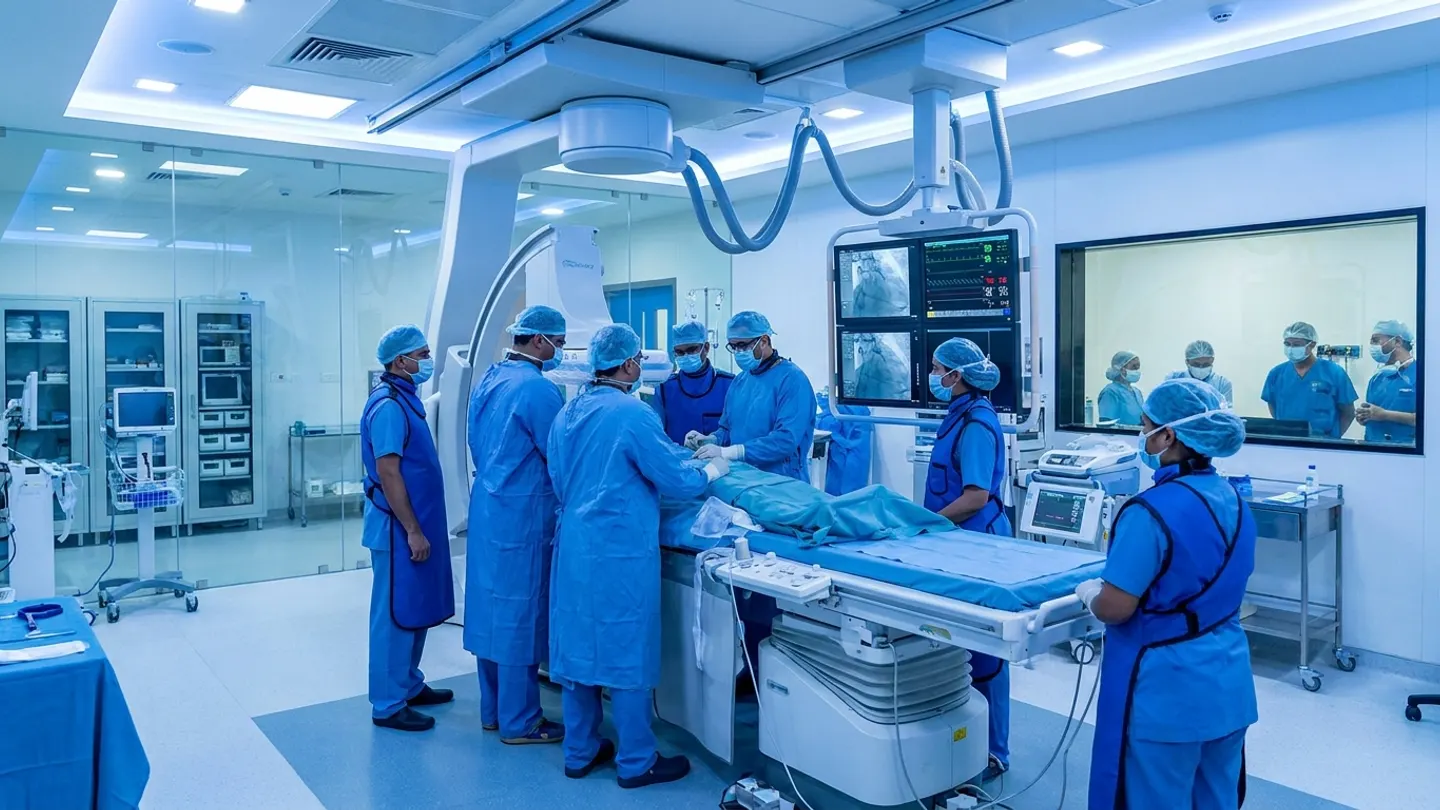
You opened your insurance Explanation of Benefits and saw a number that made you sit down. Or your cardiologist said “ablation,” your insurance company said “we’ll cover part of it,” and the remaining out-of-pocket cost still runs to tens of thousands of dollars. If atrial fibrillation is disrupting your life and the US healthcare bill feels impossible, you are not alone — and there is a realistic path forward.
Atrial Fibrillation Ablation Cost in India: The Bottom Line
Atrial fibrillation ablation cost in India typically runs between $5,000 and $9,000 all-inclusive, covering the procedure, hospital stay, pre-operative cardiac workup, and follow-up before you fly home. In the United States, the same procedure is billed at $30,000 to $80,000 or more, and out-of-pocket exposure can still reach $10,000 to $30,000 depending on your plan. For uninsured Americans, those facing high deductibles, or anyone on a long waiting list for an electrophysiology appointment, India offers world-class cardiac care — not as a compromise, but as a genuine clinical choice.
Why the price gap is so large
India’s lower cost of living, a highly competitive hospital sector, and government pricing policies on medical devices combine to make advanced cardiac care dramatically cheaper without cutting corners on technology or training. The electrophysiologists performing your ablation typically trained in the United States, United Kingdom, or Europe, returned to India, and now lead high-volume EP programs. Volume matters: centers that perform hundreds of ablations per year tend to have lower complication rates and more experienced procedural teams.
India vs. US: AF Ablation Cost Comparison 2026
| Procedure | United States (estimated) | India (estimated) |
|---|---|---|
| Radiofrequency (RF) catheter ablation | $30,000 to $60,000 | $5,000 to $7,500 |
| Cryoablation (balloon ablation) | $35,000 to $65,000 | $6,000 to $9,000 |
| Pulsed field ablation (PFA) | $45,000 to $80,000 | $7,000 to $10,000 |
| 3D electroanatomical mapping | Usually bundled | Included in above |
| 2 to 3 night private hospital stay | $8,000 to $20,000 (billed separately) | Included in above |
| Pre-procedure cardiac workup | $1,500 to $4,000 (billed separately) | Included in above |
| Estimated flights and hotel (14 days) | Not applicable | Approximately $2,000 to $4,000 |
All figures are indicative 2026 ranges for planning purposes. Actual costs depend on hospital, city, procedure complexity, and individual clinical factors. Always request a detailed written quote before committing.
What Types of AF Ablation Are Available in India?
India’s top-tier cardiac hospitals offer every technique used at leading US centers, supported by the same generation of mapping and ablation technology.
Radiofrequency (RF) catheter ablation
RF ablation remains the most widely performed approach worldwide. Catheters deliver radiofrequency energy to electrically isolate the pulmonary veins, which are the most common source of the rogue signals that trigger AF. Indian EP labs use Carto, Rhythmia, and EnSite 3D mapping platforms — the same systems found at institutions like the Cleveland Clinic and Mayo Clinic.
Cryoablation (Arctic Front balloon)
Cryoablation uses a balloon tipped with extreme cold rather than heat to achieve pulmonary vein isolation. It often shortens procedure time for paroxysmal AF and has a well-established safety profile. Several Indian cardiac centers perform more than 200 cryoablation cases per year, giving their teams a high level of proficiency with this technique.
Pulsed field ablation (PFA)
PFA is the newest generation of ablation technology, receiving regulatory approval in the US and Europe in 2023 and 2024. It uses ultra-short electrical pulses that selectively affect heart muscle while sparing surrounding structures such as the esophagus and phrenic nerve — an important safety advantage. Leading Indian hospitals have introduced active PFA programs for international patients. Expect a modest premium over RF ablation costs, as reflected in the table above.
Is AF Ablation in India Safe? Accreditation and Quality Standards
This is the most important question, and it deserves a direct, honest answer.
“I kept asking my daughter: is this actually safe? She spent two weeks researching. The hospital had JCI accreditation, the doctor had trained in the US, and the waiting list was three days instead of eight months. We booked the flights.” — Representative patient experience shared with permission; not an identifiable individual.
India’s best cardiac hospitals hold JCI (Joint Commission International) and/or NABH accreditation — the same global quality benchmarks required for hospitals treating international patients. These accreditations cover infection control protocols, clinical care standards, patient rights, medication safety, and outcomes reporting. Before IndoMedTour recommends any hospital, we verify current accreditation status and review procedural volumes.
Beyond accreditation, look for these specific markers of quality when evaluating an EP center:
- A dedicated electrophysiology lab with 24-hour cardiac surgical backup on site
- High annual ablation volume (ideally 300 or more cases per EP cardiologist per year)
- An on-site cardiac intensive care unit
- English-speaking care teams with documented experience treating international patients
- Transparent written cost estimates provided before you commit to travel
All of these factors are part of IndoMedTour’s hospital matching process.
What Is Typically Included in the All-Inclusive Package?
When IndoMedTour arranges your AF ablation, a standard package generally covers:
- Pre-procedure evaluation: ECG, echocardiogram, blood panel, and initial EP consultation
- Catheter ablation procedure with 3D mapping and fluoroscopy
- Anaesthesia and full electrophysiology team fees
- Two to three nights in a private hospital room with nursing care
- Post-procedure Holter monitoring or telemetry observation
- Discharge medications (anticoagulants, rhythm medications as prescribed)
- Final follow-up consultation with discharge summary before departure
- Airport and hospital transfers within the city
Not typically included: international flights, travel insurance, accommodation outside the hospital, personal expenses, and any additional procedures required if clinical complications arise. Always request a line-item written breakdown before signing anything.
Visit our treatments and costs page for a broader overview, or learn about the full patient journey on our how it works page.
How Long Will You Need to Stay in India?
For a straightforward AF ablation without major complications, plan for 10 to 14 days in total:
- Day 1: Arrival, hotel transfer, rest and pre-procedure testing
- Days 2 to 4: Procedure day plus 2 to 3 nights of hospital observation
- Days 5 to 11: Hotel-based recovery with outpatient follow-up appointments
- Days 12 to 14: Cardiologist clearance to fly; departure
Most electrophysiologists, whether in the US or India, advise a minimum 24 to 72-hour observation window after ablation before discharge. Long-haul flying within the first week after the procedure is generally not recommended due to clot risk. Your IndoMedTour coordinator will help you build a timeline that satisfies both your clinical needs and your return flight schedule.
What US Patients Should Know Before Booking
Planning cardiac ablation abroad requires attention to a few practical details that go beyond buying a plane ticket.
Anticoagulation management: Nearly all AF patients are on blood thinners such as apixaban or rivaroxaban. Your Indian EP team will provide a bridging protocol to manage anticoagulation around the procedure, following the same standards used in the US. Share your complete medication list and most recent INR results as early as possible.
Medical records: Bring or share electronically your most recent echocardiogram report, Holter or event monitor results, any previous cardiac catheterization reports, and your current medication list. The more clinical information the EP cardiologist has before your arrival, the more accurate the pre-procedure plan will be.
Travel insurance: Purchase travel insurance that explicitly covers pre-existing cardiac conditions and includes medical evacuation coverage. This is non-negotiable for any international medical journey. Do not rely on credit card travel protections for this level of coverage.
Post-return follow-up: Arrange for your US-based cardiologist or primary care physician to manage follow-up care after you return home. IndoMedTour provides detailed discharge summaries and procedure reports formatted to be compatible with US medical records systems, so your home team has everything they need.
For more complex cardiac cases, you may also want to review our cardiac surgery treatment page to understand the full scope of what Indian hospitals can offer. And if you are still weighing your options, reading a few success stories from patients who have made the journey can help put things in perspective.
How IndoMedTour Helps
From your very first call, you have a dedicated patient coordinator who manages every detail: a free counselling call to understand your clinical history and budget, hospital matching with JCI and NABH-accredited cardiac centers, and written cost quotes before you commit to a single dollar of travel expense. We handle your visa support documentation, airport transfers, hotel accommodation near the hospital, and interpreter services where needed. Your coordinator stays beside you through pre-procedure tests, the ablation day itself, and the recovery period — and remains reachable for questions after you return home.
You bring the worry. We bring the plan.