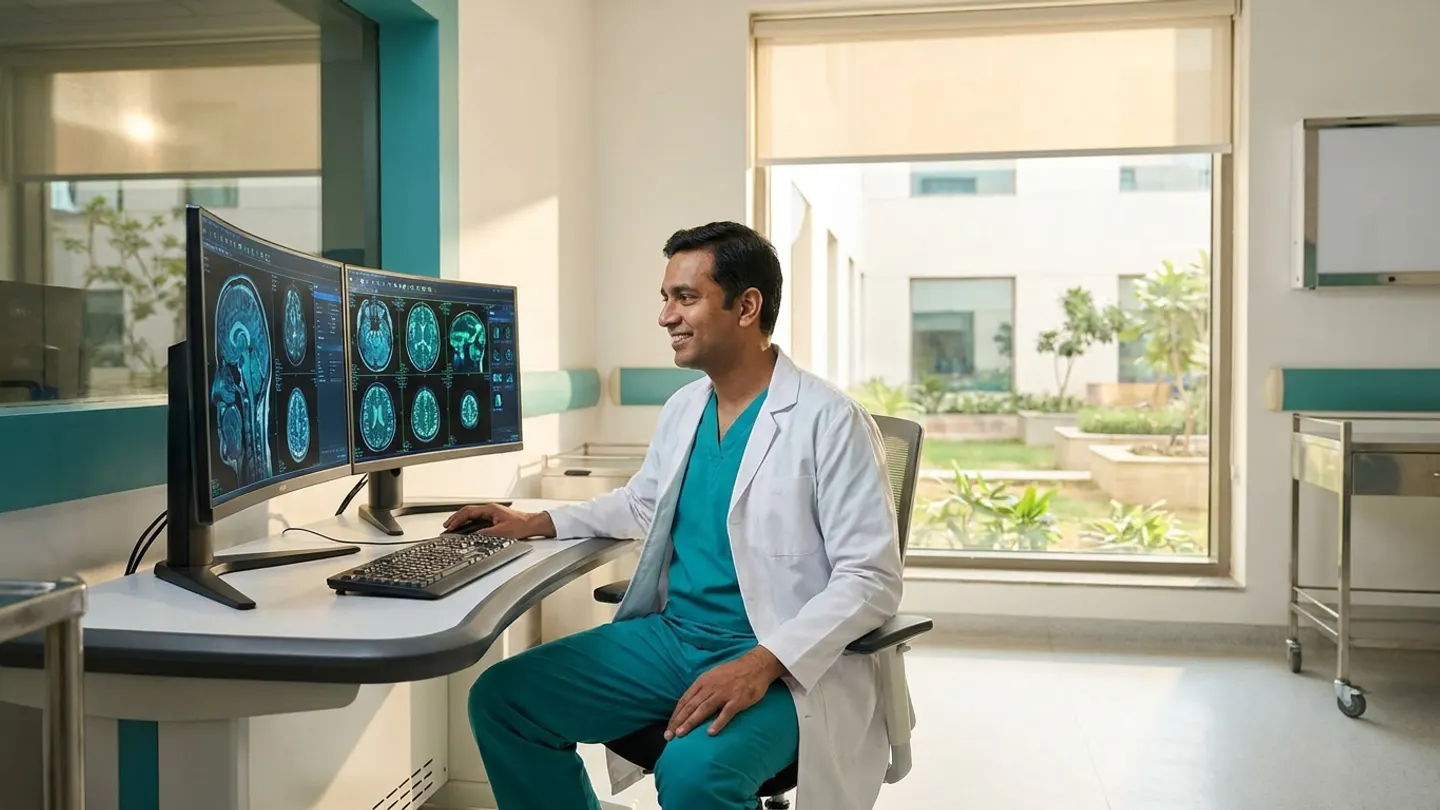
Hearing that a tumour is pressing on or near the part of your brain that controls your speech or your ability to move is one of the most frightening things a person can experience. And then — before you have even fully processed the diagnosis — you discover the procedure costs six figures at home, or the waiting list stretches to six months or more. That combination of medical fear and financial panic is exactly what we hear from patients when they first contact us.
What Is Awake Craniotomy, and Why Are Patients Choosing India?
Awake craniotomy cost in India typically ranges from approximately USD 7,000 to USD 15,000 all-inclusive — roughly 70-80% less than comparable care in the United States, United Kingdom, or Australia. The procedure itself involves temporarily removing part of the skull while the patient remains conscious during a critical mapping phase, allowing the neurosurgical team to continuously test speech, movement, and cognition in real time. This lets the surgeon remove as much of the tumour or lesion as safely possible without damaging the healthy brain tissue responsible for those functions.
The technique is used most often for:
- Tumours located in or near eloquent cortex — the areas of the brain governing speech, language comprehension, motor control, or sensory function
- Epilepsy focus resection, where the seizure-generating tissue is close to functional zones
- Deep-brain stimulation lead placement for Parkinson’s disease or essential tremor
- Arteriovenous malformation (AVM) removal in functional zones
India has built genuine depth in this subspecialty over the past decade. Several neurosurgery units now perform 50 to 100 awake craniotomies per year, supported by intraoperative neurophysiology monitoring teams, awake-anaesthesia specialists trained in monitored anaesthetic care protocols, and neuropsychologists who run real-time language and motor mapping during the procedure itself. For more on what to expect from the surgical pathway, see [/treatments/neurosurgery-spine].
Awake Craniotomy Cost in India vs Other Countries
The table below shows indicative all-inclusive package costs covering surgery, anaesthesia, hospital stay, neurophysiology monitoring, and standard post-operative care. International flights, personal accommodation outside the hospital, and optional rehabilitation programmes are not included.
| Country | Approximate Total Cost (USD) |
|---|---|
| United States | 80,000 – 150,000 |
| United Kingdom | 45,000 – 80,000 |
| Australia | 40,000 – 70,000 |
| UAE (Dubai) | 25,000 – 45,000 |
| India (JCI/NABH Tier-1 hospital) | 9,000 – 15,000 |
| India (NABH mid-range hospital) | 7,000 – 10,000 |
“I was quoted over $110,000 in the United States. The total bill in India — including a week in hospital and two weeks of recovery accommodation — came to under $12,000. That saving literally kept our family financially whole.” A sentiment we hear regularly from international patients; representative of typical feedback, not a specific identifiable individual.
These are indicative ranges. Your individual written quote will depend on case complexity, the specific hospital chosen, and any additional investigations required before surgery. Always request an itemised estimate before committing.
What Affects the Awake Craniotomy Cost in India?
Hospital Accreditation and Infrastructure
JCI-accredited hospitals (Joint Commission International) and NABH-accredited hospitals are the quality benchmarks in India. These facilities invest heavily in neuro-ICU infrastructure, intraoperative monitoring suites, and experienced awake-anaesthesia teams. Their packages sit toward the upper end of the cost range — and for a procedure of this complexity, that investment is generally worthwhile. Mid-range NABH hospitals in cities such as Chennai, Hyderabad, or Pune can offer excellent neurosurgery at the lower end of the range, particularly for cases with straightforward tumour geometry.
Tumour Location, Size, and Surgical Duration
A small, well-defined glioma near Broca’s area might require three to four hours of theatre time. A larger or more complex lesion involving multiple functional zones can extend to seven or eight hours, with proportional increases in anaesthesia and monitoring costs. Always share your most recent MRI scans and radiology reports when requesting a cost estimate — the quote will be substantially more accurate.
City and Location
Delhi, Mumbai, and Bengaluru carry a modest premium over Chennai, Hyderabad, and Ahmedabad, largely due to real-estate and staffing costs. The difference is rarely more than 10-15% for equivalent care quality, so it should not be the primary deciding factor.
Pre-Operative Functional Mapping Studies
Functional MRI (fMRI), diffusion-tensor imaging (DTI) tractography, and neuropsychological mapping are typically completed before surgery to plan the procedure precisely. These investigations can add approximately USD 500-1,500 to the total cost but are critical for both safety and surgical planning. Most specialist neurosurgery centres include them in their package quote; confirm this when you receive your estimate.
Is Awake Craniotomy Safe in India?
The word “awake” during brain surgery understandably alarms most patients when they first hear it. In practice, a skilled awake-anaesthesia team keeps the patient comfortable, calm, and entirely pain-free throughout, using sedation and local scalp-block protocols that are well established internationally. Consciousness is maintained only during the functional mapping phase, typically 30-60 minutes of the total procedure, and patients consistently report the experience as less distressing than they had anticipated.
As for safety standards in India specifically: the country’s leading neurosurgery centres maintain complication rates consistent with published international benchmarks. JCI and NABH accreditation means these hospitals follow the same surgical protocols, sterile-field requirements, patient-safety checklists, and nursing standards used in top Western centres. The accreditation is not a marketing label — it is an independently audited certification renewed on a defined cycle.
Realistic Risks to Discuss With Your Surgeon
Awake craniotomy does not eliminate surgical risk; it reduces one of the primary risks — inadvertent damage to eloquent cortex. Before you travel, ask your neurosurgeon to walk through:
- Temporary or (rarely) permanent neurological deficits affecting speech, movement, or cognition
- Seizures during or after surgery (addressed through anti-epileptic protocols in the operating theatre)
- Infection or cerebrospinal fluid (CSF) leak, managed with rigorous sterile technique and prophylactic antibiotics
- Fatigue and anxiety during the awake mapping phase, and how the team manages distress
- Standard surgical risks: bleeding, haematoma, anaesthesia reaction, deep-vein thrombosis
A thorough pre-operative consultation — including formal neuropsychological testing — will give you a clear, honest picture of your individual risk profile. Reputable Indian neurosurgery centres will not minimise or oversell.
Awake Craniotomy Recovery: A Realistic Timeline
Recovery is often faster than patients expect precisely because the goal of the procedure is to preserve function from the outset.
Typical milestones:
- Days 1-2: Neurological observations in a neuro-ICU or high-dependency unit. Most patients are sitting up and taking fluids within 24 hours.
- Days 3-5: Transfer to a regular ward. Physiotherapy and speech therapy assessments begin where relevant.
- Days 7-10: Discharge from hospital for uncomplicated cases.
- Weeks 2-4: Light activity and short walks. Fatigue is normal and should be respected rather than pushed through.
- Weeks 4-8: Most patients with sedentary or desk-based work can begin a phased return. Physical or high-concentration roles take longer.
- 3 months: Follow-up MRI to assess the extent of resection; oncology review of pathology if tumour removal was the indication.
International patients typically plan for a total stay of three to four weeks in India: the hospital period plus sufficient recovery time before the treating team clears them to fly. Our coordinators help arrange comfortable accommodation near the hospital for the recovery phase.
Checklist: Questions to Ask Before You Commit
Before accepting any quote or booking flights, make sure you have clear answers to the following:
- Does the hospital hold JCI or NABH accreditation, specifically for its neurosurgery department?
- How many awake craniotomies does this neurosurgeon perform per year?
- Is a dedicated intraoperative neurophysiologist part of the operating team?
- Is a neuropsychologist present and conducting active mapping during the awake phase?
- What does the package price include — and what is billed separately (ICU nights, pathology, implants, physiotherapy)?
- What is the escalation protocol if the patient becomes distressed during the awake mapping phase?
- What post-operative rehabilitation services are available on site or nearby?
- What structured follow-up documentation will be shared with my home doctors?
Getting clear written answers to all of these before you travel is standard practice at every hospital we recommend through our our hospitals network.
How IndoMedTour Helps
Start with a free counselling call — share your scans, your diagnosis, and your questions, and we will match you with two or three neurosurgery teams whose experience aligns with your specific case and functional mapping requirements. We provide written, itemised quotes so you can compare clearly and honestly. We handle visa invitation letters, airport transfers, and accommodation near the hospital throughout your stay. A dedicated coordinator stays beside you from the moment you land through surgery, recovery, and your final medical clearance to fly home. Read success stories from patients who have been through this journey, see exactly how the process works on our how it works page, and review treatments and costs for a broader picture of neurosurgical care in India.
You bring the worry. We bring the plan.