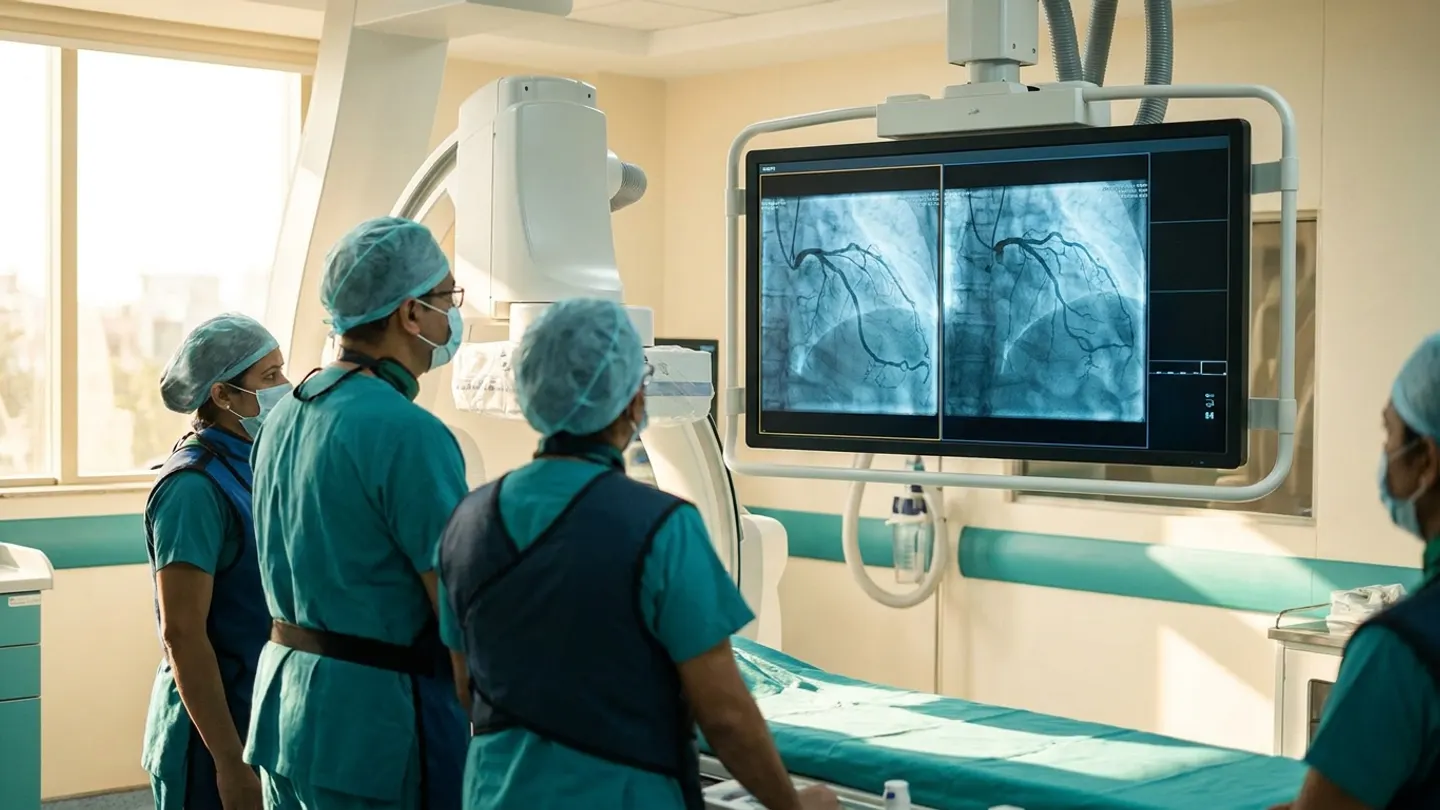
When your cardiologist says the words “blocked artery” and “stent,” fear arrives almost immediately. Then a second fear follows close behind — the bill. Whether you are facing a $30,000 hospital invoice in the United States, an eighteen-week waiting list on the NHS in the UK, or simply an out-of-pocket cost that feels impossible anywhere else in the world, you deserve a clear, honest answer about what treatment in India would actually cost, and whether it is safe.
What Does Coronary Stent Cost in India in 2026?
Coronary stent cost in India in 2026 typically runs from approximately $1,500 to $4,500 for the complete angioplasty-with-stenting procedure, all costs included. That is compared to $15,000 to $50,000 or more in the United States for the same intervention. The price covers the consultation, the catheterization laboratory procedure, the stent device itself, anaesthesia, a two-to-three night hospital stay, and standard post-procedure medications on discharge.
The range exists because several factors shape the final number:
- Type of stent — drug-eluting or bare-metal (explained in detail below)
- Single vs multiple stents — each additional stent adds approximately $400 to $800 to the overall bill
- Hospital tier — a tertiary cardiac centre in a major metro city costs more than a regional facility, though both must meet recognised accreditation standards
- City of treatment — Mumbai, Chennai, and Delhi tend to sit at the upper end of the range; Hyderabad, Ahmedabad, and Kochi often come in slightly lower
“I expected India to feel like a compromise. Instead, the catheterization lab in Chennai looked identical to the one back home in Canada — except the bill came to one-tenth the price. My cardiologist was US-trained and walked me through every step before we even started.” — representative patient experience shared with IndoMedTour.
Drug-Eluting vs Bare-Metal Stents in India: Which Costs More — and Why?
The stent type is the single biggest variable in your final cost. Understanding the difference helps you have an informed conversation with your cardiologist rather than simply accepting whatever is quoted.
Drug-Eluting Stents (DES)
Drug-eluting stents are coated with medication — typically sirolimus or everolimus — that releases slowly into the arterial wall over several weeks, suppressing the scar tissue growth that can re-narrow a treated artery. Because of the pharmaceutical coating and more complex manufacturing, they cost considerably more than bare-metal alternatives.
In India, a single drug-eluting stent costs approximately $800 to $1,800 depending on the brand, generation, and polymer type. Third-generation biodegradable-polymer DES devices sit at the higher end of that range and represent the current global standard of care.
The clinical return on that extra investment is significant. Drug-eluting stents reduce the risk of in-stent restenosis (re-narrowing of the treated artery) to roughly 5 to 10 percent, compared to 20 to 30 percent with bare-metal devices. For patients with diabetes, small-diameter arteries, or long lesions, the evidence strongly favours DES.
Bare-Metal Stents (BMS)
Bare-metal stents are stainless steel mesh tubes without any drug coating. In India, a single bare-metal stent costs approximately $150 to $400. Their main clinical advantage is a shorter requirement for dual antiplatelet therapy — typically four to six weeks, versus twelve months or more for DES — making them appropriate for patients who need non-cardiac surgery soon after stenting, or who have significant bleeding risk.
For the majority of straightforward cases, however, the global and Indian cardiology consensus has shifted firmly toward drug-eluting stents. The higher upfront cost is generally well justified by the lower rate of repeat procedures over the following years.
Coronary Stent Cost in India vs US, UK, Australia, and UAE
| Country | Single-stent procedure (all-in, indicative) | Drug-eluting stent device only |
|---|---|---|
| India | $1,500 – $4,500 | $800 – $1,800 |
| United States | $15,000 – $50,000 | $3,000 – $6,000 |
| United Kingdom (private) | $12,000 – $25,000 | $2,500 – $5,000 |
| Australia (private) | $10,000 – $20,000 | $2,000 – $4,000 |
| UAE | $8,000 – $18,000 | $2,000 – $4,500 |
All figures are indicative 2026 ranges. Your final cost will depend on your specific anatomy, the number of vessels involved, stent brand, and choice of hospital. Always obtain a written itemised quote before confirming travel.
Even after accounting for international flights and accommodation for two to three weeks, most patients from the US, UK, or Australia save 60 to 80 percent compared to home-country private-sector costs. See our full treatments and costs page for a broader breakdown across cardiac procedures.
What Is Included in the Coronary Stent Procedure Cost in India?
Most Indian cardiac hospitals offer a package price designed for overseas patients. Before signing anything, confirm that your written quote specifically covers:
- Pre-procedure consultation, ECG, and blood panel
- Coronary angiography (if performed in the same admission)
- Catheterization laboratory fees and anaesthesia
- The stent device itself, with the number and type stated explicitly
- Hospital stay (typically two to three nights for a planned, elective procedure)
- Standard medications dispensed on discharge
- One follow-up outpatient consultation before you fly home
Items that may be billed separately include review of your international cardiology reports before arrival, CT coronary angiography if required before the procedure, any additional stents beyond the number initially quoted, an ICU upgrade if clinically needed, and travel-related concierge services. Requesting an itemised estimate removes the possibility of surprises.
Learn exactly how our hospital matching and quoting process works
Is It Safe to Have a Stent Placed in India?
This is the question every patient asks, and it deserves a straight answer.
Yes — at an accredited centre with a high-volume programme. India’s leading cardiac hospitals hold JCI (Joint Commission International) or NABH (National Accreditation Board for Hospitals) accreditation, the internationally recognised benchmarks for patient safety, infection control, and clinical governance. Many of the interventional cardiologists practising at these centres completed their fellowship training at leading institutions in the United States, United Kingdom, or Europe, and regularly publish in peer-reviewed cardiology journals.
India performs hundreds of thousands of percutaneous coronary interventions (PCI — the clinical term for balloon angioplasty with stenting) every year. High volume matters in procedural cardiology: centres that perform large numbers of procedures consistently produce better outcomes, with lower complication rates. The hospitals in our network are selected exclusively from JCI and NABH accredited facilities with documented, mature cardiac intervention programmes.
How Many Stents Will I Need? Cost Implications of Multi-Vessel Disease
If your angiogram reveals significant narrowing in more than one coronary artery, your cardiologist may recommend two or three stents placed in the same procedure. Each additional stent adds to the total cost, but even a three-stent procedure in India typically costs less than a single-stent procedure in most Western countries.
For patients with complex multi-vessel disease, your cardiologist may also raise CABG (coronary artery bypass grafting) as an alternative strategy. Our dedicated cardiac surgery page covers the cost and candidacy comparison between stenting and bypass surgery in detail.
Checklist Before You Travel to India for Your Coronary Stent
Being well-prepared makes the entire experience calmer and safer:
- Gather your most recent coronary angiogram report, CT angiography images (DICOM files if possible), and recent ECGs
- Write out a complete medication list, including any anticoagulants or blood thinners, with dosages
- Ask IndoMedTour whether your travel insurer or home health plan offers any partial overseas reimbursement
- Arrange for a companion or family member to travel with you — most Indian cardiac centres actively welcome them throughout the recovery period
- Plan for a minimum stay of eight to twelve days in India (procedure, monitoring, discharge review, and final clearance before flying)
- Confirm your passport is valid for at least six months beyond your travel date
- Request written discharge instructions and a full cardiology summary in English before you leave the hospital
Book a free counselling call to walk through your personal situation with a coordinator before you make any decision.
How IndoMedTour Helps
From your very first question to the moment you board your flight home, IndoMedTour is with you at every step. We start with a free video consultation to review your medical reports and understand your concerns, then match you with two or three JCI or NABH accredited cardiac centres best suited to your anatomy, risk profile, and budget — providing written, itemised cost quotes before you commit to anything. Our team prepares your medical visa support letter, coordinates airport pickup, and assigns a dedicated patient coordinator who remains reachable around the clock during your hospital stay and recovery. We understand that planning a cardiac procedure abroad can feel overwhelming; our role is to make it feel manageable and safe.
You bring the worry. We bring the plan.
Talk to us today — it is free | Explore all cardiac treatment options | Read patient success stories