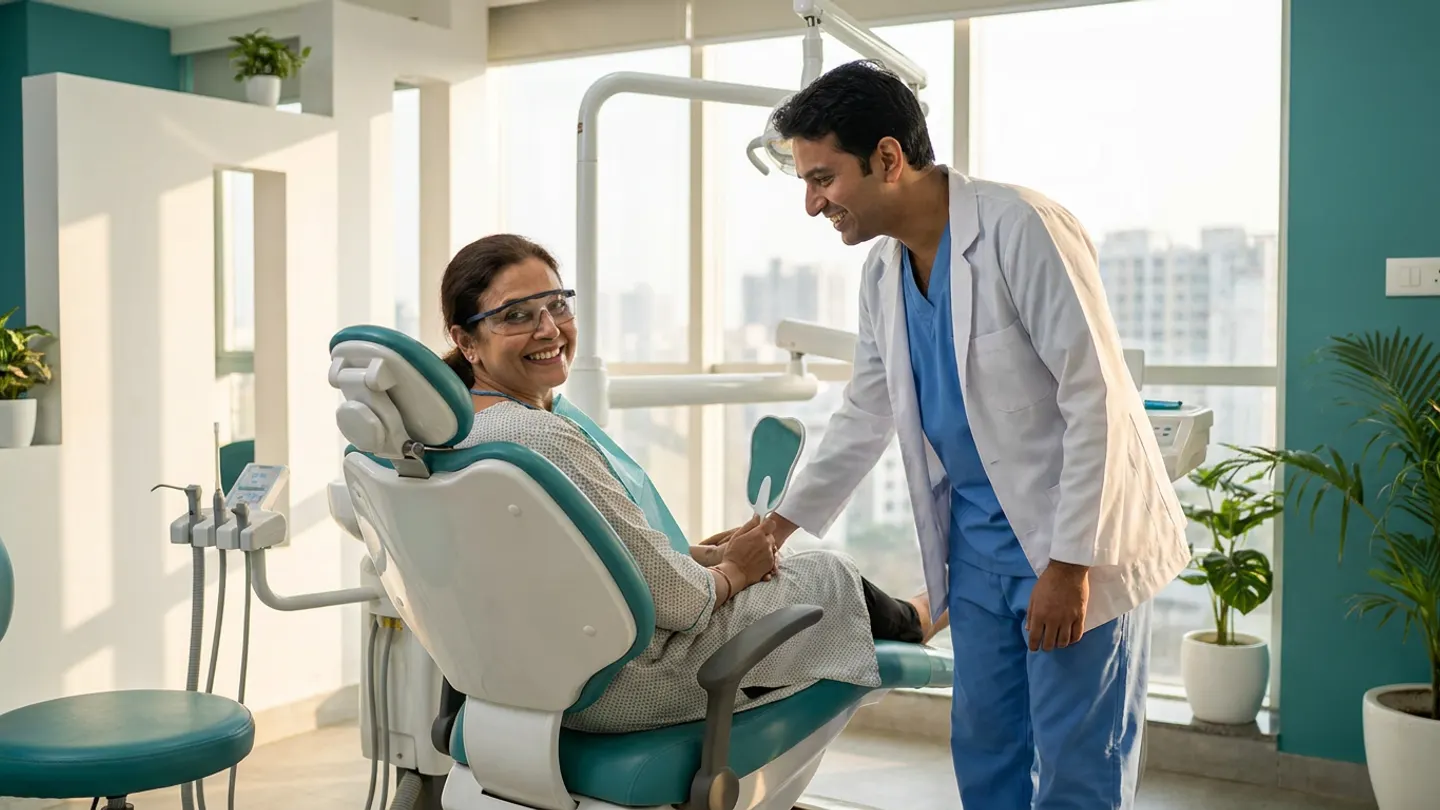
If you have just called a Canadian dental office and nearly fallen off your chair at the quote, this guide is for you. Dental care is one of the most under-insured expenses in Canada, and a full smile restoration or even a handful of implants can run tens of thousands of dollars out of pocket.
There is a well-trodden alternative that thousands of Canadians are quietly using: getting dental work done in India for a fraction of the price, at internationally accredited clinics staffed by English-speaking specialists who trained in Canada, the UK, or the United States.
Dental Tourism in India for Canadians: What You Need to Know First
Dental tourism in India for Canadians is no longer a niche idea. It is a practical, well-organised pathway that lets you combine serious dental treatment with a meaningful saving of CAD $5,000 to $25,000 or more, depending on your treatment plan. India’s top dental centres hold JCI (Joint Commission International) or NABH accreditation — the same quality benchmarks used to evaluate hospitals in North America — and use materials and implant systems from brands you would recognise from any Canadian dental office.
The key difference is labour cost and overhead. A specialist dentist in a Canadian metro earns multiple times what an equally qualified dentist earns in India, and Indian clinics carry none of the malpractice insurance costs or facility overhead that drive Canadian prices upward. Those savings flow almost entirely to you.
How Do Costs Compare? India vs Canada in 2026
The table below gives realistic indicative ranges. Your personal quote will vary based on jaw condition, number of teeth involved, implant brand, and the city and clinic tier you choose.
| Procedure | Canada (Approx. CAD) | India (Approx. CAD) | Typical Saving |
|---|---|---|---|
| Single dental implant (per tooth) | $4,500 – $6,000 | $700 – $1,500 | 70–80% |
| All-on-4 full arch | $25,000 – $35,000 | $5,000 – $9,500 | 70–75% |
| Porcelain crown (per tooth) | $1,200 – $2,000 | $180 – $400 | 75–80% |
| Porcelain veneer (per tooth) | $1,200 – $2,500 | $200 – $500 | 70–80% |
| Root canal + crown | $1,800 – $3,000 | $250 – $550 | 75–85% |
| Full-mouth reconstruction | $50,000 – $100,000+ | $8,000 – $20,000 | 75–80% |
| Teeth whitening (professional) | $600 – $1,200 | $80 – $200 | 80–85% |
All figures are indicative 2026 ranges in Canadian dollars. Exchange rates fluctuate; always request a written quote in both USD and CAD.
Even after accounting for return flights from Toronto, Vancouver, or Calgary (typically CAD $900 to $1,600 return), accommodation (CAD $40 to $120 per night at mid-range hotels near dental hubs), and two weeks of meals, most Canadians finish their trip thousands of dollars ahead. Many describe it as a dental trip that paid for an extended holiday in Rajasthan, Kerala, or Goa.
Which Cities in India Are Best for Dental Tourism?
India has multiple cities with mature dental tourism ecosystems. Each has its own character, and your choice might be influenced by which cities have direct or single-connection flights from your Canadian airport.
Delhi and Gurgaon (NCR)
The National Capital Region is home to some of India’s most established dental super-speciality clinics. Flight times from Toronto (via a hub such as Dubai or London) are typically 16 to 20 hours. This region suits patients who want maximum choice of specialists for complex cases like full-mouth rehabilitation or implant-supported bridges.
Mumbai
India’s financial and Bollywood capital has a concentration of cosmetic dental clinics catering specifically to international patients. Many clinics here have in-house patient coordinators who will liaise with your coordinator at IndoMedTour in real time. Flight connections from Vancouver are often slightly quicker via Hong Kong or Singapore.
Bangalore (Bengaluru)
Bangalore’s large English-speaking professional community means most clinic staff are highly comfortable with international patients. The city is a hub for digital dentistry — same-day CAD/CAM crowns, 3D-printed surgical guides, and cone-beam CT scanning are widely available. Costs tend to be slightly lower than Delhi for equivalent quality.
Chennai
A long-standing destination for medical and dental tourism, Chennai’s clinics are particularly experienced with diaspora patients from the UK, Canada, and the Gulf. It is worth considering if you want to combine dental care with other medical procedures.
What Treatments Do Canadians Most Commonly Get in India?
The majority of Canadian dental tourists fall into three groups.
Implant patients are the largest group. Canada’s provincial health plans cover almost no restorative dental work, so a full arch of implants — a genuinely life-changing procedure — can require the same out-of-pocket spend as a modest car. India brings this within reach.
Full-mouth rehabilitation patients arrive with old crowns, failing bridges, worn teeth, and an accumulation of deferred treatment. In India, a multi-disciplinary team (periodontist, prosthodontist, implant surgeon, and ceramist) can often execute a complete treatment plan in two visits.
Cosmetic patients — those wanting veneers, teeth whitening, and composite bonding — find that Indian clinics use the same composite resins and ceramic materials as Canadian practices, but at 75 to 85 per cent less cost.
Quality and Safety: What to Look For
“India has more JCI-accredited hospitals than any other country in the Asia-Pacific region. This is not a consolation prize for affordability — it is independent, internationally benchmarked quality assurance.”
When you are researching clinics from Canada, the key markers of a trustworthy dental centre are:
- JCI or NABH accreditation — look for the certificate number and verify it on the accreditation body’s website
- Documented specialist credentials — your implant surgeon should hold an MDS (Master of Dental Surgery) in oral and maxillofacial surgery or implantology from a recognised Indian dental university
- Internationally recognised implant brands — Nobel Biocare, Straumann, Osstem, or BioHorizons (avoid clinics that won’t name their implant system)
- In-house 3D CBCT scanning — essential for implant planning; a clinic that outsources this step adds delay and coordination risk
- Transparent written quotes — itemised, in writing, before any money changes hands
- Patient coordinators who speak fluent English — your questions deserve clear answers, not vague reassurance
Our hospitals page lists the clinics IndoMedTour works with and the accreditations each holds. You can also review how it works to understand how we vet facilities before recommending them.
Planning Your Trip: A Practical Canadian’s Checklist
Getting dental work abroad is not complicated if you plan methodically. Here is what experienced dental tourists recommend:
- Get a detailed written treatment plan from your Canadian dentist first — it forms the basis of your Indian quote
- Send X-rays and panoramic scans digitally to Indian clinics at least two weeks before departure (most will do an initial virtual review at no charge)
- Book accommodation within 15 to 20 minutes of your chosen clinic — post-procedure swelling or sensitivity can make long commutes unpleasant
- Allow one to two buffer days in your itinerary for any lab delays or additional impressions
- Carry written records of any medications, allergies, and past dental work
- Check that your travel insurance covers dental complications abroad (many policies exclude pre-planned dental procedures — read the fine print)
- Arrange a follow-up appointment with your Canadian dentist three to four months after returning, so they have a baseline record of the completed work
Flights, Time Zones, and How Long to Stay
There are no direct flights between Canada and India; a single connection via Dubai, Abu Dhabi, or Doha adds a few hours to the journey. From Toronto expect roughly 16 to 20 hours city-to-city; from Vancouver, routes via Hong Kong or Singapore can be slightly shorter. Return economy fares typically run CAD $900 to $1,600, which is negligible once set against a five-figure dental saving.
India is 9.5 hours ahead of Eastern Time and 12.5 hours ahead of Pacific Time. Allow one or two buffer days on arrival to rest before any procedure that involves sedation or complex planning sessions.
For implant work, most patients need two trips: a first visit of 10 to 14 days for implant placement and temporaries, then a shorter return of 5 to 7 days after three to six months for final ceramic restorations. Single crowns, veneers, and root canals can usually be completed in one stay of five to seven days, especially at clinics with in-house CAD/CAM milling.
You can review detailed procedure information and indicative total costs on our treatments and costs page and the dental treatment page.
What Real Savings Look Like: A Typical Canadian Case
Consider a Canadian patient arriving with a plan covering four implants, two porcelain crowns, and professional whitening. In Canada that plan might be quoted at CAD $24,000 to $28,000. In India, at an NABH-accredited clinic using Osstem or Nobel Biocare implants, the same plan typically costs CAD $5,500 to $9,000 including lab fees. Add flights and comfortable accommodation for two weeks and the total trip still comes in well under CAD $14,000 — often half the Canadian dental quote alone.
Read what other patients experienced on our success stories page.
How IndoMedTour Helps
When you book a free counselling call with IndoMedTour, one of our coordinators reviews your treatment plan, matches you with two or three accredited clinics that have demonstrable experience with Canadian patients, and requests written, itemised quotes on your behalf. We handle the logistics — visa invitation letters, airport transfers, hotel recommendations near your clinic, and translator support if needed — so you land in India with a clear itinerary rather than a question mark. Your dedicated coordinator stays reachable from your first appointment through to your post-operative discharge, and remains your point of contact if any questions arise after you return home.
You bring the worry. We bring the plan.