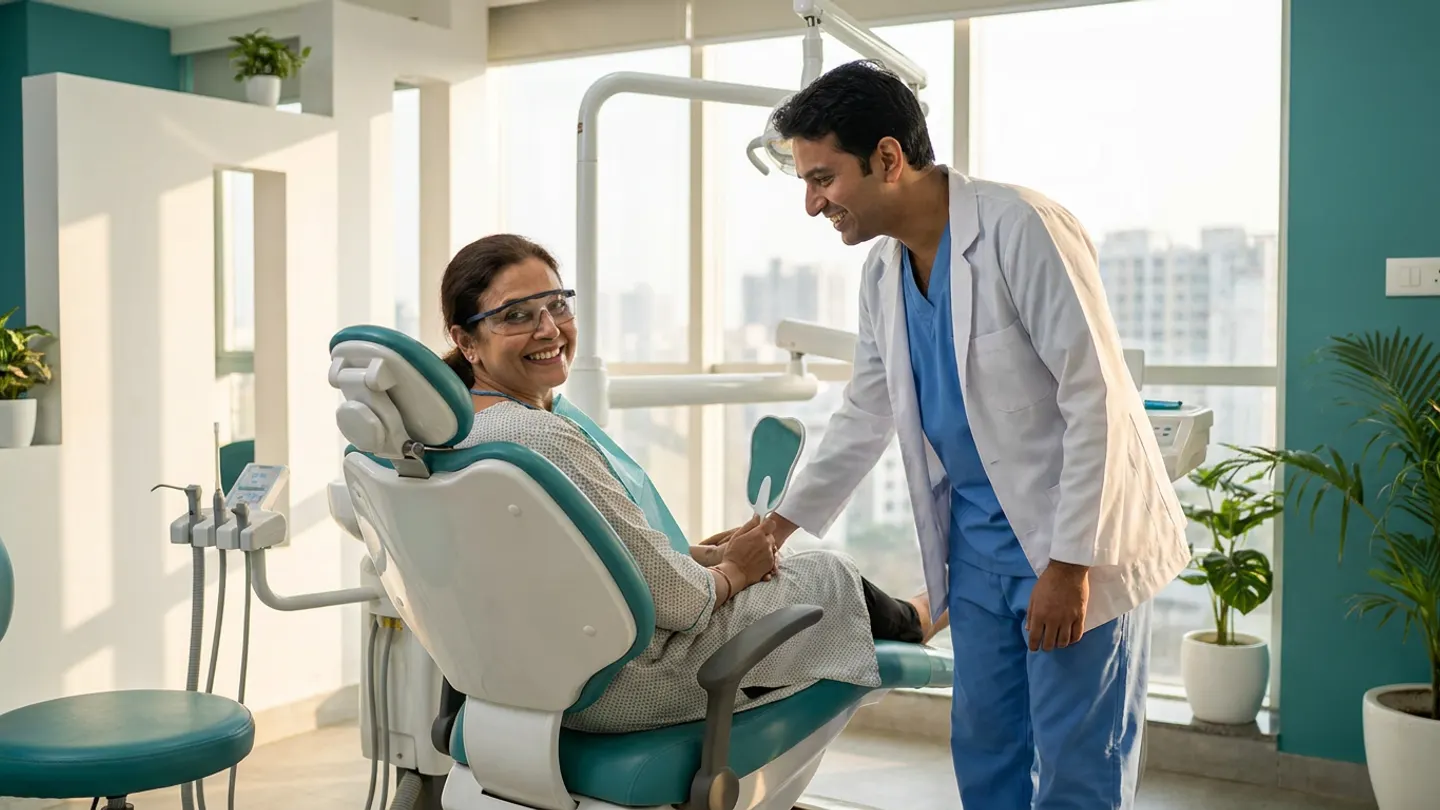
You’ve done the numbers — probably more than once — and they still sting. A full set of porcelain veneers in Australia can cost more than a family car, health fund extras barely dent the bill, and your dentist’s schedule stretches out for months. If you’re wondering whether dental treatment in India is a genuine option or just an internet rabbit hole, this guide is for you.
How dental veneers in India vs Australia compare on cost
Dental veneers in India typically cost between AUD 180 and AUD 450 per tooth — a saving of 70 to 80 per cent compared with Australia, where a single porcelain veneer runs from AUD 1,200 to AUD 2,500. For a full smile makeover of 10 to 16 veneers, Australian patients commonly save AUD 12,000 to AUD 30,000 or more by choosing a JCI- or NABH-accredited dental centre in India, even after return flights and accommodation are included.
| Veneer type | India (per tooth, AUD) | Australia (per tooth, AUD) | Approximate saving |
|---|---|---|---|
| Composite veneers | 80 – 150 | 600 – 900 | ~80% |
| Porcelain (feldspathic) | 180 – 320 | 1,200 – 1,800 | ~75% |
| E.max porcelain | 250 – 380 | 1,400 – 2,200 | ~75% |
| Zirconia veneers | 280 – 450 | 1,500 – 2,500 | ~72% |
| Full smile (10 teeth, E.max) | 2,500 – 4,000 | 16,000 – 24,000 | ~75–80% |
All prices are indicative 2026 ranges. Your final quote will depend on the number of teeth, chosen material, any preparatory work needed, and the city and clinic you select.
What you actually get for the price in India
The cost gap is driven by economics, not corners cut. India’s lower cost of living, lower clinic overheads, and intensely competitive private dental sector mean that world-class laboratories, certified ceramics, and internationally trained dentists are genuinely less expensive to access — not less capable.
Materials and technology
Leading Indian dental centres use the same brands of porcelain and zirconia that you would find in Sydney or Melbourne. CEREC CAD/CAM in-house milling, Ivoclar Vivadent e.max press, and German-manufactured zirconia blocks are all standard at premium centres. The price difference in Australia is largely explained by clinic rent in expensive city suburbs, dental staff salaries benchmarked to Australian wages, and the administrative burden of the private health insurance system.
Accreditation: the quality marker to look for
NABH (National Accreditation Board for Hospitals and Healthcare Providers) is India’s gold-standard accreditation framework, covering everything from infection control and sterilisation protocols to patient records and clinical governance. JCI (Joint Commission International) accreditation applies the same rigorous standard used by leading hospitals in the United States and Europe. Both are meaningful quality signals. When IndoMedTour matches you to a clinic, confirmed accreditation status is a baseline requirement, not an optional extra. You can also explore our treatments and costs page and our hospitals to understand the types of facilities we work with.
“My quote in Brisbane was AUD 21,500 for 10 veneers with a four-month wait. I had the identical treatment at a NABH-accredited centre in India for under AUD 4,200 all in — including flights and nine nights of accommodation. I was home in less than two weeks with a smile I’d been postponing for years.” — Representative experience; not a specific identifiable patient.
Is it safe to get dental veneers in India?
For most healthy adults, veneer placement carries low inherent clinical risk wherever it is performed. The real safety question is about the clinic, the clinician, and what happens if you need follow-up after returning home. Here is a checklist to evaluate any overseas dental centre:
- Holds current NABH or JCI accreditation — ask for the certificate number and verify it online
- The treating dentist has postgraduate training in prosthodontics or cosmetic dentistry
- The clinic uses an in-house or formally certified external dental laboratory
- A written, itemised treatment plan and cost quote is provided before any payment is taken
- Digital shade matching and a smile simulation or mock-up preview are offered before preparation begins
- Clear aftercare instructions are provided in English, along with a remote consultation protocol for questions after you return home
- The clinic is matched to you by a facilitator with documented experience placing Australian patients
The honest trade-offs
India is a strong option for most veneer patients, but there are situations where you should think carefully.
Complex preparatory work adds complication. If your teeth need significant gum treatment, root canal therapy, or extensive reshaping before veneers can be placed, managing that preparatory work across two countries adds logistical complexity. Many patients complete preparatory treatment at home in Australia and then travel for the final veneer placement.
Travel costs are real. Return economy flights from Sydney, Melbourne, or Brisbane to major Indian dental hubs — Mumbai, Chennai, Delhi, or Hyderabad — typically run AUD 900 to AUD 1,600. Seven to twelve nights of comfortable accommodation near the clinic adds approximately AUD 400 to AUD 900. These costs are well absorbed by the savings on a full smile makeover, but they make single-tooth or two-tooth composite veneers a less compelling reason to travel alone.
Minor bite adjustments. Some patients need small adjustments after bonding. Reputable Indian clinics build a review appointment into the treatment schedule before your departure date. Most adjustment needs can also be addressed by any registered Australian dentist on return, since veneers are a standard restoration with no proprietary lock-in.
Learn more about what to expect at our how it works page, or see dental treatment options for a broader overview of what patients access in India.
What the full trip typically looks like
Most Australian patients travelling for dental veneers follow a similar 10 to 12 day schedule:
Days 1–2: Arrival, rest and recovery from the flight, initial consultation. Digital X-rays sent in advance are reviewed, photographs are taken, and the treatment plan is confirmed. You approve the shade, shape, and smile design before any preparation begins.
Days 3–5: Tooth preparation, optical scanning or digital impressions, temporary veneers placed while the laboratory fabricates the permanent restorations.
Days 6–8: Laboratory fabrication. This window is typically used for rest, sightseeing, or a short trip outside the city.
Days 9–10: Try-in session for fit, shade, and comfort. Final adjustments and bonding of permanent veneers. Post-treatment review and written aftercare instructions.
Day 11–12: Buffer day for any minor follow-up, then the homeward flight.
The clinical process is essentially the same as what you would experience in Australia. The difference is the number on the invoice and the city beyond the clinic window.
Common questions from Australian patients
Will my dentist at home be able to help if something goes wrong? Any registered Australian dentist can assess and treat issues with porcelain or zirconia veneers regardless of where they were placed. Bringing your full treatment records home — which accredited Indian clinics provide as standard — makes any follow-up visit entirely straightforward.
Can I claim on my health fund extras? Australian health fund extras cover dental treatment performed in Australia only. Even domestically, cosmetic veneers attract limited rebates. This is rarely a material factor in the decision; the out-of-pocket cost in Australia after any rebate typically still exceeds the all-in cost of travelling to India for treatment.
What about the language barrier? India’s top private dental centres are accustomed to international patients. Consultations, treatment plans, consent forms, and aftercare documents are all provided in English as standard practice.
Read success stories from patients who have made the journey, or book a free counselling call to talk through your specific situation with no pressure and no obligation.
How IndoMedTour helps
When you contact us, you are connected with a care coordinator — not a commission-based agent — who listens to your dental goals, reviews your history, and matches you with two or three accredited clinics that fit your case and budget. We obtain written, itemised quotes so you can compare options clearly before committing to anything. Once you decide to proceed, we handle your visa support letter, coordinate accommodation close to your clinic, arrange airport transfers, and stay reachable through every appointment. Your coordinator continues to be a point of contact after you return home, ready to answer questions and help you connect with local follow-up care if needed. You bring the worry. We bring the plan.