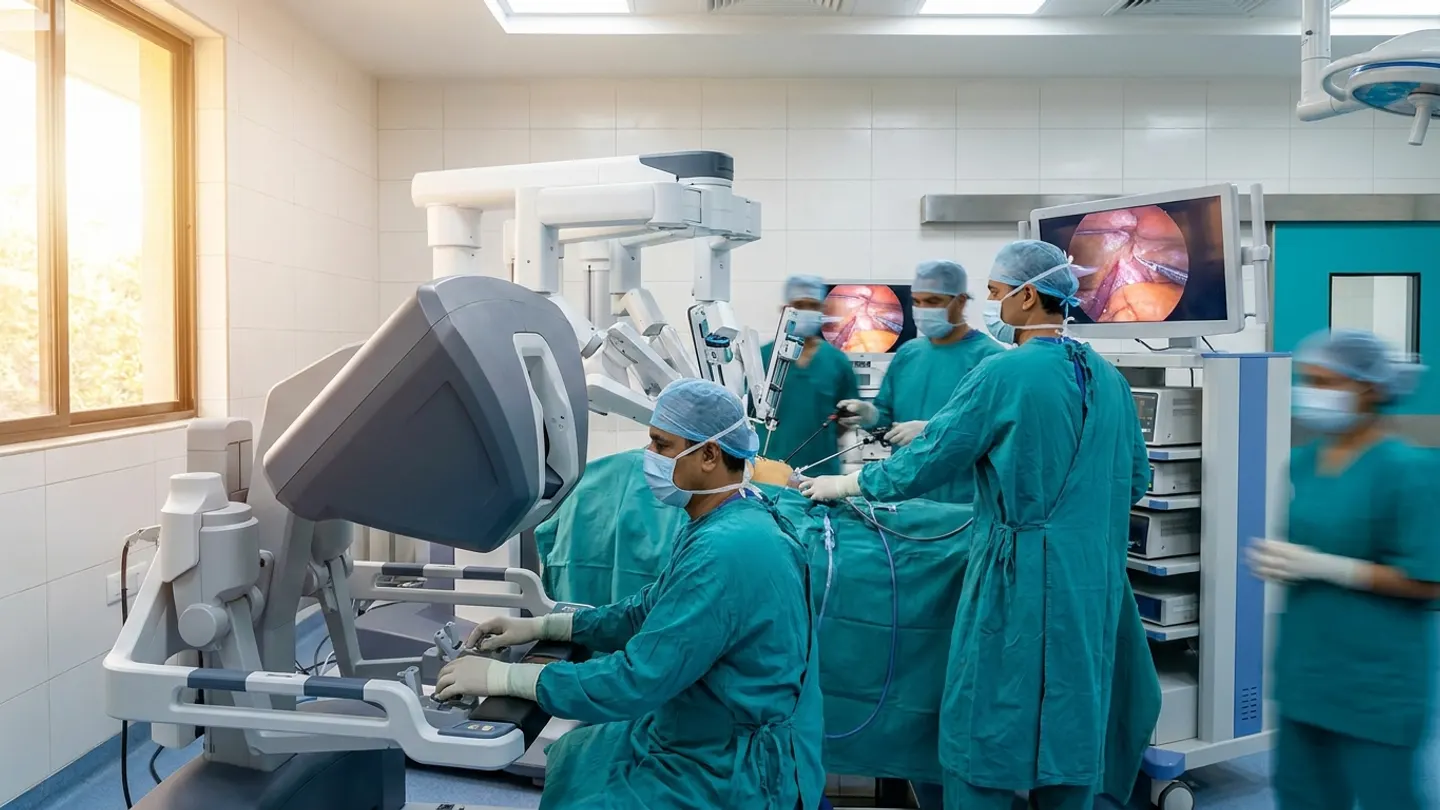
Facing major surgery is frightening enough at home. Doing it in another country, far from family and familiar hospitals, adds a whole extra layer of worry. If you have been searching “is robotic surgery safe in India” at midnight, trying to weigh up a terrifying bill at home against the unknown of going abroad, you are not alone. You deserve honest answers, not brochure promises.
Is Robotic Surgery Safe in India? The Direct Answer
Robotic surgery in India is safe at accredited hospitals, and outcomes routinely match those published by leading centres in the US, UK, and Australia. India’s top surgical facilities use the same FDA-cleared robotic platforms — including the da Vinci Surgical System and the Versius robot — as hospitals in the West, and their surgeons are often fellowship-trained abroad. Patient safety data from JCI-accredited Indian hospitals consistently shows complication rates, surgical blood loss, and recovery timelines that are comparable to international benchmarks.
That single fact matters because many patients assume “affordable” must mean “lower quality.” In India, the lower cost comes from the country’s overall cost-of-living structure — wages, real estate, administrative overhead — not from shortcuts in equipment, surgeon training, or infection control.
How Robotic Surgery Works — and Why the Technology Travels Well
Robotic-assisted surgery uses a surgeon-controlled console to guide miniaturised instruments through small incisions, with a high-definition 3D camera providing magnified views of the operative field. The robot does not operate independently; every movement is a precise extension of the surgeon’s hands, filtered through software that eliminates natural hand tremor and scales down large movements into micro-level precision.
Crucially, the core technology is identical whether the operating room is in Houston, London, or Hyderabad. This means the safety equation rests primarily on four factors:
- The surgeon’s training and annual procedure volume
- Hospital infection control and nursing protocols
- Post-operative monitoring standards and intensive-care capability
- Accreditation and independent quality audits
India’s leading hospitals perform strongly on all four.
India’s Quality Standards: JCI, NABH, and Why They Matter
JCI and NABH Accreditation — the Global Safety Bar
The most reliable marker of hospital quality in India is independent accreditation. JCI (Joint Commission International) is the same body that certifies hospitals in the US, the UAE, and Europe. Its standards cover surgical safety checklists, sterilisation protocols, infection monitoring, patient rights, and post-operative care ratios. NABH (National Accreditation Board for Hospitals) is India’s own rigorous national standard, recognised internationally and benchmarked against JCI criteria.
India has more JCI-accredited hospitals than almost any other country in Asia. These facilities undergo unannounced inspections, maintain detailed outcome registries, and meet the same standards that earn certification in New York or Dubai. When evaluating any hospital for robotic surgery abroad, JCI or NABH accreditation is the first filter to apply — not the price.
“I was nervous about having surgery in another country. But the hospital felt more organised and calm than some I have visited at home. The surgical team explained every step before and after. I never felt like a foreigner — I felt like a patient being well cared for.” — representative patient experience shared with our care team.
Surgeon Volume and Specialisation
High surgical volume is one of the strongest independent predictors of good outcomes in complex robotic procedures. India’s large population and rapidly growing medical-tourism patient base mean that leading robotic surgeons perform hundreds of cases each year — substantially more than surgeons in smaller Western markets where a hospital’s robotic system may see far less frequent use.
Many senior surgeons at top Indian centres completed robotic-surgery fellowships or subspecialty training in the US, UK, or Germany before returning to India. Peer-reviewed publications, international conference presentations, and participation in global clinical trials are now routine at this level. Volume and training together are what actually produce good surgical outcomes, and both are present in abundance at accredited Indian facilities.
Robotic Surgery Cost in India vs the Rest of the World (2026 Estimates)
The cost difference between India and Western countries is large — and it is real.
| Procedure | India (approx.) | USA (approx.) | UK Private (approx.) | Australia Private (approx.) |
|---|---|---|---|---|
| Robotic prostatectomy | $5,000 – $9,000 | $25,000 – $45,000 | £14,000 – £22,000 | AUD 20,000 – 35,000 |
| Robotic hysterectomy | $3,500 – $6,500 | $15,000 – $30,000 | £9,000 – £16,000 | AUD 15,000 – 25,000 |
| Robotic partial nephrectomy | $6,000 – $11,000 | $30,000 – $55,000 | £16,000 – £28,000 | AUD 25,000 – 40,000 |
| Robotic colorectal resection | $4,500 – $8,000 | $20,000 – $40,000 | £12,000 – £22,000 | AUD 18,000 – 32,000 |
| Robotic cardiac surgery | $8,000 – $14,000 | $40,000 – $80,000 | £25,000 – £50,000 | AUD 35,000 – 65,000 |
All figures are indicative 2026 ranges. They include the surgeon fee, anaesthesia, and a standard hospital stay. They do not include international flights, accommodation, or pre-operative investigations. Your exact quote will depend on the specific case, hospital tier, and procedure complexity.
The savings typically cover international flights and accommodation with significant amounts left over. For most patients, the total cost of treatment plus travel in India is still 50 to 70 percent below the bill they received at home. See our treatments and costs page for procedure-specific comparisons.
Robotic Procedures Commonly Performed in India
India’s robotic surgery programmes now span a wide range of specialities:
- Urology: radical prostatectomy, partial and radical nephrectomy, bladder reconstruction, pyeloplasty
- Gynaecology: hysterectomy, myomectomy for fibroids, endometriosis resection, pelvic floor repair
- Cardiac surgery: mitral valve repair, atrial septal defect correction, coronary bypass (minimally invasive)
- General and colorectal surgery: anterior resection, colectomy, rectal cancer surgery, hernia repair
- Head and neck oncology: robotic-assisted resection for oropharyngeal and tongue-base cancers
- Orthopaedics: robotic-arm-assisted knee and hip replacement for precise implant positioning
For cardiac procedures, visit our cardiac surgery page. For robotic-assisted joint replacement, see orthopaedics and joint replacement. Cancer-related robotic procedures are covered at cancer and oncology.
What the Clinical Evidence Shows
Published studies comparing robotic surgery outcomes between accredited Indian tertiary hospitals and comparable Western institutions consistently find:
- Intraoperative blood loss rates similar to or lower than open-surgery alternatives
- Oncological surgical margins in cancer cases that meet international standards
- Length-of-stay figures within expected ranges for the procedure type
- Post-operative infection rates within WHO and Joint Commission benchmarks at accredited sites
No surgical method anywhere eliminates risk entirely. Robotic-assisted surgery carries the same broad categories of risk as open or laparoscopic surgery — anaesthetic reactions, bleeding, infection, and procedure-specific complications. What robotic assistance reliably does is reduce some of those risks compared to open surgery by limiting tissue trauma, improving visualisation, and enabling more precise dissection. At accredited Indian hospitals, those advantages are fully realised.
A Checklist Before You Book Robotic Surgery Abroad
Use this before committing to any hospital or facilitator:
- Is the hospital JCI- or NABH-accredited?
- How many robotic procedures has this specific surgeon performed in the past 12 months?
- Which robotic platform is used, and how long has the team been using it?
- Is there a dedicated adult ICU and 24-hour post-operative monitoring?
- Will I receive my surgical plan and written cost quote before I travel?
- What is the protocol if I need to extend my stay because of a complication?
- Is there a bilingual patient coordinator assigned to me from arrival through discharge?
- Does the hospital have experience managing international patients and visa documentation?
IndoMedTour will walk you through every one of these questions — and provide answers in writing before you book anything. Read how it works and explore our hospitals to understand how we select facilities.
How IndoMedTour Helps
When you book a free counselling call, our care team listens first: to your diagnosis, your concerns about safety, your timeline, and your budget. We then match you with JCI- or NABH-accredited hospitals that have demonstrable robotic surgery volume in your procedure type, obtain written cost estimates so you can compare clearly without surprises, and arrange your medical visa, airport transfers, and accommodation. A dedicated coordinator stays with you from your first video consultation with the surgeon through to your flight home — and beyond, if you need follow-up support. You bring the worry. We bring the plan.