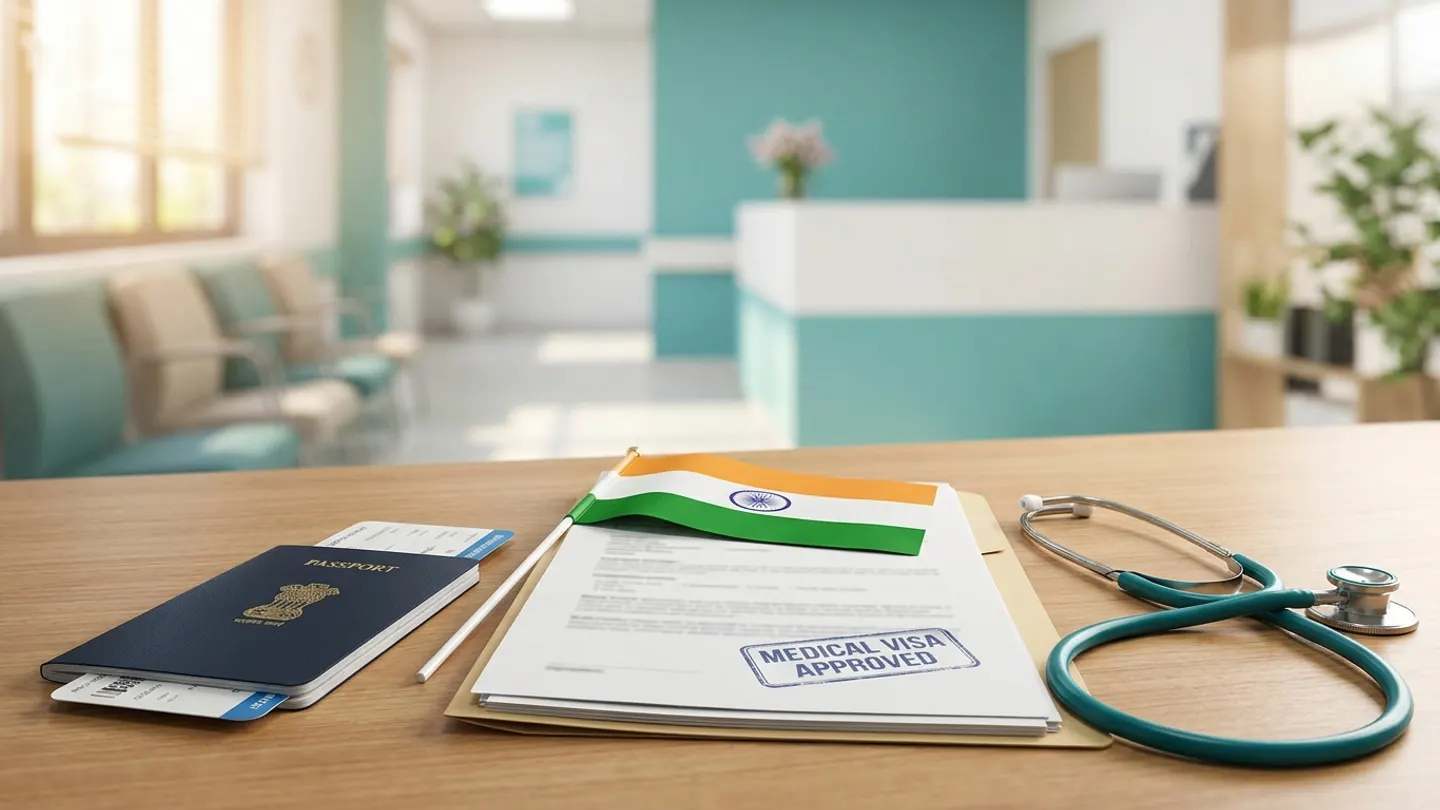
Navigating a serious health decision is stressful enough without a paperwork maze standing between you and the care you need. The good news is that India’s medical visa process is far more straightforward than most patients expect, and with the right preparation it rarely delays your treatment by more than a week.
What Is a Medical Visa for India and Who Needs One?
A medical visa for India (officially designated “MED” on the visa sticker) is a purpose-specific entry permit issued to foreign nationals who travel to India solely or primarily to receive medical treatment. It is different from a regular tourist visa: it carries a longer maximum duration, permits multiple entries, and can be extended inside India if your recovery takes longer than planned.
You need a medical visa if you are travelling for planned procedures — whether that is cardiac surgery, joint replacement, cancer treatment, IVF, organ transplant, dental work, or any other clinical purpose. In general, medical tourism visitors who stay fewer than 60 days and are not receiving complex treatment sometimes enter on an e-Tourist visa, but using the correct MED visa protects you legally, simplifies hospital registration, and is always the right choice for anything surgical or multi-visit.
“The MED visa exists because India’s government actively wants international patients to access its hospitals safely and with full legal protection. Think of it as a welcome letter, not a hurdle.”
Types of Indian Medical Visa in 2026
Standard Medical Visa (MED)
This is the principal visa for patients. Key features:
- Validity: Up to one year from the date of issue, or for the duration of treatment (whichever is shorter). Extensions are possible at the Foreigners Regional Registration Office (FRRO) inside India.
- Entries: Triple entry as standard; single or double entry is also possible.
- Companions: Up to two attendants may simultaneously apply for the linked Medical Attendant Visa.
Medical Attendant Visa (MED-X)
Issued to a spouse, parent, child, or close family member accompanying the patient. The MED-X visa mirrors the patient’s visa dates exactly. Companions cannot take employment or conduct business activities in India on this visa.
e-Medical Visa (e-MED)
India’s online portal offers an e-Medical Visa that can be applied for entirely online, with no embassy visit required. It is currently available to nationals of over 165 countries. Validity is typically 60 days with triple entry, making it ideal for shorter procedures like dental treatment, minor surgeries, or a first diagnostic consultation before a longer trip.
Step-by-Step: How to Apply for a Medical Visa for India
Step 1 — Gather your documents first
Before you open the application portal, collect every document. Missing paperwork is the single biggest cause of delays.
Patient documents:
- Valid passport (minimum 6 months validity beyond your intended departure date, at least two blank pages)
- Recent passport-size photographs (white background, as per Indian government specifications)
- Completed application form from the Indian e-Visa portal or your local Indian embassy / High Commission
- Proof of sufficient funds (bank statements for the past three to six months)
Medical documents:
- A referral letter from your treating physician at home, explaining your diagnosis and the recommended treatment
- An invitation or appointment letter from the Indian hospital or clinic confirming they will receive you (on hospital letterhead, with the treating doctor’s name and registration number)
- Previous medical records, diagnostic reports, or imaging relevant to your condition
Financial proof specific to medical travel:
- An estimate of costs issued by the Indian hospital (many JCI- and NABH-accredited hospitals in India issue these routinely for visa purposes)
Step 2 — Choose your application route
| Route | Best for | Typical processing time | Embassy visit needed? |
|---|---|---|---|
| Indian e-Visa portal (online e-MED) | Short procedures, most nationalities | 72 hours to 5 business days | No |
| Indian embassy / High Commission in your country | Complex cases, longer stays, nationalities not eligible for e-MED | 3-10 business days | Usually yes |
| Visa on Arrival (select airports) | Not available for MED category — do not rely on this | — | — |
Step 3 — Complete the application form carefully
Whether applying online or on paper, pay close attention to:
- Purpose of visit: Select “Medical” explicitly. Do not select “Tourist.”
- Port of entry: Name the Indian airport or border crossing you will use.
- Duration: State the number of days you expect to be in India, erring on the generous side. It is much easier to leave early than to extend unexpectedly.
- Hospital details: Provide the full name, address, and contact information of your receiving hospital exactly as it appears on their letter.
Step 4 — Pay the visa fee
Fees vary by nationality and application route. As a general guide:
| Nationality | e-MED visa fee (approx.) |
|---|---|
| US citizens | ~USD 25 |
| UK citizens | ~USD 15 |
| Australian citizens | ~USD 25 |
| UAE residents (many nationalities) | ~USD 10-25 |
| Most other nationalities | ~USD 10-25 |
Fees are set by the Indian government and subject to change. Always verify the current fee on the official Indian e-Visa website or with your embassy.
Step 5 — Track and receive your visa
For e-MED applications, you will receive the Electronic Travel Authorisation (ETA) by email. Print two copies and carry them with your passport. For embassy-issued visas, your passport is returned with the visa sticker.
Costs and Savings: Why the Visa Fee Is the Smallest Number on Your Invoice
The medical visa fee is genuinely minor compared to the treatment cost savings that motivate most patients to make this journey. To put it in context:
| Procedure | Typical cost in the US / UK / Australia | Typical cost in India (indicative) |
|---|---|---|
| Hip or knee replacement | USD 30,000 – 60,000 | USD 5,000 – 9,000 |
| Coronary artery bypass (CABG) | USD 70,000 – 150,000 | USD 7,000 – 14,000 |
| IVF cycle (single) | USD 15,000 – 25,000 | USD 2,500 – 5,000 |
| Cancer chemotherapy (6 cycles) | USD 50,000 – 120,000 | USD 6,000 – 18,000 |
| Dental implants (full arch) | USD 20,000 – 40,000 | USD 3,000 – 7,000 |
All figures are indicative 2026 ranges. Actual costs depend on hospital tier, city, treating surgeon, and individual clinical complexity. See our treatments & costs page for more detailed breakdowns.
Factoring in flights and accommodation, most patients still save 50-80% compared to home-country pricing — while being treated at hospitals holding JCI (Joint Commission International) or NABH (National Accreditation Board for Hospitals) accreditation, the globally recognised quality benchmarks that India’s top medical centres maintain.
Common Questions and Pitfalls to Avoid
Can I extend my medical visa inside India?
Yes. If your recovery is taking longer than expected, apply to the FRRO (Foreigners Regional Registration Office) in the city where you are receiving treatment. Your hospital’s international patient department will normally assist with the paperwork. Apply before your current visa expires — overstaying, even for medical reasons, can complicate future visa applications.
What if my diagnosis changes after I arrive?
Your visa is tied to the broad purpose of “medical treatment,” not to a specific procedure. If your Indian specialist recommends a different or additional intervention, your visa remains valid. Inform the FRRO only if you need to extend your stay.
Will the Indian embassy contact my hospital?
Sometimes yes. Indian consular officers may call or email the hospital named in your documents to verify the letter is genuine. This is routine and is completed well within the standard processing window. Using a well-known, accredited hospital reduces the chance of additional verification delays.
Checklist before you submit your application
- Passport valid for at least 6 months beyond your return date
- At least 2 blank pages in your passport
- Diagnosis letter from your home doctor
- Hospital invitation / appointment letter from India (on letterhead)
- Cost estimate from Indian hospital (for visa and budgeting)
- Bank statement showing sufficient funds
- Recent passport photographs meeting Indian specifications
- Completed application form double-checked for spelling errors (name must match passport exactly)
- Visa fee payment confirmed
- Printed copy of ETA or original visa sticker in hand before travelling
Arriving in India: What Happens at Immigration
Carry your medical documents in your hand luggage, not checked baggage. At the immigration desk, present your passport, visa (or ETA printout), and the hospital invitation letter. Immigration officers may ask a few brief questions about your treatment plan. This is standard and rarely takes more than a few minutes if your documents are in order.
Your dedicated IndoMedTour coordinator will typically arrange airport pickup and transfer you directly to your hospital or hotel. You will not need to navigate an unfamiliar city alone at any point.
How IndoMedTour Helps
From your very first free counselling call, IndoMedTour takes the administrative weight off your shoulders. We match you with the right JCI- or NABH-accredited hospital for your condition, help you request the official hospital invitation letter needed for your visa application, and guide you through every document on the checklist above. We provide written treatment quotes so you know exactly what to expect financially, and we coordinate your flights, accommodation, and airport transfers. Once you arrive, a dedicated patient coordinator stays beside you through every consultation, procedure, and day of recovery — so you are never alone in a strange place trying to make sense of a healthcare system you don’t know.
Explore your treatment options or how the process works to take the next step — or simply get in touch for a no-obligation conversation. You bring the worry. We bring the plan.