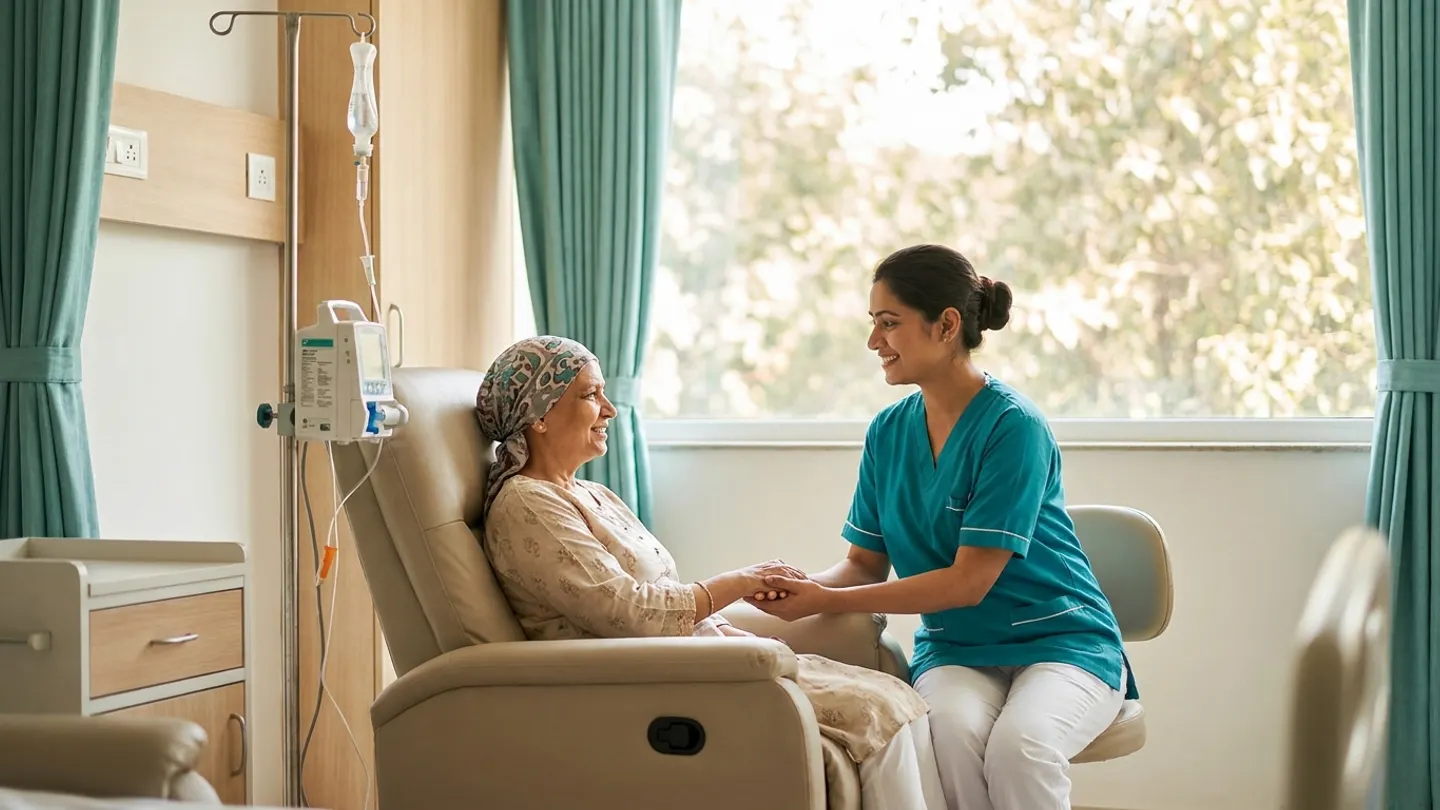
A cancer diagnosis turns your world upside down. Then comes the bill — or the waiting list — and the fear of navigating all of it alone, possibly thousands of miles from home. You are not the first person to feel this way, and there is a well-worn path through it.
Why International Patients Choose the Best Cancer Hospitals in Mumbai
The best cancer hospitals in Mumbai deliver internationally accredited oncology care at costs that are typically 60 to 80 percent lower than equivalent treatment in the United States, United Kingdom, or Australia. Mumbai has become one of Asia’s foremost cancer-care destinations — not because of cost alone, but because its leading hospitals combine subspecialised oncologists, full-spectrum diagnostic and treatment technology, and genuine infrastructure for patients who arrive from abroad without a local support network.
The city hosts hospitals that receive patients from across Sub-Saharan Africa, the Gulf states, Southeast Asia, and increasingly from the UK and North America. That scale of international experience matters: it means the paperwork, the language support, the visa assistance, and the care coordination are all built into the system, not bolted on as an afterthought.
What Makes a Cancer Hospital in Mumbai World-Class
Accreditation: Your Non-Negotiable Starting Point
When you are evaluating oncology care overseas, accreditation is the single most reliable quality filter available to you. The Joint Commission International (JCI) sets a globally recognised benchmark covering patient safety, infection control, surgical protocols, staff credentialing, and medication management. The National Accreditation Board for Hospitals (NABH) is India’s own rigorous equivalent, with standards that map closely to JCI requirements. Mumbai’s leading cancer centres carry one or both of these credentials, and no reputable medical tourism facilitator would refer you to a hospital that does not.
When you review a hospital, look for these capabilities as a minimum:
- A dedicated multi-disciplinary tumour board that reviews complex cases as a team, not in isolation
- Radiation oncology units offering IMRT, IGRT, stereotactic body radiotherapy (SBRT), and ideally CyberKnife or similar precision systems
- Robotic and laparoscopic surgical oncology platforms for minimally invasive procedures
- In-house PET-CT, MRI, bone marrow biopsy, and next-generation genomic sequencing
- A bone marrow transplant and haematology unit (for patients needing stem-cell therapy)
- A dedicated international patient services desk available around the clock
- ICU and post-operative oncology recovery units with intensivist oversight
The Oncology Subspecialties Available in Mumbai
Mumbai’s top hospitals cover the full cancer spectrum. Breast oncology, gastrointestinal cancers, hepato-biliary surgery, head and neck tumours, thoracic oncology, urological cancers, neuro-oncology, gynaecological oncology, and haematological malignancies including lymphoma, leukaemia, and multiple myeloma — all of these have dedicated subspecialists, not general surgeons who occasionally handle cancer.
For patients comparing treatments and costs across countries, it is worth knowing that some of India’s most complex oncology cases are referred from hospitals in neighbouring Asian countries. The technical depth is not a gap you are bridging by coming to Mumbai; in many respects you are accessing it.
Cancer Treatment Costs in Mumbai vs the World
Cost is a practical conversation, not a mercenary one. When a course of chemotherapy at home costs the same as a house, exploring alternatives is simply responsible. The table below gives indicative 2026 price ranges; every case is individual, and your written quote will vary by hospital, diagnosis, stage, and protocol.
| Treatment | Mumbai, India | United States | United Kingdom | Australia | UAE |
|---|---|---|---|---|---|
| Breast cancer surgery + reconstruction | $5,000 – $9,000 | $40,000 – $80,000 | $25,000 – $45,000 | $20,000 – $40,000 | $18,000 – $35,000 |
| Chemotherapy course (standard protocol) | $3,000 – $8,000 | $30,000 – $100,000 | $20,000 – $60,000 | $15,000 – $50,000 | $12,000 – $40,000 |
| Robotic radical prostatectomy | $6,000 – $11,000 | $35,000 – $70,000 | $22,000 – $40,000 | $18,000 – $35,000 | $16,000 – $30,000 |
| Autologous bone marrow transplant | $18,000 – $28,000 | $150,000 – $300,000 | $80,000 – $150,000 | $70,000 – $120,000 | $55,000 – $100,000 |
| Lung cancer lobectomy (VATS) | $6,500 – $12,000 | $40,000 – $85,000 | $25,000 – $55,000 | $20,000 – $45,000 | $18,000 – $38,000 |
| IMRT radiation (30 sessions) | $3,500 – $7,000 | $25,000 – $60,000 | $18,000 – $40,000 | $14,000 – $35,000 | $12,000 – $28,000 |
All figures are indicative 2026 ranges in USD. They do not include travel, accommodation, or ancillary services. Individual quotes from hospitals may differ based on cancer stage, treatment complexity, and chosen facility.
Book a free counselling call to receive actual written estimates tailored to your specific diagnosis.
What the International Patient Journey Looks Like
The logistics of cancer treatment abroad sound complicated from a distance. In practice, Mumbai’s major hospitals have streamlined the process for international patients considerably.
“I arrived not knowing what to expect, carrying scans from three different hospitals at home. Within two days I had a treatment plan from the tumour board and a clear cost breakdown in writing. My coordinator met me at the airport. I never felt alone.” — representative composite account; not a specific identifiable patient.
Here is how the journey typically unfolds:
- Share your records — send pathology reports, imaging, and any prior treatment history via email or a secure hospital portal.
- Receive a written protocol and cost estimate — the international patient team responds within 48 to 72 hours with a proposed treatment plan and indicative costs.
- Apply for a medical visa — India’s M-visa is issued by the Indian High Commission or embassy in your home country; hospitals provide the required invitation letter.
- Arrive and complete a baseline assessment — your oncologist reviews your case on arrival and confirms or refines the treatment plan.
- Begin treatment — surgical, medical, or radiation oncology proceeds as planned, with your dedicated coordinator present throughout.
- Discharge and follow-up — you receive a comprehensive discharge summary for your home physician; virtual follow-up consultations are available post-departure.
Practical Questions to Ask Before Choosing a Hospital
Not every hospital will be the right fit for every cancer or every patient. These are the questions worth getting written answers to before you travel:
- Is the hospital JCI or NABH accredited, and when was the last assessment?
- Does a dedicated tumour board review my cancer type specifically?
- What is my oncologist’s subspecialty and how many cases of my diagnosis have they managed?
- Does the hospital have the specific technology my treatment requires — for example, CyberKnife, HIFU, allogeneic transplant capability, or a specific immunotherapy drug on formulary?
- Who is my named coordinator, and how do I reach them outside business hours?
- What happens if I experience a complication after returning home?
Any hospital on our network of accredited hospitals will answer every one of these questions in writing without hesitation. If a hospital is evasive on accreditation or subspecialty experience, that is a meaningful signal.
Second Opinions: A Reason Many Patients Come to Mumbai First
A growing number of international patients do not come to Mumbai for treatment immediately — they come for a second opinion. Leading cancer hospitals here offer formal second-opinion consultations where your scans and histopathology are reviewed by a specialist tumour board, and you receive a detailed written report, often within 72 hours.
Sometimes the recommended treatment is identical to what you were told at home, and the certainty that brings is worth the trip alone. Occasionally the diagnosis is refined, the staging is reconsidered, or a different treatment sequence is proposed. Our cancer and oncology treatment page explains what to prepare for a second-opinion consultation and what formats hospitals prefer for imaging submissions.
Waiting Times: Why Speed Matters in Oncology
In some national health systems, the target wait from GP referral to first cancer treatment is 62 days. Actual experience is often longer. In India’s private hospital sector, most patients begin treatment within one to two weeks of arrival, and surgical cases are typically scheduled within days of a pre-operative assessment.
For many cancers, the difference between a two-week wait and a two-month wait is not merely a matter of comfort. It is clinically significant. That reality is one of the most honest reasons international patients choose Mumbai.
How IndoMedTour Helps
We know that researching the best cancer hospitals in Mumbai from across the world — while also managing a diagnosis, a frightened family, and an uncertain financial picture — is an enormous amount to carry. IndoMedTour offers a free counselling call where one of our medical coordinators reviews your diagnosis and medical records, identifies the most appropriate accredited hospital or hospitals for your specific cancer, and sends you a side-by-side comparison of written cost estimates. We handle visa invitation letters, accommodation guidance, and airport coordination — and a dedicated patient coordinator stays beside you from arrival through your final discharge, available at any hour.
You bring the worry. We bring the plan.