If your child has been diagnosed with thalassemia major, you already know the exhaustion of twice-monthly transfusions, the silent iron overload building in their organs, and the question that keeps you awake at night: is there a cure? There is one — and for thousands of families around the world, bone marrow transplant in India has made that cure financially possible.
Bone Marrow Transplant for Thalassemia in India: Can It Actually Cure the Disease?
Bone marrow transplant for thalassemia in India is a proven, potentially curative treatment, with leading accredited centres reporting event-free survival rates of 85-92% in well-selected patients. Unlike lifelong transfusion therapy, a successful allogeneic BMT replaces the faulty stem cells producing abnormal haemoglobin with healthy donor cells — stopping the disease at its source, permanently.
The procedure is not new to Indian hospitals. India’s top haematology centres have been performing BMT for thalassemia for over two decades, accumulating case volumes that rival many Western institutions. And because India’s healthcare costs are structurally lower — not because corners are cut — the price of this life-changing procedure is accessible to families who would otherwise face an impossible bill abroad.
How Much Does Bone Marrow Transplant for Thalassemia in India Cost?
This is the first question most families ask, and it deserves an honest answer. The table below shows indicative 2026 cost ranges for a matched sibling donor transplant across different countries.
| Country | Approximate BMT Cost (Matched Sibling Donor) |
|---|---|
| India | $18,000 — $32,000 USD |
| United States | $150,000 — $300,000 USD |
| United Kingdom | £80,000 — £150,000 (NHS wait often 12+ months) |
| Australia | AUD $120,000 — $200,000 (private sector) |
| UAE | $80,000 — $120,000 USD |
Costs are indicative 2026 ranges covering the transplant procedure, conditioning chemotherapy, isolation room, and standard post-transplant monitoring. Travel, accommodation, visa fees, and any complication management are additional.
India’s cost advantage is not about inferior care. It reflects lower operational and staffing costs in a country that has invested heavily in tertiary medical infrastructure. A family spending approximately $25,000 in India for the same evidence-based protocol that costs $250,000 in the United States is accessing identical science at a fraction of the price.
For a detailed cost breakdown by case type, see our treatments and costs page, or book a free counselling call to receive a written estimate tailored to your child’s specific situation.
Who Is Eligible for a BMT Cure?
Not every thalassemia patient is an ideal transplant candidate. Indian haematologists use the Pesaro Classification to assess risk before recommending BMT:
- Class I — no liver enlargement, no portal fibrosis, regular chelation history. Best outcomes; cure rates consistently above 90% in this group.
- Class II — one or two of those risk factors present. Good outcomes; 80-88% event-free survival at expert centres.
- Class III — all three risk factors present, often older patients with established liver disease. Higher risk; teams evaluate very carefully on a case-by-case basis.
The strongest candidates for a successful transplant share these characteristics:
- Children under 14 years of age (younger patients generally have better outcomes)
- A fully matched sibling donor (the recognised gold standard)
- Adequate pre-transplant iron chelation and minimal organ damage
- No active infection at the time of conditioning
If no matched sibling is available, matched unrelated donors or haploidentical (half-matched) parent donors are increasingly used. Outcomes with these alternatives have improved substantially with modern immunosuppression and graft engineering. Your IndoMedTour coordinator can arrange a pre-assessment from the BMT team — before you book a single flight — so you know exactly where your child sits on the risk spectrum.
“We had six years of monthly transfusions behind us. The team in our country told us a BMT was possible but quoted us the equivalent of $190,000. A friend who had used IndoMedTour mentioned India. We paid less than a fifth of that price. Our daughter is now three years post-transplant, transfusion-free, and running around at school like any other child.” — Representative account from a family supported by IndoMedTour.
This is a representative narrative illustrating the kind of outcomes international families have experienced; it does not identify a specific individual.
Cure Rates: What the Evidence Shows
Published outcome data from high-volume Indian BMT centres is encouraging and consistent:
- 85-92% event-free survival in Class I and II patients with matched sibling donors
- 70-80% success rates with matched unrelated donor transplants in well-prepared patients
- Graft failure rates below 10% at experienced, high-case-volume centres
- Severe graft-versus-host disease (GvHD) in fewer than 15% of cases, managed with modern prophylaxis protocols
These figures compare favourably with outcomes published by European and North American centres. In several peer-reviewed analyses, high-volume Indian centres report disease-free survival rates that are statistically equivalent to leading Western programmes — a reflection of the sheer number of thalassemia cases they manage annually.
For the broader landscape of transplant options available through IndoMedTour, visit our organ transplant treatments page.
Choosing the Right Hospital: Why Accreditation Is Non-Negotiable
India has many hospitals advertising BMT services. Quality varies significantly. When evaluating options, look specifically for these markers:
- JCI (Joint Commission International) or NABH (National Accreditation Board for Hospitals) accreditation — the internationally recognised benchmarks for patient safety and clinical standards
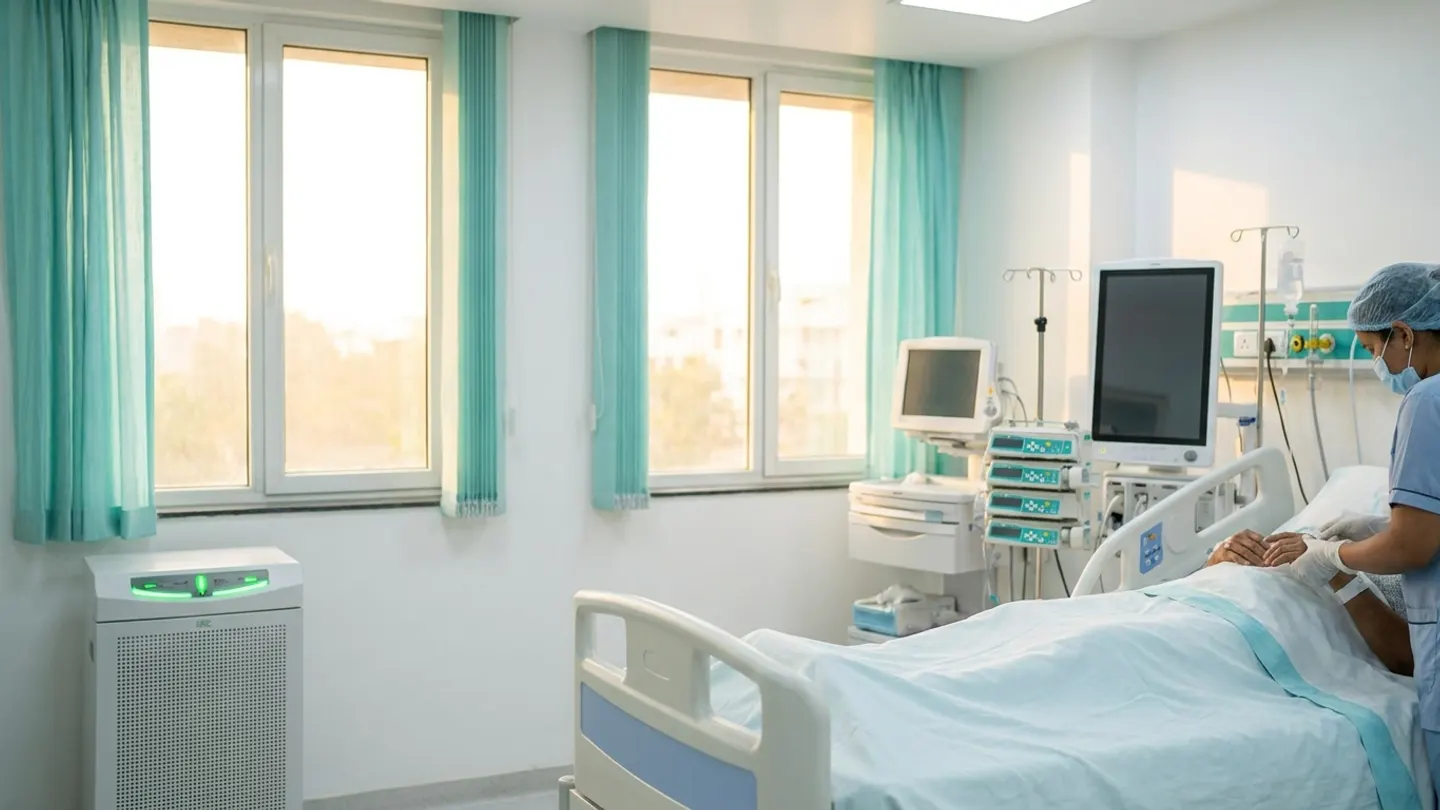
- A dedicated haematology and BMT unit with HEPA-filtered, positive-pressure isolation rooms
- Annual allogeneic transplant volume of at least 30 cases specifically for thalassemia
- An on-site HLA typing laboratory and 24-hour haematology specialist cover
- A specialist paediatric team when the patient is a child
IndoMedTour refers patients only to hospitals that meet these criteria. We do not work with facilities we have not formally assessed. See our hospitals for the full list of partner centres, along with their accreditation status and transplant volumes.
What the Bone Marrow Transplant Process Looks Like
Before You Arrive in India
A safe transplant begins weeks before the patient leaves home:
- Donor HLA typing — coordinated via a sample collection kit; results reviewed by the Indian team
- Pre-transplant medical review — your child’s records are assessed remotely; a written protocol and fixed-price cost plan are issued before any commitment
- Visa and travel planning — medical visa for the patient, companion visa for one caregiver; IndoMedTour assists with both applications
- Pre-conditioning optimisation — the team may recommend specific chelation adjustments, dental clearance, and infection screening before travel
Plan for a total stay of approximately 90 to 120 days in India. The transplant itself spans several days, but safe discharge from isolation typically requires 30-45 days post-infusion, and outpatient monitoring before the patient is cleared to fly adds further time.
During the Transplant
- Conditioning phase (approximately Day -8 to Day -1): chemotherapy — and in some protocols, low-dose radiation — destroys the patient’s existing marrow
- Infusion day (Day 0): donor stem cells are infused intravenously; the procedure itself usually takes a few hours and is similar to a blood transfusion in appearance
- Engraftment window (approximately Day +14 to Day +28): the team monitors closely for signs of engraftment, infection risk, and early GvHD
- Isolation period: the patient stays in a sterile HEPA-filtered room; one family caregiver is typically permitted entry with appropriate protective precautions
Recovery and Follow-Up
After discharge from the isolation unit, patients remain near the hospital for outpatient reviews. IndoMedTour arranges serviced accommodation close to the hospital for the patient and accompanying family members. Once the patient returns home, structured digital follow-up with the Indian BMT team is available for a minimum of 12 months post-transplant. Your coordinator remains a point of contact throughout.
Explore our how it works page for a full overview of how IndoMedTour manages the end-to-end journey.
How IndoMedTour Helps
From the moment you reach out, your dedicated IndoMedTour coordinator connects you with a shortlist of JCI- or NABH-accredited hospitals specialising in bone marrow transplant for thalassemia, and collects written cost quotes so there are no surprises on arrival. We manage your medical visa application, airport transfers, and accommodation close to the hospital. A coordinator is on-call throughout the conditioning, transplant, and recovery period — translating medical updates, answering questions at any hour, and making sure your family is never alone in a foreign country navigating the hardest weeks of their lives. Reach us today for a free counselling call and let us match you with the right centre for your child.
You bring the worry. We bring the plan.