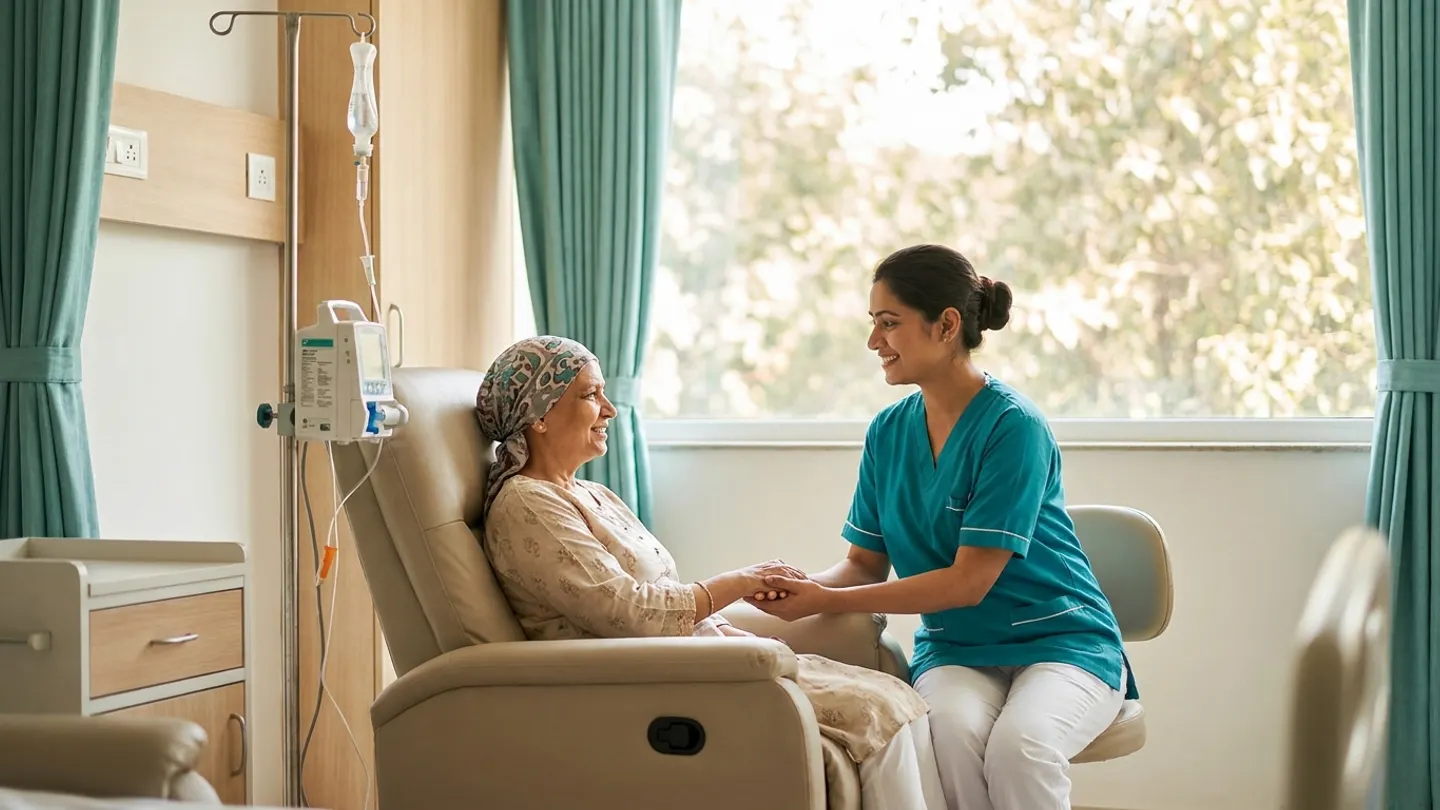
A cancer diagnosis is one of the most frightening moments any person or family can face. If you are in Nigeria and you have just learned what the treatment will cost locally, or that the specialist you need has a months-long waiting list, you are probably wondering whether there is a better way.
There is. Thousands of African patients travel to India every year for high-quality, affordable cancer care, and Nigeria is consistently one of the top five source countries. This guide explains everything you need to know — costs, hospitals, logistics, and how to take your first step.
Cancer Treatment in India for Nigerians: Cost and Quality at a Glance
Cancer treatment in India for Nigerian patients costs between 60 and 80 percent less than equivalent care in the United States, United Kingdom, or UAE, without any sacrifice in clinical quality. India’s top oncology centres use the same technologies — robotic surgery, proton therapy, advanced immunotherapy, PET-CT scanning — that you would find in London or Houston, staffed by specialists who often trained at those very institutions.
The savings are structural, not a sign of lower standards. Lower labour costs, a large pool of trained oncologists, and a highly competitive private hospital market combine to create prices that make world-class cancer care genuinely accessible.
Indicative Cost Comparison: Cancer Treatment Costs in India vs Other Countries
| Treatment | India (approx.) | Nigeria Private (approx.) | USA (approx.) | UK Private (approx.) | UAE (approx.) |
|---|---|---|---|---|---|
| Breast cancer surgery (mastectomy) | USD 3,000 – 6,000 | USD 4,000 – 8,000 | USD 25,000 – 50,000 | USD 18,000 – 35,000 | USD 15,000 – 28,000 |
| Chemotherapy (per cycle) | USD 300 – 600 | USD 500 – 1,200 | USD 3,000 – 10,000 | USD 2,000 – 6,000 | USD 1,500 – 4,000 |
| Radiation therapy (full course) | USD 4,000 – 8,000 | USD 5,000 – 12,000 | USD 30,000 – 60,000 | USD 20,000 – 45,000 | USD 12,000 – 25,000 |
| Bone marrow transplant | USD 18,000 – 30,000 | Rarely available | USD 150,000 – 300,000 | USD 80,000 – 150,000 | USD 60,000 – 100,000 |
| Prostate cancer (radical prostatectomy) | USD 4,000 – 7,500 | USD 6,000 – 10,000 | USD 20,000 – 45,000 | USD 15,000 – 30,000 | USD 12,000 – 22,000 |
| PET-CT scan | USD 200 – 400 | USD 500 – 900 | USD 2,500 – 5,000 | USD 1,500 – 3,000 | USD 800 – 1,500 |
All figures are indicative 2026 ranges. Actual costs depend on cancer stage, number of treatment cycles, hospital tier, and room category. IndoMedTour provides a written quote before you commit to anything.
Why Nigerian Patients Choose India Over Other Destinations
India has emerged as the clear first choice for African cancer patients for reasons that go well beyond price.
“I was told I needed a bone marrow transplant and the cost in London was simply impossible. My doctor in Lagos suggested India. Within three weeks I had a confirmed date at a hospital with a full African patient support team. I wish I had known this was possible earlier.” — Representative account from a West African patient assisted by a medical tourism facilitator.
The practical reasons are compelling:
- No language barrier. Indian oncologists and coordinators routinely speak English, and most hospitals have patient-liaison teams experienced with Nigerian and other West African patients.
- Short visa turnaround. India’s e-Medical Visa is available online and is typically approved within 3-5 business days for Nigerian passport holders.
- Direct flights. Several airlines operate direct or one-stop connections between Lagos, Abuja, or Port Harcourt and Chennai, Mumbai, Delhi, or Hyderabad.
- Large Nigerian patient community. Many top Indian oncology hospitals have significant West African patient populations, meaning the cultural adaptation is easier than you might expect.
- No waiting lists. Treatment appointments are typically available within two to four weeks of your first inquiry.
What Cancers Are Commonly Treated in India?
India’s oncology hospitals cover the full spectrum of cancer types. The most common conditions treated for international patients include:
- Breast cancer (all stages, including triple-negative)
- Blood cancers: leukaemia, lymphoma, multiple myeloma
- Prostate and cervical cancer
- Liver, kidney, and gastrointestinal cancers
- Brain and spinal tumours
- Lung cancer
- Thyroid cancer
- Bone and soft-tissue sarcomas
- Head and neck cancers
- Gynaecological cancers (ovarian, endometrial, cervical)
For complex cases requiring bone marrow or stem-cell transplants, India is one of the most cost-effective destinations in the world. You can read more on our treatments and costs page and the dedicated cancer and oncology treatment section.
Choosing the Right Hospital: What JCI and NABH Accreditation Means
Not every hospital in India is equal, and quality matters enormously when you are choosing where to receive chemotherapy, radiation, or major surgery. The standard quality markers to look for are:
- JCI accreditation (Joint Commission International): the globally recognised gold standard for hospital safety and quality, used as the benchmark by health ministries worldwide.
- NABH accreditation (National Accreditation Board for Hospitals): India’s own rigorous national standard, widely recognised across Asia and Africa.
When IndoMedTour matches you with a hospital, we work only with facilities that hold one or both of these accreditations. You can browse our vetted network on the our hospitals page.
What to Ask Before Choosing a Hospital
When evaluating any hospital for cancer care abroad, ask the following:
- Is the hospital JCI or NABH accredited?
- Does the oncology department have a dedicated tumour board that reviews complex cases?
- How many international patients, and specifically African patients, does it treat each year?
- What is the hospital’s published outcome data for my specific cancer type?
- Is there an on-site international patient department with language support?
- What telemedicine follow-up is available after I return home?
IndoMedTour’s coordination team asks all of these questions on your behalf when matching you with the right centre.
Practical Steps: How to Get Cancer Treatment in India from Nigeria
The process is more straightforward than most patients expect. Here is a typical timeline:
- Share your medical records. Send your biopsy report, pathology results, imaging (CT/MRI/PET), and any previous treatment history. This can be done by WhatsApp or email.
- Receive a written opinion and quote. Within 48-72 hours, you receive a treatment recommendation and itemised cost estimate from a specialist oncologist, in writing, at no charge.
- Apply for your e-Medical Visa. IndoMedTour provides the hospital invitation letter you need. The visa application is completed online at indianvisaonline.gov.in.
- Travel and begin treatment. A coordinator meets you at the airport and stays beside you throughout your stay, including during consultations, procedures, and discharge planning.
- Return home with a full medical summary. Your Indian oncologist provides a detailed treatment summary and follow-up protocol for your Nigerian doctor, and telemedicine check-ins can continue remotely.
For more detail on each step, see our how it works page.
Managing the Journey: Practical Tips for Nigerian Patients
Travelling for cancer treatment involves more than medicine. A few practical pointers:
- Bring a companion. Most hospitals encourage a family member or trusted friend to accompany you. Companion accommodation is widely available near hospital campuses at modest cost.
- Plan for 3-8 weeks minimum. Duration depends heavily on the treatment protocol. Surgery patients may be ready to fly home in 10-14 days; chemotherapy or radiation patients may need to stay longer or make multiple trips.
- Carry originals and copies of all medical documents. Bring the originals of your biopsy and pathology reports; hospitals will want to verify rather than rely solely on scan images.
- Budget for daily living costs. Accommodation near major Indian hospitals ranges from approximately USD 20 per night (budget guesthouse) to USD 80-120 per night (hospital-adjacent serviced apartment). Food and local transport are inexpensive.
You can read accounts from patients who have made this journey on our success stories page, and explore the full range of treatments and costs to understand what your specific situation may require.
How IndoMedTour Helps
IndoMedTour is a free-to-patient medical-tourism facilitator. Our oncology coordinators will review your records, match you with the right JCI or NABH-accredited hospital, and send you a written quote with no obligation. Once you decide to travel, we handle your hospital appointment, support your e-Medical Visa application, arrange airport transfers, and assign a dedicated care coordinator who will be physically present with you from arrival through surgery and into recovery. After you return to Nigeria, we stay in contact to ensure your follow-up care is smooth and that your Indian oncologist can be reached if your local doctor has questions.
Book a free counselling call today. You bring the worry. We bring the plan.