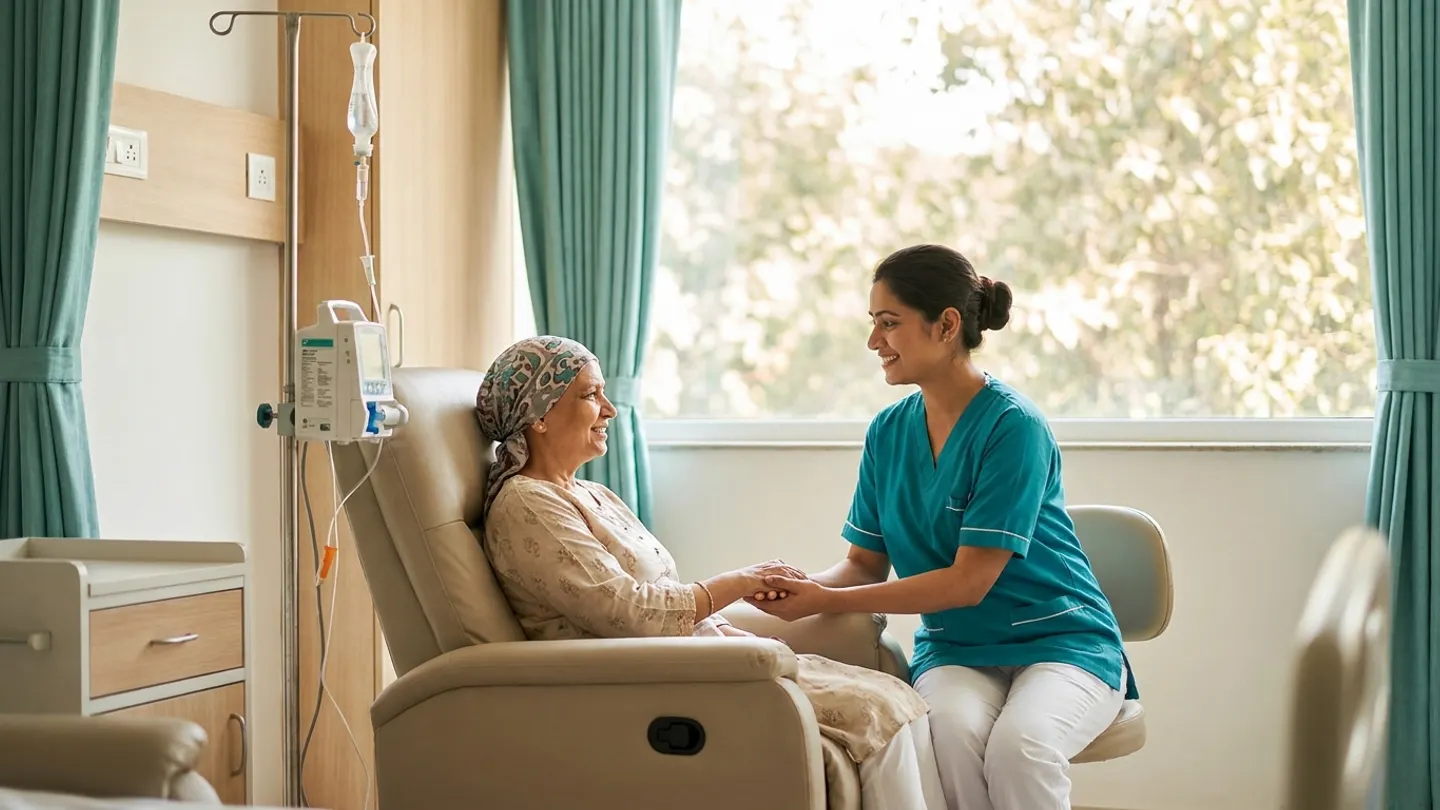
A cancer diagnosis turns your world upside down. The last thing you need is a treatment bill that does the same, or an NHS waiting list that stretches for months while you watch calendars and try not to lose hope.
Cancer Treatment India vs UK Cost: What UK Patients Are Paying in 2026
Cancer treatment in India costs approximately 60–80% less than equivalent private healthcare in the UK. A combination of surgery, chemotherapy, and targeted radiation therapy that might cost £60,000–£100,000 at a London private hospital is typically available at JCI-accredited cancer centres in India for £10,000–£25,000, with no insurance battles and the same international treatment protocols.
For UK patients, the reality has become a two-lane system: wait on the NHS, often 16–20 weeks or longer for complex oncology pathways to progress, or pay private UK prices that can quickly exceed a year’s salary. India has emerged as a credible third option, not because standards are lower, but because operating costs, currency differences, and a deep pool of specialist oncologists make the economics dramatically different. You can learn more about how this process works before making any decision.
The NHS Waiting List Reality in 2026
NHS cancer pathways have improved for urgent two-week-wait referrals, but complex cases involving multidisciplinary team (MDT) reviews, specialist surgeons, and combined treatment modalities can still take many weeks from referral to the start of actual treatment. For cancers where time matters, and most cancers do, that delay carries real clinical weight.
Patients who are told their condition is “not immediately life-threatening” sometimes find themselves waiting 14–20 weeks for surgery. In that same window, many patients treated in India are already in recovery. That gap is the core reason more UK patients are exploring this route in 2026.
What India’s Top Cancer Hospitals Actually Offer
This is not 1990s medical tourism. India’s leading oncology centres, accredited by the Joint Commission International (JCI) and the National Accreditation Board for Hospitals (NABH), operate robotic surgical suites, linear accelerators, PET-CT scanners, and molecular tumour boards. Oncologists at these hospitals frequently trained in the UK, USA, or Europe, and many publish in peer-reviewed international journals.
“I kept expecting to feel like I was in a budget facility. I never did. The technology was the same as what I had seen in a major UK teaching hospital, the nursing ratio was better, and I never once had to chase a test result.” — Representative experience of a UK patient who travelled to India for colorectal surgery followed by adjuvant chemotherapy. This is an illustrative composite, not a specific identifiable patient.
When you choose a properly accredited Indian cancer hospital, you can expect:
- A dedicated international patient department with English-speaking coordinators on-site
- Pre-travel tumour board review of your UK pathology reports and scan images
- The same FDA-approved and EMA-approved drugs used in UK private oncology (not unregulated substitutes)
- Robotic surgery systems for prostate, colon, and gynaecological cancers
- Stereotactic body radiation therapy (SBRT) and intensity-modulated radiation therapy (IMRT) for precise tumour targeting
- Psychological support and oncology nutrition counselling during inpatient stays
- Structured discharge summaries formatted for your UK GP or NHS oncology team
Cancer Treatment Costs: India vs UK Compared by Treatment Type
The table below uses indicative 2026 ranges. NHS treatment remains free at point of use; these comparisons are set against UK private costs, which is the relevant benchmark for patients trying to control their timeline or manage costs their NHS trust will not cover. For a fuller breakdown, see our treatments and costs page.
| Treatment | UK Private (approx.) | India Accredited Hospital (approx.) | Potential Saving |
|---|---|---|---|
| Breast cancer surgery and reconstruction | £20,000–£40,000 | £5,000–£12,000 | 60–75% |
| Prostate cancer (robotic surgery) | £18,000–£30,000 | £5,000–£9,000 | 65–80% |
| Chemotherapy course (6 cycles, standard) | £30,000–£60,000 | £6,000–£15,000 | 65–80% |
| Bone marrow transplant (allogeneic) | £150,000–£250,000 | £25,000–£45,000 | 75–85% |
| Lung cancer surgery (lobectomy) | £25,000–£45,000 | £7,000–£14,000 | 65–75% |
| Head and neck cancer (combined modality) | £40,000–£80,000 | £10,000–£22,000 | 65–75% |
| Radiation therapy (IMRT, 25 sessions) | £20,000–£35,000 | £4,000–£9,000 | 70–80% |
All figures are indicative ranges. Your exact costs depend on cancer type, stage, chosen hospital tier, and the personalised treatment plan drawn up by the oncology team. IndoMedTour provides written itemised quotes before you commit to anything.
Even after factoring in return flights from major UK airports (typically £500–£900 economy), accommodation for yourself and a companion near the hospital, and incidental travel costs, most patients save tens of thousands of pounds compared with going private in the UK. Many use part of that saving to stay an extra week in India to recover properly before the flight home.
Is It Safe to Get Cancer Treatment in India?
Safety is the right question, and the honest answer is: yes, at a properly accredited centre, with a few things worth knowing upfront.
JCI and NABH accreditation means hospitals are independently audited on infection control, patient safety protocols, surgical outcome tracking, and medication management. This is not a rubber stamp; it involves recurring on-site inspections against international standards. The same chemotherapy agents approved by the MHRA in the UK are administered at these hospitals under equivalent protocols. See our cancer and oncology treatment page for more on what to expect clinically.
The critical caveat is that not every hospital in India operates at this level. The gap between a top-tier cancer centre in Mumbai, Delhi, Chennai, or Bangalore and a smaller, unaccredited regional facility can be very significant. This is precisely why working with a facilitator who has vetted hospitals and tracks patient outcomes is important. You should not be choosing a cancer hospital from a Google search.
Travel fitness also matters. Patients in the middle of active systemic treatment, or with certain metastatic presentations affecting mobility or immune status, may not be medically cleared to fly. A free counselling call with the IndoMedTour team can help you establish whether your timing, stage, and fitness align before any planning begins.
Who Should Seriously Consider India for Cancer Care?
Going to India for oncology makes strong clinical and financial sense if you are:
- A newly diagnosed patient facing a long NHS wait for surgery or radiotherapy and unable to afford UK private rates
- Self-funded with a UK private quote exceeding £20,000 and looking for comparable quality at lower cost
- Seeking a second opinion from a specialist MDT before committing to your NHS treatment plan
- Pursuing targeted therapies or advanced robotic techniques not yet routinely available on the NHS
- Coordinating care for a parent or sibling in the UK who cannot manage the cost of going private
It is also worth knowing that many UK patients combine their India treatment with a quieter recovery period before flying home, then continue follow-up oncology care with their NHS or private GP in the UK using the detailed discharge documentation provided.
How the Journey Works
Most patients follow a straightforward sequence. First, you share your pathology reports, scan images, and referral letters with IndoMedTour. Indian oncologists then review your case and provide a written treatment recommendation and itemised cost estimate before you book any flights. You speak with the specialist team via a video call, ask every question you have, and compare what is being proposed with your UK options. Once you decide to proceed, the planning process begins: medical visa application, accommodation near the hospital, and airport transfers are all arranged. A dedicated IndoMedTour coordinator is present throughout your treatment, from hospital admission to discharge. You leave India with a full medical summary your UK doctors can use for ongoing care.
How IndoMedTour Helps
Book a free counselling call and our care team will listen to your diagnosis, your timeline concerns, and your budget before recommending anything at all. We match patients only to hospitals with verified JCI or NABH credentials and a documented track record in your specific cancer type. You receive written cost quotes with no surprises, and we manage your medical visa application, accommodation, and ground transfers. Your dedicated coordinator stays beside you from arrival in India through to the day you fly home, and remains reachable during your recovery. You bring the worry. We bring the plan.