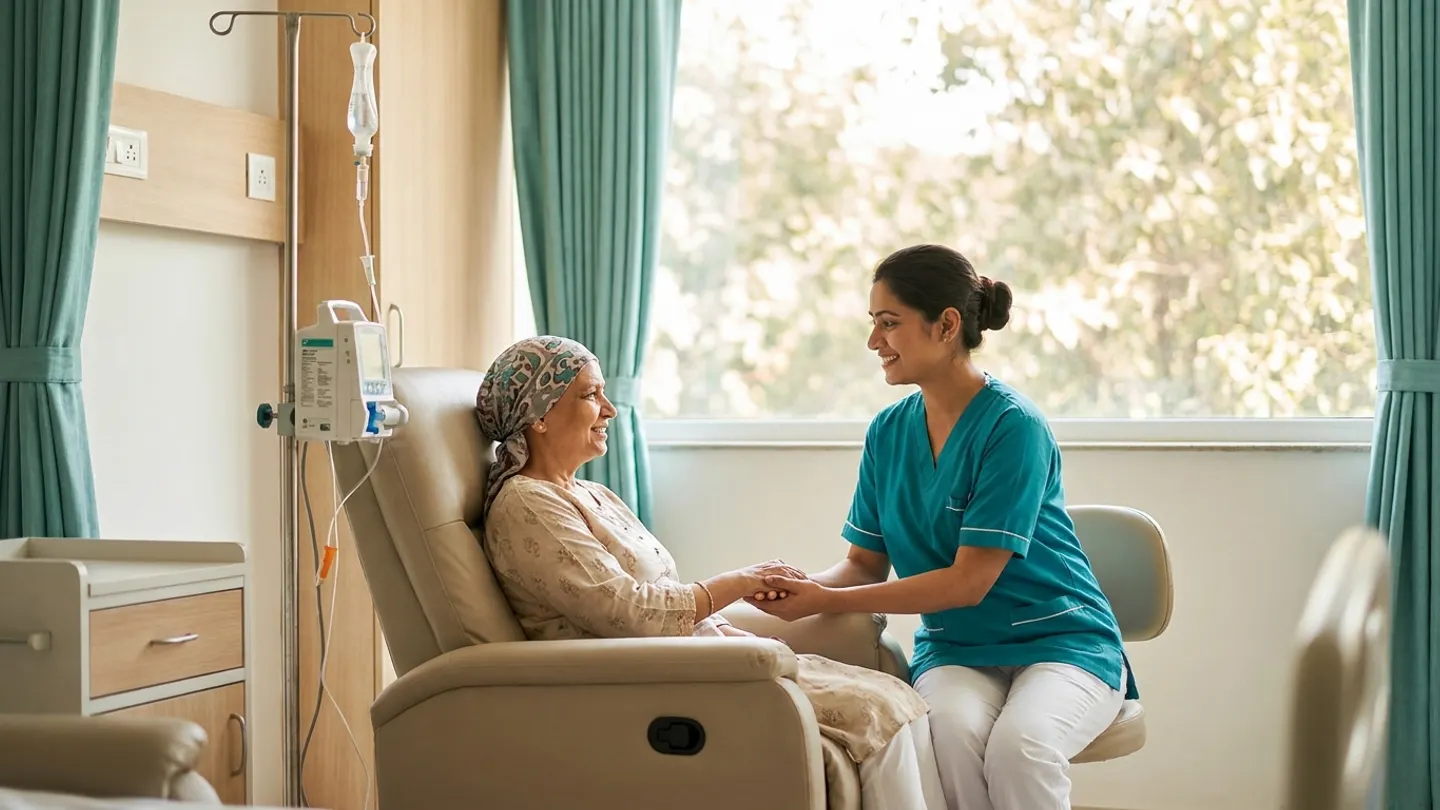
Facing a cancer diagnosis is frightening enough on its own. When the treatment bill arrives — or when your oncologist tells you there is a six-week wait just to start — the fear doubles. You deserve a clear, honest answer about your options.
What Does Chemotherapy Cost in India in 2026?
Chemotherapy cost in India in 2026 typically ranges from USD 300 to USD 1,500 per cycle, depending on the drug regimen, the hospital tier, and the city. For a full course of 4-8 cycles, most international patients spend between USD 2,000 and USD 10,000 in total — a fraction of what the same treatment costs in the United States, United Kingdom, Australia, or the UAE.
This is not a compromise in quality. India’s top cancer hospitals use the identical drug protocols published by the National Comprehensive Cancer Network (NCCN) and the European Society for Medical Oncology (ESMO). The difference is in the cost structure of the healthcare system, not in the standard of care delivered.
Why Is Chemotherapy So Much Cheaper in India?
The savings come from structural differences, not corners cut:
- Lower operating costs — salaries, real estate, and hospital administration cost a fraction of what they do in the West.
- Local pharmaceutical manufacturing — India is the world’s largest generic-drug producer, so many chemotherapy agents are available at a fraction of the branded Western price.
- Favourable exchange rates — for patients paying in USD, GBP, AUD, or AED, the Indian rupee stretches their budget significantly.
- Government pricing caps — India’s National Pharmaceutical Pricing Authority (NPPA) caps the price of many essential cancer drugs.
- Competition among JCI- and NABH-accredited hospitals — multiple world-class facilities compete for international patients, keeping prices transparent and reasonable.
“My oncologist in Canada said the drug I needed would cost me $14,000 CAD per cycle out of pocket. The same molecule, the same dosage, delivered in a JCI-accredited hospital in India, came to roughly $700 USD. The quality of care was better than I expected. I did not feel like I was cutting costs — I felt like I was being treated properly for the first time.” — Representative patient account; details are illustrative of common patient experiences, not a specific identifiable individual.
Chemotherapy Cost Comparison: India vs Other Countries (2026)
The table below shows indicative per-cycle costs for a standard intravenous chemotherapy session at an accredited hospital. Prices vary by drug, body surface area, protocol, and individual hospital.
| Country | Cost Per Cycle (Approx. USD) | Full Course — 6 Cycles (Approx. USD) |
|---|---|---|
| United States | USD 3,000 – 12,000 | USD 18,000 – 72,000+ |
| United Kingdom | USD 2,500 – 8,000 (private) | USD 15,000 – 48,000+ |
| Australia | USD 2,000 – 7,500 | USD 12,000 – 45,000+ |
| UAE | USD 1,500 – 5,000 | USD 9,000 – 30,000+ |
| India (Tier-1 city, JCI hospital) | USD 600 – 1,500 | USD 3,600 – 9,000 |
| India (Tier-2 city, NABH hospital) | USD 300 – 900 | USD 1,800 – 5,400 |
All figures are indicative ranges for 2026. Drug costs vary significantly by protocol (e.g., carboplatin/paclitaxel vs. trastuzumab-based regimens). Request a written quote for your specific protocol.
What Affects the Cost of Chemotherapy in India?
Not all chemotherapy is the same, and your individual quote will depend on several factors.
The Drug Protocol
The biggest cost variable is which drug — or combination of drugs — your oncologist prescribes. A basic carboplatin and paclitaxel regimen (common in lung, ovarian, and endometrial cancers) is far less expensive than a targeted therapy like trastuzumab (Herceptin) for HER2-positive breast cancer, or a checkpoint inhibitor like pembrolizumab (Keytruda) for immunotherapy. Even in India, targeted biologics and immunotherapy agents carry higher price tags, though still significantly lower than in the West.
Hospital Tier and City
India’s cancer hospitals fall into broad tiers:
- Tier 1 — JCI-accredited super-specialty hospitals in Delhi, Mumbai, Chennai, Hyderabad, and Bengaluru. These have the widest range of drugs, the most experienced oncologists, and the highest international-patient support infrastructure. Per-cycle costs sit at the higher end of the Indian range.
- Tier 2 — NABH-accredited regional hospitals in cities like Pune, Ahmedabad, Kolkata, and Kochi. Excellent oncology departments, lower costs, and less international-patient volume. Suitable for straightforward protocols.
Additional Treatment Components
A realistic chemotherapy budget for an international patient in India should also account for:
- Pre-chemotherapy tests (CBC, LFT, renal function, PET-CT or CT scan) — approximately USD 150 to USD 500 per round
- Anti-nausea and supportive medications — approximately USD 50 to USD 200 per cycle
- Hospitalization (for inpatient infusion protocols) — approximately USD 80 to USD 250 per night
- Oncologist consultation fees — approximately USD 50 to USD 150 per visit
- Accommodation near the hospital for the duration of treatment
Is the Quality of Chemotherapy in India International Standard?
Yes — and this is worth saying clearly, because it is the question that matters most. India’s leading cancer centres hold JCI (Joint Commission International) accreditation and NABH accreditation, the same benchmarks used to evaluate hospitals in the United States and Europe. Treatment protocols follow NCCN and ESMO guidelines. Many senior oncologists completed postdoctoral fellowships at institutions in the US, UK, Germany, or Australia before returning to practice in India.
What you will not find at an accredited hospital in India is a shorter consultation, a less experienced oncologist, or inferior drugs because of your budget. What you will find is a lower invoice.
Planning Your Chemotherapy Trip to India: A Practical Checklist
Before you travel, make sure you have:
- A confirmed diagnosis and pathology reports (tumour type, stage, receptor status, genomic markers if available)
- Your complete medical records and recent imaging (CT, PET-CT, MRI, or X-ray with reports)
- A list of any chemotherapy you have already received (drug names, doses, dates)
- A written treatment recommendation from your home oncologist or a second opinion
- A valid passport with at least six months of validity remaining
- A medical visa (India’s e-Medical Visa is available online for most nationalities)
- Travel insurance that covers cancer treatment abroad
- A companion or caregiver — most hospitals welcome and accommodate one
How Many Cycles Will I Need, and Should I Plan to Stay in India?
The number of cycles depends entirely on your cancer type, stage, and protocol. Breast cancer adjuvant chemotherapy is commonly 4-6 cycles. Lung cancer or ovarian cancer protocols often run 6 cycles. Some regimens are given every 21 days; others weekly.
Most international patients plan for one of two approaches:
- Stay for the full course — rent a serviced apartment or use hospital-affiliated accommodation for 3-5 months. This is cost-effective and avoids the disruption of repeated long-haul travel.
- Cycle travel — fly to India for each 3-4 week cycle, return home in between. This works well for patients with obligations at home, though airfare adds to the total cost.
Your IndoMedTour coordinator will help you plan a realistic schedule once your protocol is confirmed.
What About Chemotherapy Combined With Other Treatments?
Many patients need chemotherapy alongside surgery, radiation therapy, targeted therapy, or immunotherapy. India’s top cancer hospitals offer all of these under one roof, and the cost savings extend across the full treatment pathway. If you need an operation before or after chemo, you can read more about indicative costs on our cancer and oncology treatments page or explore our treatments and costs overview.
For patients with specific needs — bone marrow transplant alongside chemotherapy, for example — our organ transplant page covers the combined planning process.
How IndoMedTour Helps
Getting a cancer diagnosis is not the time to spend hours researching hospitals on your own. IndoMedTour offers a free counselling call where one of our care team members — not a salesperson — listens to your diagnosis, your concerns, and your timeline. We then match you with two or three shortlisted JCI- or NABH-accredited oncology teams, obtain written cost estimates for your specific drug protocol, and help you secure your medical visa, airport transfers, and accommodation. A dedicated coordinator stays beside you through every infusion, every scan result, and every follow-up appointment — and remains available to your home oncologist for handover notes when you return. You bring the worry. We bring the plan.
Learn more about how it works or book your free call today.