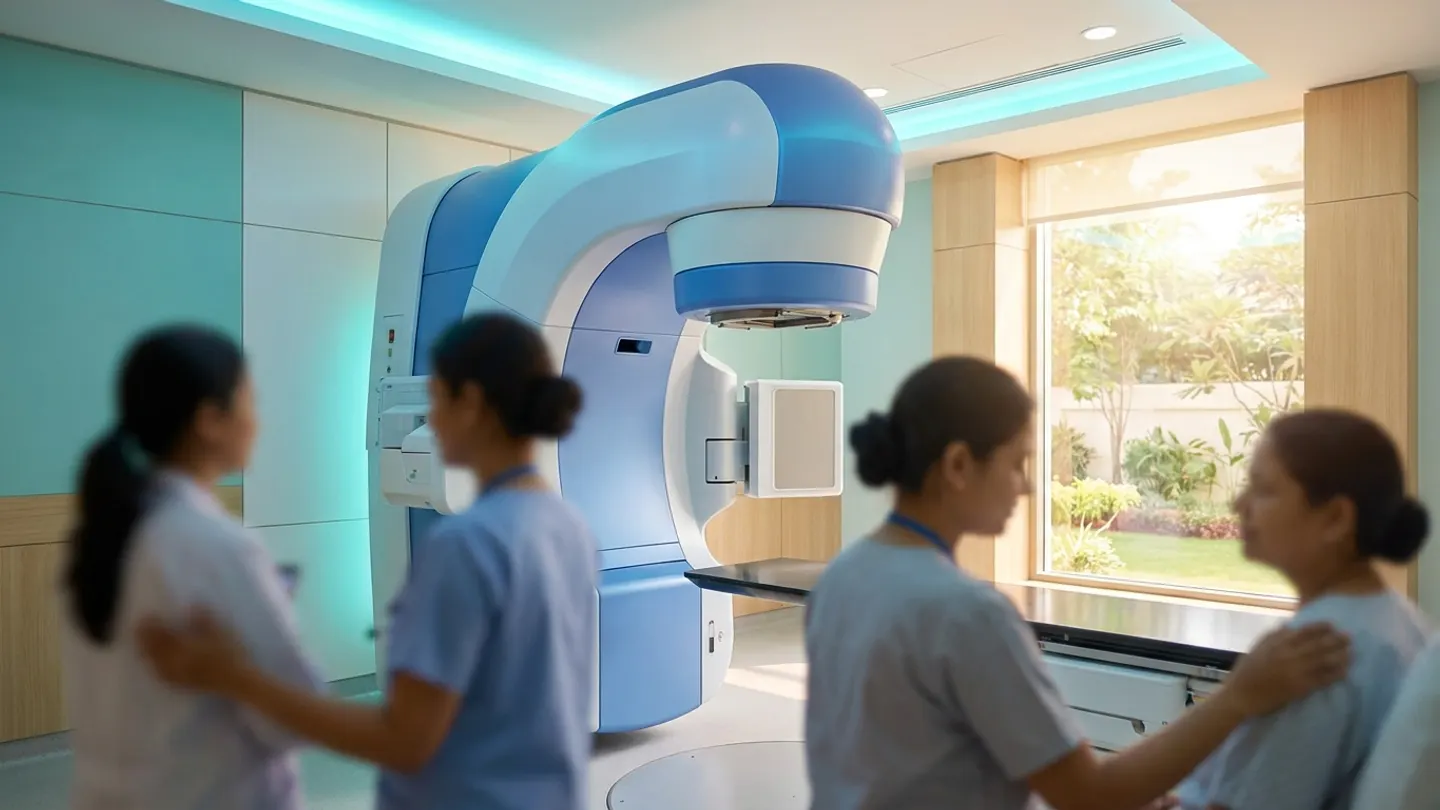
Hearing that you or someone you love needs radiosurgery is frightening enough. Then comes the cost estimate from a hospital at home — or the wait-list letter telling you it will be months before treatment starts. Both of those feel impossible. There is a third path worth knowing about.
CyberKnife Treatment Cost in India: What You Will Actually Pay
CyberKnife radiosurgery in India costs approximately $3,000 to $9,000 USD for a complete course of treatment for international patients, all-in. That figure covers the treatment planning scan (CT/MRI simulation), the radiation oncology team’s fee, the machine time across all fractions, and standard follow-up before you travel home. The equivalent course in the United States typically runs $30,000 to $100,000 or more; in the United Kingdom, Australia, and the UAE it ranges from $15,000 to $50,000. The savings are not because standards are lower — they reflect lower operational costs, lower medical labour costs, and a government priority on keeping healthcare affordable.
Price Comparison: CyberKnife Treatment Costs by Country (2026)
| Country | Indicative Cost (USD) | Typical Wait Time |
|---|---|---|
| India | $3,000 – $9,000 | 1–2 weeks |
| United States | $30,000 – $100,000+ | 2–6 weeks |
| United Kingdom (NHS) | Covered, but wait-listed | 4–16 weeks |
| United Kingdom (private) | $18,000 – $45,000 | 1–3 weeks |
| Australia | $15,000 – $40,000 | 2–8 weeks |
| UAE / Dubai | $12,000 – $35,000 | 1–3 weeks |
| Thailand | $8,000 – $18,000 | 1–2 weeks |
All figures are indicative ranges for 2026 and may vary based on tumour type, number of fractions, and individual hospital pricing. Ask for a written quote before making any decisions.
What Is CyberKnife and Why Does It Cost What It Does?
CyberKnife is a robotic radiosurgery system that delivers highly focused beams of radiation to a tumour from hundreds of different angles, guided in real time by image-tracking software. Unlike conventional radiotherapy, which typically requires 20 to 35 daily sessions, CyberKnife often completes a full course in just one to five fractions. There is no incision, no general anaesthesia in most cases, and no hospital admission — patients walk in and walk out each day.
The machine itself costs several million dollars to purchase and maintain, which is why the treatment carries a premium even in India. However, that premium is priced at a fraction of what Western hospitals charge, because the underlying hospital infrastructure, staffing, and administrative overhead in India are fundamentally different.
Conditions Commonly Treated with CyberKnife in India
CyberKnife is used for a wide range of cancerous and non-cancerous conditions, including:
- Brain tumours (primary and metastatic)
- Acoustic neuroma (vestibular schwannoma)
- Spinal tumours and spinal metastases
- Prostate cancer (localised, low-to-intermediate risk)
- Lung cancer (early-stage, or oligometastatic)
- Liver and pancreatic tumours
- Arteriovenous malformations (AVMs)
- Trigeminal neuralgia
- Head and neck cancers (selected cases)
If your oncologist has suggested stereotactic radiosurgery (SRS) or stereotactic body radiotherapy (SBRT) as the preferred approach, CyberKnife is one of the leading technologies to deliver it.
What Affects the Final Cost?
Within the $3,000 to $9,000 range, several factors push the figure up or down.
Number of fractions. A single-fraction brain treatment for a small acoustic neuroma sits at the lower end. A five-fraction spinal or prostate course with more complex planning sits higher.
Tumour complexity. A small, well-defined lesion in an accessible location requires less machine time and simpler planning than a large, irregular, or moving target (such as a lung tumour requiring respiratory-gating).
Pre-treatment imaging. High-resolution MRI fusion for brain cases, 4D-CT for lung cases, or PET-CT for staging can each add $300 to $800 to the planning cost.
Hospital tier. A JCI-accredited cancer institute in Mumbai or Delhi typically charges more than a well-run NABH hospital in Hyderabad or Pune — both are excellent; the difference reflects location, brand, and room standards, not clinical safety.
Additional consultations. Oncology team review, neurosurgery consult for brain lesions, or a tumour board discussion before treatment begins are sometimes billed separately.
“The most important question to ask your Indian hospital is not ‘what is the machine charge?’ but ‘what does the all-in price include?’ A written itemised quote protects you from surprises and makes it possible to compare hospitals fairly.” — IndoMedTour Care Team
Quality and Accreditation: What to Look For
India’s top cancer hospitals operate Accuray CyberKnife VSI and M6 systems — the same platforms found at major cancer centres in the United States and Europe. What matters is not just the machine but the team around it: a board-certified radiation oncologist, a medical physicist who certifies the treatment plan, and a radiotherapy technician who runs daily quality assurance checks.
When evaluating any hospital for CyberKnife treatment, look for:
- JCI accreditation (Joint Commission International) or NABH accreditation — these are the internationally recognised quality benchmarks for Indian hospitals
- A dedicated tumour board that reviews complex cases
- A certified medical physicist on staff (not outsourced)
- Onsite MRI or CT simulation capability
- A clear written treatment plan shared with your home oncologist
Many hospitals in India will share the treatment plan digitally with your referring doctor abroad, so your care team at home remains informed throughout.
The Journey: What to Expect as an International Patient
Understanding the timeline helps remove the anxiety of the unknown.
Week one — planning. You arrive in India and complete a simulation scan (CT with or without MRI fusion). The radiation oncology team, often in a tumour board session, designs your treatment plan. This takes two to four days. You are not receiving radiation yet.
Week one to two — treatment. Depending on the number of fractions, treatment days begin. Each session typically lasts 30 to 90 minutes in the treatment room, though you will feel nothing during delivery. Most patients return to the hotel or a serviced apartment between sessions.
Post-treatment review. Before you fly home, the oncologist reviews your imaging and wellbeing. You receive a full discharge summary and digital copy of treatment records to share with your home team.
Follow-up. Response to CyberKnife — particularly for brain lesions — is evaluated at three to six months post-treatment with imaging. Indian hospitals offering telemedicine consultation can review these scans remotely, so you do not need to return to India unless your condition changes.
Is CyberKnife in India Right for You?
CyberKnife is a specialised tool with specific indications. It is not the right treatment for every cancer or every patient. Your suitability depends on tumour size, location, histology, and prior treatment history. The honest answer is that a consultation with a qualified radiation oncologist — reviewing your existing scans and pathology — is the only way to know.
What India offers is the ability to get that consultation, a written treatment plan, and a firm cost quote quickly and affordably. Many patients who come to IndoMedTour for CyberKnife have already spoken to oncologists at home, know they are candidates, and simply cannot afford or cannot wait for the treatment where they live.
Explore more about our cancer treatment options or read about how the process works from first contact to flying home. You can also browse our accredited hospital network to understand which centres carry CyberKnife capability, or read success stories from patients who have been through this exact journey. For a detailed breakdown of what your specific situation might cost, visit our treatments and costs page.
How IndoMedTour Helps
When you reach out to us, a care coordinator with oncology experience will speak with you for free, review the diagnosis documents you share, and match you with two or three accredited hospitals that have the CyberKnife capability and team suited to your case. We obtain written, itemised quotes from each centre so you can compare them honestly, and we arrange a virtual consultation with the radiation oncologist before you commit to anything. Once you decide to travel, we handle your medical visa paperwork, airport transfer, accommodation near the hospital, and translation support — and your dedicated coordinator stays beside you from the day you land until the day you fly home safely. Book your free counselling call to start the conversation today.
You bring the worry. We bring the plan.