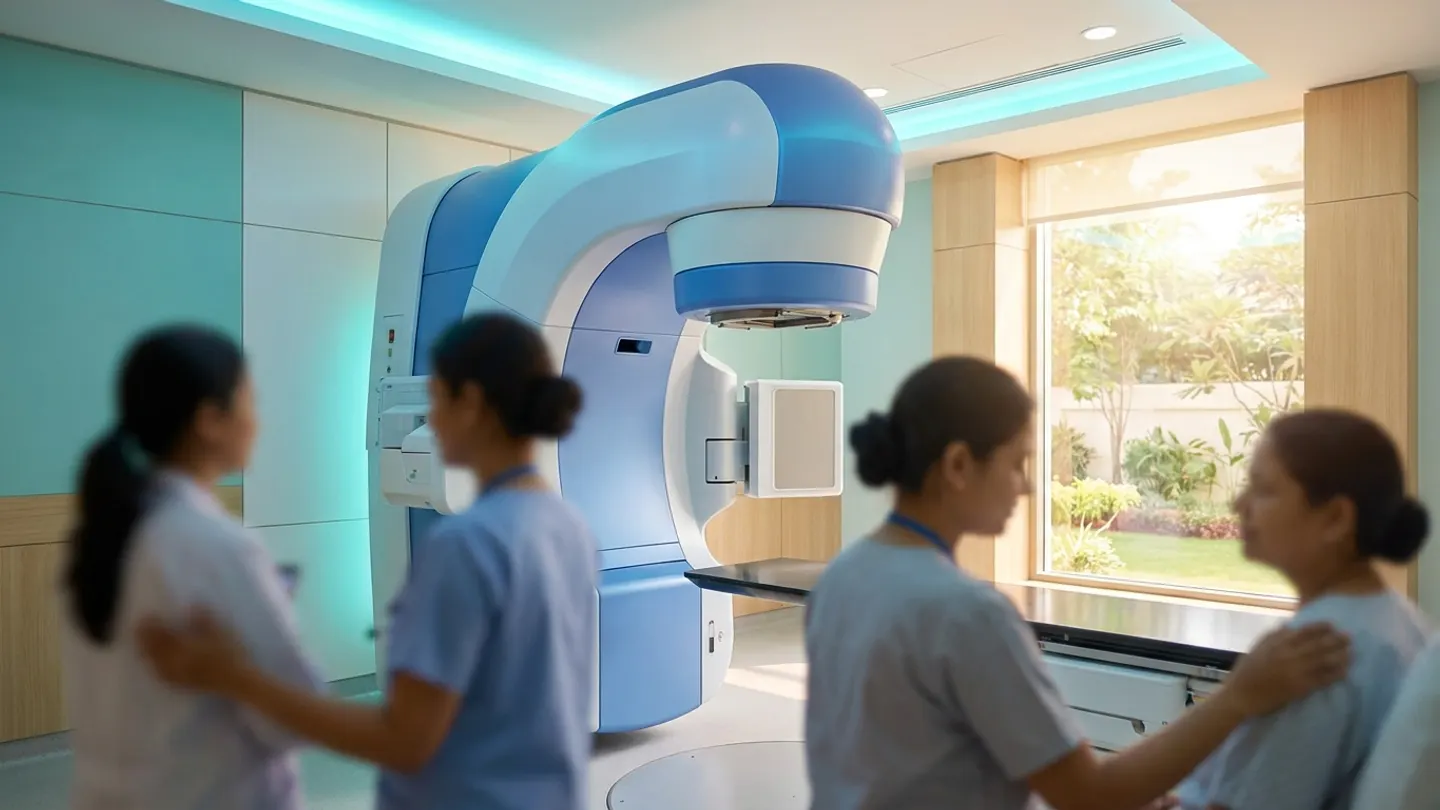
Hearing that you need gamma knife radiosurgery is frightening enough. Then the cost estimate arrives from your home hospital or insurance provider, and the financial shock can feel just as overwhelming as the diagnosis itself. If you are reading this because someone you love needs this treatment and you cannot afford months on a waiting list or a bill that could empty your savings, you are in exactly the right place.
What Is Gamma Knife Radiosurgery, and Why Are Patients Choosing India?
Gamma knife radiosurgery cost in India typically starts from approximately $4,000 and rarely exceeds $8,000 for a single session, making it four to ten times more affordable than the same procedure in the United States, United Kingdom, or Australia. Despite the dramatic price difference, India’s top neuroscience centres use the identical Leksell Gamma Knife technology found in Western hospitals and are staffed by neurosurgeons trained at international institutions.
Gamma knife radiosurgery is not surgery in the traditional sense. It is a non-invasive treatment that delivers precisely focused beams of radiation to a small target inside the brain or skull base, leaving surrounding healthy tissue largely unaffected. There is no incision, no general anaesthesia, and no extended hospital stay. Most patients go home the same day and return to normal activity within a day or two. That combination of precision, safety, and speed is why it has become one of the most requested procedures among international patients travelling to India for cancer and oncology care and neurosurgery or spine treatment.
Gamma Knife Radiosurgery Cost in India: 2026 Price Guide
The table below shows indicative costs for common indications. Prices are approximate and in US dollars; they may vary depending on the hospital, city, and individual treatment plan.
| Condition Treated | Indicative Cost in India (USD) |
|---|---|
| Brain metastases (single target) | $4,000 – $5,500 |
| Brain metastases (multiple targets) | $5,500 – $8,000 |
| Acoustic neuroma (vestibular schwannoma) | $4,500 – $7,000 |
| Meningioma (small to medium) | $4,500 – $7,500 |
| Arteriovenous malformation (AVM) | $5,000 – $8,000 |
| Trigeminal neuralgia | $4,000 – $6,000 |
| Pituitary adenoma | $4,500 – $7,000 |
| Recurrent glioma (focal) | $5,500 – $8,500 |
All figures are indicative starting points and should be confirmed with a written quote from your treating centre. See treatments and costs for a broader overview of what India’s hospitals offer.
What Affects the Total Price?
Several variables move the final number up or down:
- Number of isocentres and targets. Treating multiple separate lesions in one session increases machine time and planning complexity.
- Pre-treatment imaging. A dedicated stereotactic MRI or CT-angiogram is essential for planning and adds to the overall cost if not already done.
- Condition complexity. An irregularly shaped AVM or a tumour close to critical structures demands more time from the physics and dosimetry team.
- Hospital tier and city. Tier-1 centres in Delhi, Mumbai, Chennai, or Hyderabad may charge modestly more than newer centres in other cities, though all should meet the same safety standards if JCI or NABH accredited.
- Consultant neurosurgeon fee. This is sometimes billed separately from the procedure cost.
- Accommodation and nursing observation. Most gamma knife patients do not need overnight admission, but some centres include a half-day observation bed in the package.
Always ask for an itemised written quote before travelling. A reputable hospital will provide one based on your imaging and reports within 48 to 72 hours.
India vs the World: Cost Comparison for Gamma Knife Radiosurgery
| Country | Approximate Cost per Session (USD) | Typical Wait Time |
|---|---|---|
| India | $4,000 – $8,500 | 1 – 3 weeks |
| United States | $25,000 – $55,000 | 2 – 6 weeks (insured) |
| United Kingdom (private) | $18,000 – $35,000 | 3 – 8 weeks |
| Australia | $15,000 – $30,000 | 4 – 10 weeks |
| UAE | $12,000 – $22,000 | 1 – 4 weeks |
| Thailand | $8,000 – $14,000 | 1 – 3 weeks |
Even accounting for flights, hotel, and ground transport, most international patients save between 60% and 80% by choosing India over the US or UK. For a family accompanying a patient, that saving can fund months of post-treatment recovery at home.
Conditions Gamma Knife Treats at Indian Neuroscience Centres
India’s gamma knife programmes cover a wide spectrum of indications, including:
- Primary and secondary brain tumours (metastases from lung, breast, colon, kidney, and melanoma)
- Benign skull-base tumours such as acoustic neuromas, meningiomas, and pituitary adenomas
- Arteriovenous malformations (AVMs) and cavernous malformations
- Trigeminal neuralgia and other functional disorders
- Recurrent or residual gliomas where conventional re-irradiation is not suitable
- Selected cases of uveal (eye) tumours when combined with ophthalmic planning
If you are uncertain whether your diagnosis qualifies, an online counselling call with our team can help clarify this before you commit to travel.
Quality You Can Trust: JCI and NABH Accreditation
The single most important reassurance for any patient coming to India is independent third-party accreditation. JCI (Joint Commission International) and NABH (National Accreditation Board for Hospitals and Healthcare Providers) are the two gold standards. A JCI-accredited hospital in India has met the same patient-safety criteria used to evaluate hospitals in the United States, and NABH is the Indian equivalent recognised by the International Society for Quality in Health Care (ISQua).
Before you choose any centre, confirm that it holds active JCI or NABH accreditation. This protects you across infection control, equipment maintenance, credentialing of staff, and emergency protocols. Our vetted network at our hospitals includes only accredited centres with active gamma knife programmes.
“I had an acoustic neuroma the size of a small grape pressing on my facial nerve. Back home, the wait for gamma knife was four months and the quote was $40,000 after insurance gaps. In India, I was treated within three weeks, paid just over $6,000 all-in, and my facial nerve was spared. I was back at work in five days.” — Patient representative account; details are illustrative and do not identify any specific individual.
What Your Gamma Knife Package in India Typically Includes
Most established neuroscience centres bundle the following into their quoted price:
- Pre-treatment neurosurgery and radiation oncology consultation
- Stereotactic frame fitting or frameless mask fabrication (depending on protocol)
- Dedicated high-resolution planning MRI or CT (if not already available)
- Dosimetry planning by a medical physicist
- The gamma knife treatment session itself
- Post-treatment monitoring and same-day discharge
- One follow-up teleconsultation at four to six weeks
Usually billed separately:
- International airport transfer and in-country transport
- Hotel accommodation for accompanying family members
- Visa assistance fees
- Travel insurance
Ask your hospital and facilitator for an all-in estimate rather than just the procedure cost. How it works explains the full process from enquiry to return flight.
Practical Steps for International Patients
Planning gamma knife treatment abroad is simpler than most people expect once you have the right support. Here is a realistic timeline:
- Gather your records. Recent MRI or CT images (ideally within three months), the radiology report, any biopsy or pathology results, and a letter from your current treating neurologist or oncologist.
- Request written opinions. Send your files to two or three accredited Indian centres through a medical facilitator. Compare their treatment recommendations alongside the cost, not just the price tag alone.
- Book a direct teleconsultation. Speaking to the neurosurgeon before you travel removes uncertainty and lets you ask hard questions about targets, dosing rationale, and expected outcomes.
- Plan your travel window. Allow five to seven days in India: two days pre-treatment for the planning MRI, one treatment day, and two buffer days for rest and a post-treatment review.
- Arrange a local escort. Even though you will feel well enough to walk out of the treatment room, having a family member or friend with you for the first 24 hours is strongly advisable.
You can also explore success stories from patients who have made this journey and come back with positive outcomes.
How IndoMedTour Helps
IndoMedTour offers every patient a free, no-obligation counselling call to talk through their diagnosis, discuss which JCI or NABH-accredited centres specialise in their specific condition, and request itemised written quotes from multiple hospitals so you can compare options fairly. Once you decide to proceed, we handle visa invitation letters, airport transfers, hotel arrangements near the hospital, and a dedicated coordinator who stays with you from the morning of your planning scan through to discharge. We also follow up with your home oncologist on your behalf to ensure continuity of care after you return. You bring the worry. We bring the plan.
Book your free counselling call today and take the first step toward treatment that your family can actually afford.