You’ve been told you need a bone marrow transplant, but there is no perfectly matched donor in your family or on any registry. That news can feel like a door slamming shut. The good news is that another door has opened — and for many patients around the world, it leads to India.
Haploidentical (half-matched) transplantation has transformed blood cancer treatment over the past decade. It means that a parent, child, or sibling — who shares roughly 50% of your tissue type — can now donate safely, thanks to modern graft engineering. India has embraced this technique rapidly, and its combination of technical expertise, significantly lower costs, and short waiting times makes it an increasingly realistic option for international patients.
What is haploidentical bone marrow transplant and who does it suit?
A haploidentical bone marrow transplant in India typically costs between $18,000 and $35,000 USD for the complete treatment episode — roughly 60–75% less than the same procedure in the United States or United Kingdom. The procedure uses stem cells from a half-matched family member (a ‘haplo’ donor), overcoming the biggest barrier in transplantation: finding a 10/10 HLA-matched donor.
It is particularly suited to patients who:
- Have acute leukaemia (AML or ALL), myelodysplastic syndrome, aplastic anaemia, or certain lymphomas
- Have no fully matched sibling donor
- Are not matched on unrelated donor registries, which disproportionately affects patients from South Asian, African, Middle Eastern, or mixed-heritage backgrounds
- Need a transplant urgently and cannot wait months for a registry search
- Have had a previous transplant that failed and need a second procedure
How haploidentical differs from matched sibling or unrelated donor transplant
In a conventional allogeneic transplant, doctors seek a donor who matches your HLA type at 10 out of 10 genetic markers. Finding such a donor outside close family is difficult for many ethnicities, and even within registries the wait can stretch to three to six months.
A haploidentical donor matches at only 5 of 10 markers, but modern conditioning regimens — especially the post-transplant cyclophosphamide (PTCy) approach pioneered at Johns Hopkins and now widely adopted in India — have brought rates of serious graft-versus-host disease (GVHD) down to levels comparable with matched transplants. The result is that nearly every patient has at least one suitable haploidentical donor available immediately.
Haploidentical bone marrow transplant cost in India vs other countries
The table below shows indicative, all-inclusive cost ranges for 2026. Figures cover hospital stay, conditioning chemotherapy, stem cell harvest and infusion, engraftment monitoring, and standard post-transplant medications for approximately 30 days in-hospital. Costs exclude flights, accommodation outside hospital, and extended immunosuppression after discharge.
| Country | Approximate Total Cost (USD) |
|---|---|
| United States | $200,000 – $400,000 |
| United Kingdom | $120,000 – $200,000 |
| Australia | $100,000 – $180,000 |
| UAE / Dubai | $70,000 – $120,000 |
| India (JCI/NABH centre) | $18,000 – $35,000 |
Prices are indicative and depend on disease complexity, donor logistics, conditioning intensity, and the hospital tier chosen. See treatments and costs for current written quotes.
Why India for haploidentical BMT?
Quality and accreditation
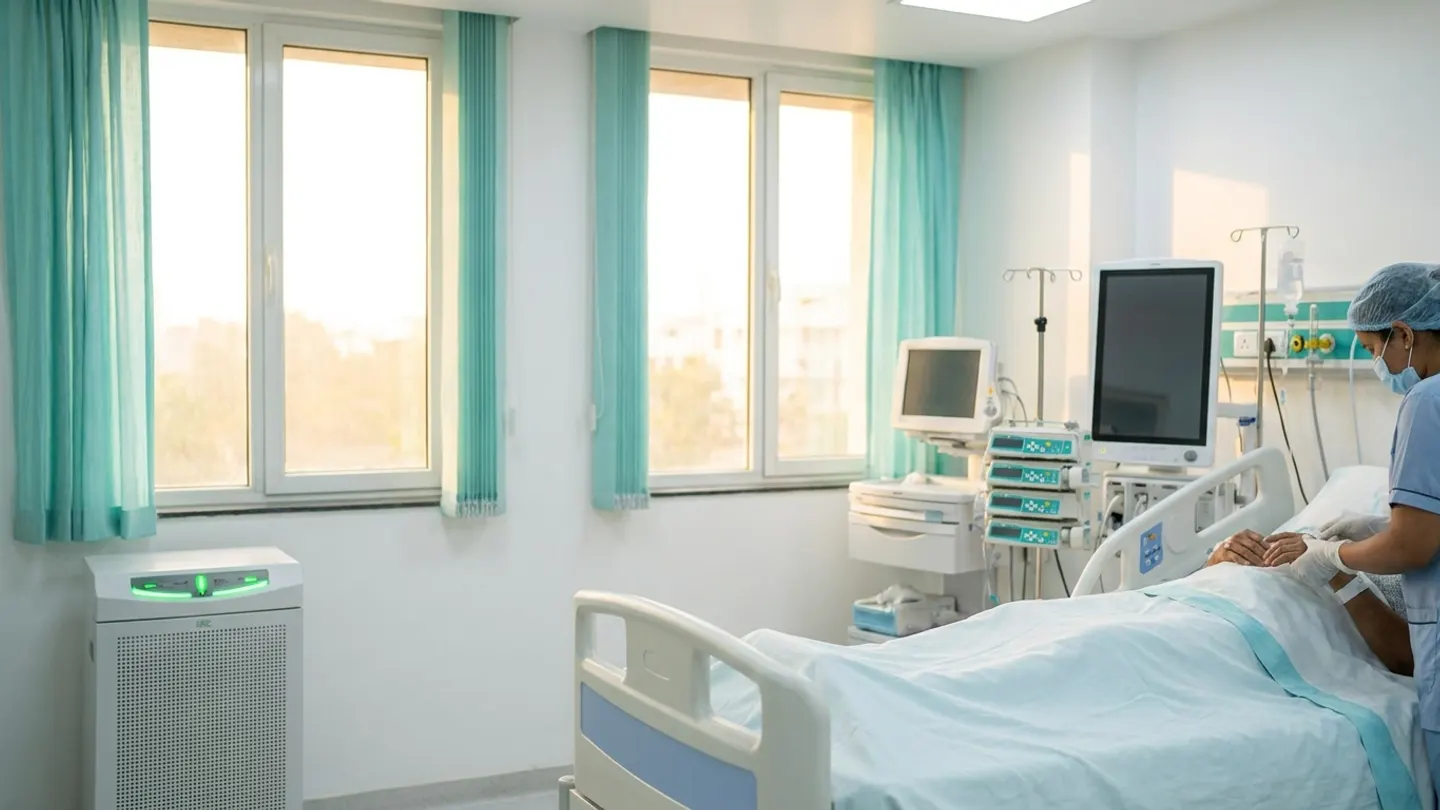
India’s top transplant programmes operate dedicated bone marrow transplant units with HEPA-filtered laminar-airflow rooms, 24-hour intensivist cover, and pharmacies stocked with the full range of antifungals, antivirals, and immunosuppressants required post-transplant. The quality benchmark to look for is JCI or NABH accreditation — these are internationally recognised standards that govern infection control, nursing ratios, medication safety, and clinical governance. IndoMedTour works only with accredited centres; explore our hospitals to see the full panel.
The donor advantage that makes India special
For many international patients, the haploidentical route is not a compromise — it is the only route. Donor registries in countries like India, Nigeria, Saudi Arabia, and Bangladesh contain very few entries for non-European HLA types, which means a matched unrelated donor search is often futile. A haploidentical parent or sibling, by contrast, is biologically almost certain to be available. Clinicians in India are experienced at coordinating international donor travel: the donor typically arrives three to four days before the harvest, undergoes G-CSF injections to mobilise stem cells, and the peripheral blood stem cell (PBSC) collection takes place in an apheresis unit on site.
“We were told no registry match existed anywhere in the world for our son. Within two weeks of contacting IndoMedTour, we had a transplant date confirmed in India using his father as a haploidentical donor. We never knew this was possible.” — Representative patient experience, composite for illustrative purposes.
What does the treatment journey actually involve?
Here is a general sequence for an international patient undergoing haploidentical BMT in India:
- Pre-travel: Share medical records with IndoMedTour for a remote oncology review. Receive written cost estimate and hospital shortlist within 48 hours.
- Arrival and work-up (Days 1–7): Bone marrow biopsy confirmation, organ function tests, infectious disease screening, and HLA re-confirmation for donor.
- Conditioning chemotherapy (Days –7 to –1): High-dose chemotherapy (and sometimes total body irradiation) to ablate your existing marrow and suppress immunity.
- Stem cell infusion — Day 0: Donor stem cells, collected by apheresis the same morning, are infused intravenously in a 1–4 hour procedure.
- Engraftment and post-transplant cyclophosphamide (Days +3 to +4): PTCy is administered to eliminate donor T-cells that cause acute GVHD before they establish.
- Monitoring through engraftment (Days +10 to +30): Daily blood counts, infection surveillance, transfusion support, and gradual introduction of immunosuppression.
- Discharge and outpatient phase (Days +30 to +100): Patients typically stay within 30–45 minutes of the hospital for three months, attending clinic two to three times per week.
- Clearance to travel home: Usually possible after Day +90 to +100, subject to engraftment confirmation and no active GVHD.
Risks, GVHD, and what India’s centres do to manage them
No transplant is without risk, and honest information matters more than reassurance. The main risks in haploidentical BMT are:
- Acute GVHD: Donor immune cells attacking the patient’s tissues. The PTCy platform has reduced severe (Grade 3–4) acute GVHD rates to approximately 10–15% in most published series — comparable to matched transplants.
- Graft failure: The donor cells fail to engraft. This is uncommon (typically less than 5–10%) but requires a rescue strategy.
- Infection: The long period of immune suppression creates vulnerability to bacterial, fungal, and viral infections. Dedicated BMT units with strict isolation protocols and prophylactic antifungals are essential.
- Relapse: The underlying disease can return. Haploidentical transplant carries a beneficial graft-versus-leukaemia (GVL) effect, meaning donor immune cells actively attack residual cancer cells.
Ask any centre you consider for their published or audited outcomes data — engraftment rate, 100-day mortality, and two-year overall survival by disease type. Reputable programmes share this openly.
How long will you need to stay in India?
Plan for a minimum of 100 days in-country from your first admission date. This is the period of highest risk for GVHD, infection, and graft failure. Most patients spend approximately 30–45 days as an inpatient, then move to a furnished service apartment near the hospital for the outpatient phase. India’s main transplant cities — Chennai, Delhi NCR, Mumbai, Hyderabad, and Bengaluru — all have well-established medical-stay accommodation options at a fraction of Western hotel costs, many with full kitchens for dietary management.
For family members accompanying the patient, India offers a compelling combination: world-class medical care in cities with international connectivity, English-speaking staff, and daily costs for food and accommodation that are dramatically lower than equivalent cities in the US, UK, or Australia. Learn more at how it works.
How IndoMedTour helps
From the moment you make a free counselling call, a dedicated coordinator takes ownership of your journey. We review your records with our transplant oncology panel, match you to the most appropriate JCI- or NABH-accredited centre for your disease and donor situation, and send you a written cost quote — with no obligation. We handle your medical visa documentation, coordinate donor travel, and arrange airport transfers and accommodation near the hospital. Your coordinator is available on WhatsApp and phone throughout the conditioning, transplant, and recovery phases, and liaises directly with the clinical team on your behalf. Read success stories from patients who have been through this journey, and explore organ transplant options for a broader overview of what India offers.
You bring the worry. We bring the plan.