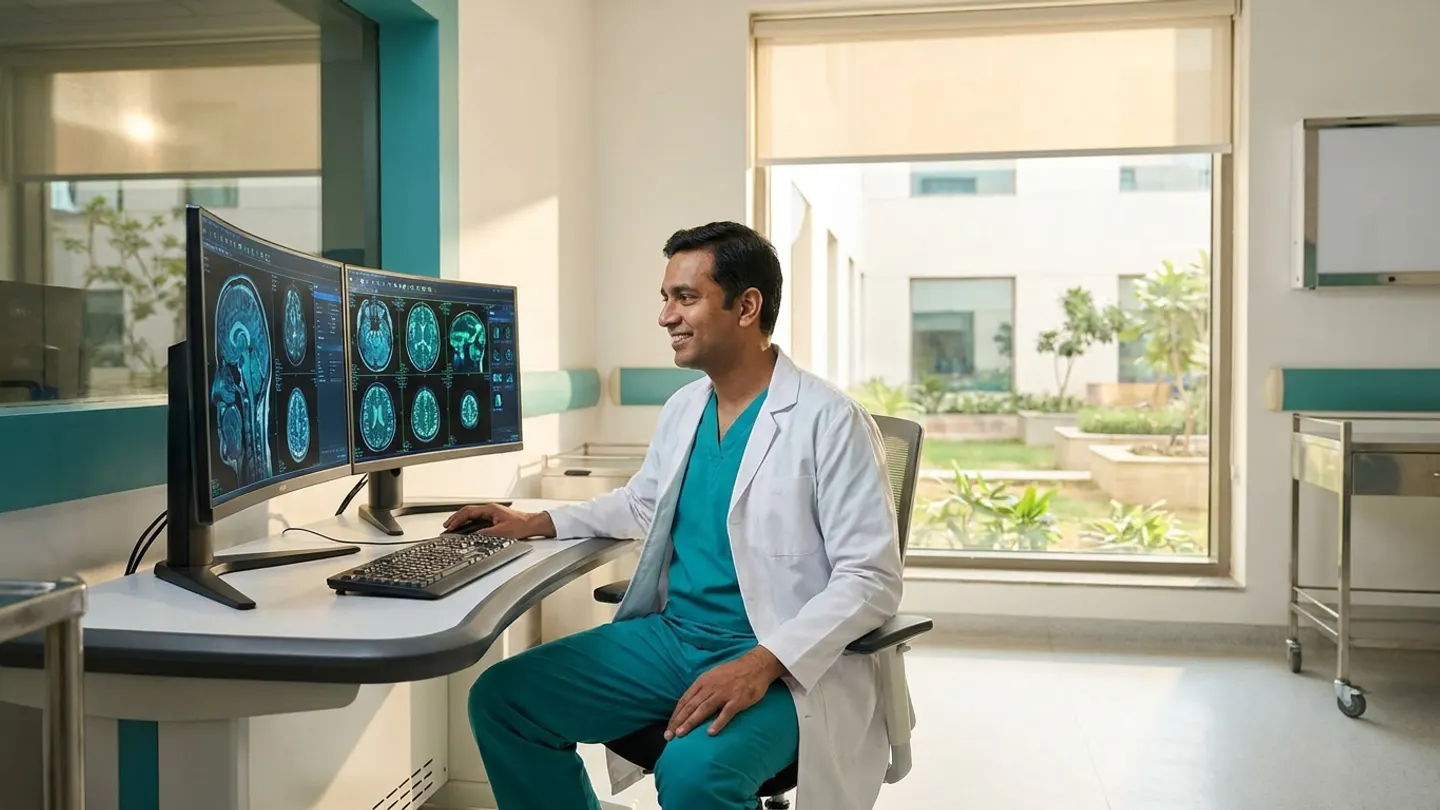
Facing brain surgery is one of the most frightening moments a patient and their family can go through. If you have arrived here comparing a daunting quote from your home country against what India might offer, you are already making a courageous and practical choice.
How to Plan Brain Surgery in India: The Essential Overview
How to plan brain surgery in India follows a clear, manageable sequence: gather your medical records, receive remote specialist opinions from accredited hospitals, select a JCI or NABH-certified neurosurgery centre, apply for a medical visa, travel, undergo surgery, complete your recovery in India, and fly home with a detailed follow-up plan. For most patients, the entire process from first inquiry to discharge takes between four and eight weeks.
India has built some of the world’s most capable neurosurgery programmes. The technology in use at top Indian hospitals, including neuro-navigation, intraoperative MRI, Gamma Knife radiosurgery, and endoscopic skull-base surgery, is the same generation deployed in leading US and UK centres. The decisive difference is cost, which runs 60 to 80 percent lower, and waiting time, which is typically measured in days rather than months.
Step 1: Compile Your Medical Records
Before any Indian hospital can give you a treatment plan or a cost estimate, their neurosurgery team needs your documentation. Gather the following:
- All MRI and CT scan images as digital DICOM files, not just printed reports
- Biopsy or pathology reports, if applicable
- A current medications list with dosages
- Letters or summaries from your neurologist, neurosurgeon, or oncologist at home
- A brief written timeline of your symptoms in your own words
Most hospitals accept files by secure email or a patient portal. If your DICOM files are large, a shared cloud link works perfectly. Do not worry about language at this stage. Leading Indian neurosurgery centres have international patient divisions experienced in multi-language cases.
Step 2: Request Remote Specialist Opinions
Send your records to two or three accredited hospitals and ask for a written remote opinion. Reputable centres typically respond within 48 to 72 hours with a preliminary clinical assessment, the recommended surgical approach, and an indicative cost range.
“The remote opinion stage is not just about price. It is your first real evaluation of the team: how clearly they explain the diagnosis, how promptly they respond, and whether they answer your questions without pushing you to book immediately.” — IndoMedTour Care Team
A credible remote opinion will specify the surgical technique being recommended, such as craniotomy, endoscopic resection, or stereotactic radiosurgery, and explain the reasoning. If a response is vague or feels like a sales pitch, request a second opinion from another centre.
Step 3: Understand the Costs
Cost is usually the primary reason international patients consider India for brain surgery, and the savings are significant. The table below shows indicative price ranges for common neurosurgical procedures.
| Procedure | India (approximate) | United States | United Kingdom | Australia |
|---|---|---|---|---|
| Craniotomy for brain tumour | $8,000 – $18,000 | $70,000 – $150,000 | £40,000 – £80,000 | AUD 60,000 – 120,000 |
| Deep Brain Stimulation (DBS) | $12,000 – $22,000 | $80,000 – $120,000 | £50,000 – £90,000 | AUD 80,000 – 140,000 |
| Gamma Knife / Radiosurgery | $5,000 – $10,000 | $25,000 – $60,000 | £15,000 – £35,000 | AUD 20,000 – 50,000 |
| Endoscopic skull-base surgery | $9,000 – $20,000 | $75,000 – $130,000 | £45,000 – £85,000 | AUD 65,000 – 115,000 |
| Spinal tumour resection | $7,000 – $15,000 | $60,000 – $110,000 | £35,000 – £70,000 | AUD 55,000 – 100,000 |
All figures are indicative 2026 ranges and exclude flights and accommodation. Actual quotes will depend on hospital tier, city, and the complexity of your individual case.
Even after accounting for return flights, accommodation for a companion, and four weeks of living expenses in India, most international patients save between 60 and 75 percent compared with private treatment at home. Our treatments and costs page breaks down the numbers in more detail.
Step 4: Choose a JCI or NABH-Accredited Hospital
Accreditation is your non-negotiable quality benchmark. JCI (Joint Commission International) accreditation applies the same standards used to certify leading US hospitals. NABH (National Accreditation Board for Hospitals) is India’s rigorous national standard, with strict protocols for infection control, surgical outcomes, and patient safety reporting.
When comparing hospitals, also assess:
- A dedicated International Patient Department with multilingual coordinators
- A Neuro-ICU with 24-hour intensivist and neurosurgery cover
- In-house neuropsychology, physiotherapy, and rehabilitation services
- Transparent written cost quotations, not just verbal estimates
Browse our hospitals page for a curated shortlist of accredited neurosurgery centres in Delhi, Mumbai, Chennai, Hyderabad, and Bangalore. You can also explore condition-specific options on our neurosurgery and spine treatment page.
Step 5: Apply for an Indian Medical Visa
India operates a dedicated e-Medical Visa category for patients travelling for treatment. The key points:
- Apply online at indianvisaonline.gov.in, ideally 7 to 10 days before your intended travel date
- You will need a letter from the Indian hospital confirming your appointment
- Your accompanying family member or caregiver applies separately for an e-Medical Attendant Visa
- The e-Medical Visa allows multiple entries and is valid for up to 60 days; extensions can be arranged from within India if your recovery requires more time
Your hospital’s international patient desk or your IndoMedTour coordinator will supply the formal invitation letter the visa application requires.
Step 6: Prepare for Your Stay and Recovery
How long will you need to stay in India?
For most brain surgeries, plan for 10 to 14 days in hospital followed by 10 to 21 days of post-surgical recovery before your neurosurgeon clears you to fly. That puts the typical total India stay between three and five weeks. Your team will give you a personalised estimate once the procedure and your individual health profile are confirmed.
Pre-travel checklist
- Surgical consent forms reviewed and signed with your coordinator
- Companion arranged (most hospitals require one attendant throughout)
- Travel insurance confirmed, covering pre-existing conditions and medical evacuation
- Accommodation booked close to the hospital for the recovery phase
- Passport, visa, and all medical records copied in cloud storage and on a USB drive
- Local SIM card or international roaming arranged
- Emergency contact list shared with family at home
- Post-return follow-up plan discussed with your home neurologist
Step 7: Navigate Post-Surgery Follow-Up
Indian hospitals routinely provide international patients with a comprehensive discharge package: operative notes, post-surgical imaging, pathology reports, a medication plan, and a wound-care guide, all in English. Most neurosurgery teams offer video follow-up consultations at two weeks, six weeks, and three months after discharge so your care continues seamlessly when you return home.
If your treatment plan includes subsequent chemotherapy or radiation, discuss at the outset whether it is more practical to complete those cycles in India or coordinate with an oncologist at home. Our cancer and oncology treatment page covers combined-treatment planning in detail.
Practical Questions Patients Often Ask
Will language be a barrier?
Medical education in India is conducted in English, and international patient departments at accredited hospitals employ coordinators across Arabic, French, Swahili, Russian, and other languages. Language is rarely a practical obstacle.
What if my condition changes during travel?
This is a genuine and reasonable concern for neurological patients. Your IndoMedTour coordinator works with the hospital in advance to establish an emergency protocol, and accredited centres can accommodate early admission if symptoms escalate en route.
Can I bring medical records in a language other than English?
Yes. Request certified medical translation before departure or allow the hospital’s international desk a few extra days to arrange it in India.
For the full patient journey from first inquiry to homecoming, visit our how it works page. You can also read accounts from patients who have made this trip on our success stories page.
How IndoMedTour Helps
Planning brain surgery abroad is a serious undertaking, and you should not have to navigate it alone. IndoMedTour offers a free counselling call where a care specialist reviews your records, answers your questions honestly, and matches you with two or three accredited neurosurgery centres best suited to your diagnosis and budget. We obtain written cost quotes on your behalf, coordinate the hospital invitation letter for your medical visa, arrange airport transfers and accommodation, and assign a dedicated patient coordinator who stays in contact from pre-operative admission through discharge and your journey home.
Book your free counselling call today and take the first step with clarity and confidence.
You bring the worry. We bring the plan.