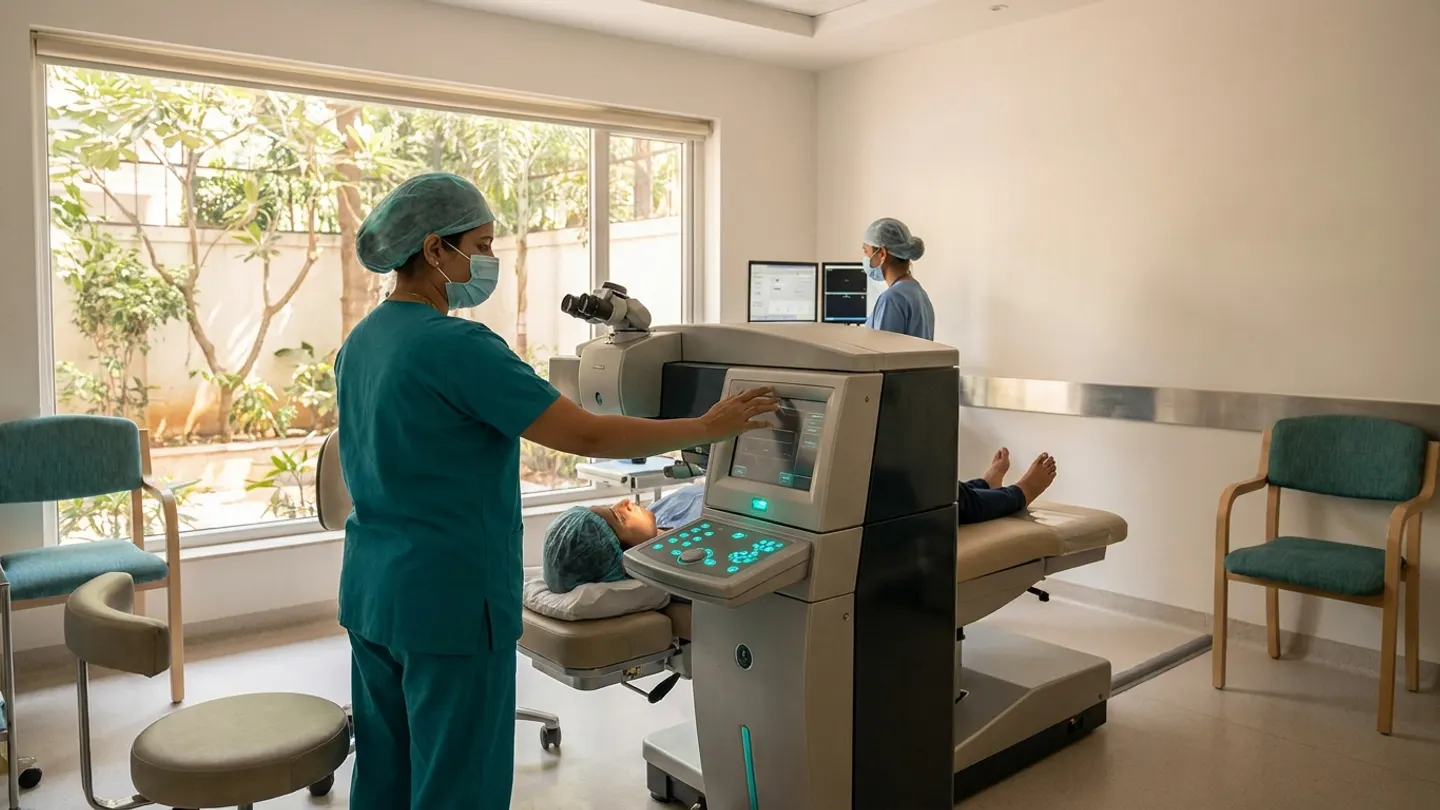
If you have been told your prescription is too high for LASIK, or if the cost of ICL surgery at home has left you feeling like clear vision is simply out of reach, you are not alone. Many people across the US, UK, Australia, and the Middle East are discovering that India offers the same FDA-approved lenses, the same surgical technique, and the same internationally accredited hospitals — at a fraction of the price they were quoted at home.
ICL Surgery Cost in India: The Number You Are Looking For
ICL surgery cost in India ranges from approximately $1,200 to $2,500 USD per eye for international patients, covering the implantable collamer lens itself, surgeon and anaesthesia fees, the operating theatre, and follow-up consultations. For both eyes together, the total typically falls between $2,400 and $5,000 USD — compared to $3,000 to $6,000 per eye in the United States. The savings are real, and they do not come at the expense of quality.
The variation within India’s price range reflects a few practical factors: the city you choose, the hospital’s accreditation tier, whether you need a toric ICL (to correct astigmatism alongside short-sightedness), and the specific lens model selected for your eye’s anatomy.
ICL Surgery Cost Comparison by Country (2026)
| Country | Cost per Eye (USD, approx.) | Both Eyes (USD, approx.) |
|---|---|---|
| India | $1,200 – $2,500 | $2,400 – $5,000 |
| United States | $3,000 – $6,000 | $6,000 – $12,000 |
| United Kingdom | $2,800 – $5,500 | $5,600 – $11,000 |
| Australia | $2,500 – $5,000 | $5,000 – $10,000 |
| UAE / Dubai | $2,000 – $4,500 | $4,000 – $9,000 |
All figures are indicative 2026 ranges for internationally accredited hospitals. Prices vary by prescription strength, lens type, and individual hospital. These are not guarantees of cost.
Even after adding return flights, hotel stays, and incidental costs, most international patients save $4,000 to $8,000 on their total ICL journey to India. See our treatments and costs page for a broader breakdown across procedures.
What Is ICL Surgery and Why Is It Different from LASIK?
An implantable collamer lens (ICL) is a soft, foldable micro-lens that is placed inside the eye, in front of the natural lens, through a tiny incision. Unlike LASIK, no corneal tissue is removed. This makes ICL the preferred option when:
- Your prescription is high (typically above -6 to -8 dioptres for short-sight, or above +3 for long-sight)
- Your corneas are thinner than the safe threshold for laser surgery
- You have dry eyes that would worsen after LASIK
- You want a reversible procedure — the lens can be removed or exchanged if your prescription changes significantly years later
The most widely used lens brand globally is EVO Visian ICL, made by STAAR Surgical. This is the same product used in top clinics in New York, London, and Sydney — and it is available in India’s accredited eye hospitals at the same quality standard.
“The lens inside my eye is exactly the same one my optician in London quoted me for £4,000 per eye. I paid a fraction of that in India, and I could see clearly enough to read my hotel menu that same evening.” — Representative of a common experience among our international patients.
What Affects the ICL Surgery Price in India?
Understanding what drives the cost helps you ask the right questions when comparing quotes.
Lens Type
A standard spherical ICL corrects short-sightedness or long-sightedness. A toric ICL additionally corrects astigmatism and typically costs $200 to $500 more per eye. If your optician has noted cylinder correction in your prescription, you will almost certainly need the toric version.
City and Hospital Tier
Major metropolitan centres such as Mumbai, Delhi, Bangalore, Chennai, and Hyderabad host the highest-concentration of JCI and NABH-accredited eye hospitals. Prices in these cities reflect their investment in technology — femtosecond laser-assisted ICL implantation, advanced diagnostic suites, and experienced surgical teams. Smaller cities may offer lower headline prices but with fewer internationally accredited options.
Pre-operative Diagnostics
A thorough work-up before ICL surgery includes corneal topography, anterior segment OCT, endothelial cell count, and precise biometry to size the lens correctly. Some hospitals bundle these into their package price; others bill them separately. Always ask for an all-inclusive quote that covers diagnostics, the procedure, the lens, and a minimum of two to three post-operative visits.
Hospital Accreditation
Choose only JCI or NABH-accredited eye hospitals for international-standard infection control, anaesthesia protocols, and patient safety governance. Accreditation is the single most reliable quality indicator you can verify before you travel. Explore our our hospitals page to see accredited eye care partners.
What Is Included in an ICL Package for International Patients?
A well-structured ICL surgery package from an internationally accredited Indian hospital should include:
- Pre-operative eye examination and measurements
- The implantable collamer lens (for both eyes)
- Surgeon and anaesthesia fees
- Operating theatre charges
- One night of observation (some cases are day procedures)
- Prescribed eye drops for the recovery period
- Two to three post-operative consultations during your stay
- Medical report and discharge summary in English for your home ophthalmologist
Items that are usually not included: flights, accommodation, airport transfers, travel insurance, and visa fees. IndoMedTour coordinates these separately so you have a single point of contact for both the medical and the travel side. Learn more about the end-to-end process on our how it works page.
Is ICL Surgery in India Safe? Quality and Accreditation Explained
Safety is the only question that matters more than price. India’s top-tier eye hospitals meet the same standards as hospitals in the US and Europe.
JCI (Joint Commission International) is the global gold standard for hospital accreditation — the same body that certifies hospitals in the United States. NABH (National Accreditation Board for Hospitals) is India’s national equivalent, recognised by the International Society for Quality in Health Care (ISQua). Both frameworks require rigorous protocols around surgical safety, infection control, equipment maintenance, and patient rights.
Ophthalmologists performing ICL surgery at accredited Indian centres typically hold fellowships from international bodies (Royal College of Ophthalmologists, American Academy of Ophthalmology) and have performed hundreds to thousands of ICL implantations. Volume matters in eye surgery: high-volume surgeons have lower complication rates, and India’s top centres consistently operate at those volumes.
A Realistic Look at ICL Surgery Risks
ICL surgery has an excellent safety profile worldwide, with serious complications being rare. However, no elective procedure is without risk. The most commonly discussed considerations include:
- Transient elevated intraocular pressure in the first 24 hours (managed with medication)
- Halos or glare in the first weeks as the eye adjusts (usually temporary)
- The rare need for lens repositioning
- Cataract development decades later in a very small proportion of patients
A thorough pre-operative assessment — including an endothelial cell count to check corneal health — significantly reduces these risks. This assessment is non-negotiable at any reputable accredited hospital.
Planning Your ICL Surgery Trip to India: Practical Checklist
Once you have received written quotes and confirmed your candidacy, use this checklist to plan your trip:
- Obtain a written, itemised quote in USD or your home currency
- Confirm the hospital’s JCI or NABH accreditation status
- Stop wearing soft contact lenses for at least 3 days (rigid lenses, 2 weeks) before measurements
- Arrange for a companion to accompany you on the day of surgery — you cannot drive after the procedure
- Plan to stay in India for a minimum of 5 to 7 days post-surgery for follow-up clearance to fly
- Purchase comprehensive travel insurance that explicitly covers elective eye surgery abroad
- Carry your full prescription records and any previous eye test results in printed form
- Confirm your airport transfer and accommodation are within 30 minutes of the hospital
Visit our success stories page to read how other international patients navigated their eye surgery journeys in India.
ICL vs LASIK vs PRK: Quick Cost Comparison in India
If you are still weighing your vision correction options, here is how the common procedures compare within India’s accredited hospitals:
| Procedure | Best For | India Cost (Both Eyes, USD) |
|---|---|---|
| LASIK / LASEK | Mild to moderate prescriptions, healthy corneas | $500 – $1,500 |
| PRK / LASEK | Thin corneas, mild prescriptions | $400 – $1,200 |
| ICL (Spherical) | High myopia / hyperopia | $2,400 – $4,500 |
| Toric ICL | High prescription + astigmatism | $2,800 – $5,000 |
| Refractive Lens Exchange | Presbyopia, very high prescriptions | $3,000 – $6,000 |
Indicative ranges for internationally accredited hospitals. Your ophthalmologist will advise the clinically appropriate procedure based on your diagnostic results.
For a full overview of ophthalmic treatments available in India, see our [/treatments/eye-ophthalmology] page.
How IndoMedTour Helps
We begin with a free counselling call — no obligation, no sales pitch — where one of our patient advisors reviews your prescription and your questions, and matches you with two or three accredited eye hospitals that are right for your case. You receive written quotes in plain language before you commit to anything. Our team handles visa invitation letters, airport pickup, hotel recommendations near your hospital, and translation support if needed. A dedicated coordinator stays beside you from the moment you land through your final post-operative check — and remains reachable after you fly home if your local ophthalmologist has questions. Book your free counselling call today.
You bring the worry. We bring the plan.