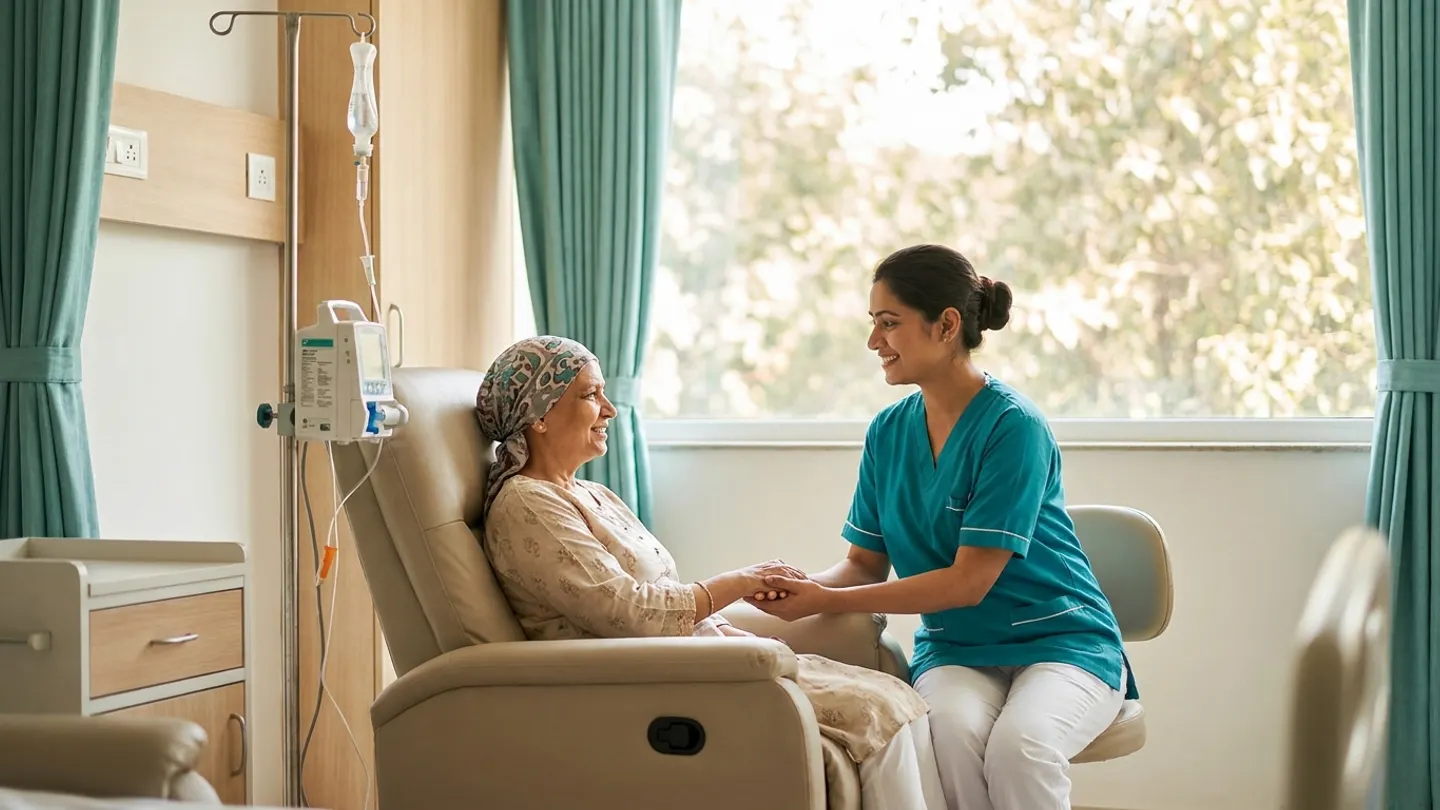
A cancer diagnosis is terrifying enough on its own. When you then discover that the treatment your oncologist has recommended could cost your family’s entire savings — or that you face a six-month wait before it can even begin — the fear compounds into something that feels impossible to carry. You are not alone in wondering whether going to India for cancer treatment is a safe and sensible option.
Is Cancer Treatment Safe in India? The Direct Answer
Yes, cancer treatment in India is safe at accredited centres, and for many patients it is every bit as effective as treatment in the United States, the United Kingdom, or Australia. India’s premier oncology hospitals hold JCI (Joint Commission International) and NABH (National Accreditation Board for Hospitals) accreditations — the same independent quality standards that govern top cancer hospitals in the West. These centres use internationally approved chemotherapy protocols, the latest radiation platforms, robotic surgical systems, and multidisciplinary tumour boards where specialists review every case together before treatment begins. That is the same process your oncologist at home would follow.
What is different is the cost and — in many countries — the waiting time.
What Accreditation Actually Guarantees
JCI and NABH accreditation are not honorary titles. Each is granted after independent inspectors audit a hospital across hundreds of criteria: infection prevention and control, medication safety, surgical checklists, patient identification protocols, oncology-specific care pathways, and data on actual treatment outcomes. A hospital must pass the audit and undergo re-inspection every three years to keep its status.
When IndoMedTour recommends a cancer centre, it is drawing from hospitals that hold one or both of these accreditations — and we verify that status is current before any patient travels.
“I kept reading that Indian hospitals were ‘good enough.’ What I found was a tumour board of eight specialists debating the exact margins of my surgery. That is not ‘good enough.’ That is excellent.” — Representative patient experience; details anonymised.
A Realistic Look at Safety Standards
Surgical Oncology
India’s leading centres perform robotic-assisted and minimally invasive cancer surgeries — prostatectomies, colectomies, mastectomies, thoracoscopic lung resections — at volumes that would be considered high even by US academic medical-centre standards. In surgical oncology, volume matters enormously: surgeons who perform a procedure repeatedly have significantly better complication rates and margin-clearance outcomes than those who do it infrequently. Many Indian oncology surgeons trained in the UK, US, or Europe and return to practise in top Indian hospitals.
Radiation Therapy Technology
Accredited Indian cancer centres run modern linear accelerators, IMRT (Intensity-Modulated Radiation Therapy), IGRT (Image-Guided Radiation Therapy), stereotactic radiosurgery (including CyberKnife and Gamma Knife), and — at a small number of specialist facilities — proton therapy. The machines themselves are the same models used in Western hospitals. Radiation planning software, dosimetry quality checks, and physicist oversight follow international guidelines from bodies such as ASTRO and ESTRO.
Medical Oncology and Chemotherapy
Chemotherapy regimens at accredited Indian hospitals follow NCCN (National Comprehensive Cancer Network) or ESMO guidelines — the same evidence-based protocols used in the US and Europe. Biosimilar drugs, which are widely used in India, are approved by India’s Central Drugs Standard Control Organisation (CDSCO) and are clinically equivalent to branded originals. Your oncology team will discuss your specific protocol before treatment begins.
Infection Control
Concern about hospital-acquired infections is reasonable — it is a risk in every country. Accredited Indian hospitals are required to track and report infection rates and maintain hand-hygiene compliance data as part of their accreditation. The best-performing centres post outcomes that are comparable to top-ranked hospitals in Western countries.
Cost Comparison: Cancer Treatment in India vs. Other Countries
The numbers below are indicative 2026 ranges in USD. Individual costs depend on cancer type, stage, treatment duration, and the specific hospital.
| Treatment | India (approx.) | United States (approx.) | United Kingdom (approx.) | Australia (approx.) |
|---|---|---|---|---|
| Chemotherapy course (6 cycles) | $8,000 – $18,000 | $50,000 – $120,000 | $20,000 – $45,000 | $15,000 – $40,000 |
| Radiation therapy (IMRT, full course) | $4,000 – $9,000 | $30,000 – $60,000 | $15,000 – $30,000 | $12,000 – $25,000 |
| Robotic cancer surgery (e.g., prostate) | $5,000 – $10,000 | $25,000 – $60,000 | $18,000 – $35,000 | $15,000 – $28,000 |
| Bone marrow transplant (autologous) | $18,000 – $30,000 | $100,000 – $200,000 | $50,000 – $90,000 | $40,000 – $80,000 |
| CyberKnife / Stereotactic radiosurgery | $5,000 – $9,000 | $25,000 – $55,000 | $15,000 – $28,000 | $12,000 – $22,000 |
Prices are indicative only and do not include travel, accommodation, or ancillary medications.
These are not discount prices achieved by skipping steps. They reflect India’s significantly lower cost of living, lower labour overheads, and a government policy that keeps many oncology drugs priced far below Western markets — while the clinical standard at accredited centres remains high.
See our full treatments and costs page for condition-specific breakdowns, or explore the cancer and oncology treatment page for more detail.
Questions to Ask Before Choosing a Hospital
When you are evaluating any cancer centre — whether in India or elsewhere — these questions separate the best from the rest:
- Is the hospital JCI-accredited, NABH-accredited, or both? (Ask for current certificate numbers.)
- Does the hospital have a multidisciplinary tumour board that reviews your case before treatment?
- What is the annual volume of patients treated for your specific cancer type?
- Is an international patient coordinator available throughout treatment — not just on admission day?
- What follow-up and telemedicine options exist once you return home?
- Are second-opinion reports and imaging available in formats your home oncologist can read?
Who Travels to India for Cancer Treatment?
Patients who travel to India for cancer care are not, as a rule, people cutting corners. They are typically:
- Uninsured or underinsured patients from the United States facing six-figure bills with no safety net.
- Patients in the UK, Canada, or Australia on long public-system waiting lists for surgery or radiation, where delay can change a staging outcome.
- Patients in the Middle East or Africa for whom India is geographically close and culturally familiar, with Indian oncologists trained at some of the same institutions as local consultants.
- People who have received a second opinion abroad recommending a procedure or drug not available locally.
In each case, the question is not whether to receive good oncology care — it is where that care is accessible and affordable.
What to Bring and How to Prepare
If you are considering cancer treatment in India, gather these before reaching out:
- Recent biopsy or pathology reports (with original staining descriptions if possible)
- Latest imaging: CT, PET-CT, MRI — on a USB drive or via a cloud link
- Operative reports if you have already had surgery
- Your current medication list, including supplements
- Any prior treatment summaries your home oncologist can provide
Indian hospitals accept these documents directly. IndoMedTour can help you compile and send them to the relevant specialist team so you have a treatment plan and a written quote before you book a single flight. You can read more about the end-to-end process on our how it works page.
How IndoMedTour Helps
Navigating a cancer diagnosis is hard enough without also becoming an expert in international healthcare logistics. When you book a free counselling call, our team listens to your diagnosis, your treatment plan, and your concerns — then matches you with two or three accredited oncology centres whose specialist volumes and treatment capabilities fit your case. You receive written cost estimates before committing to anything. We manage visa and travel planning, arrange accommodation close to the hospital, and assign you a dedicated coordinator who is present from your first consultation through surgery, treatment, and recovery — and available by phone as you return home. Explore our hospitals to see the centres we work with, or read success stories from patients who have been through this journey before you. You bring the worry. We bring the plan.