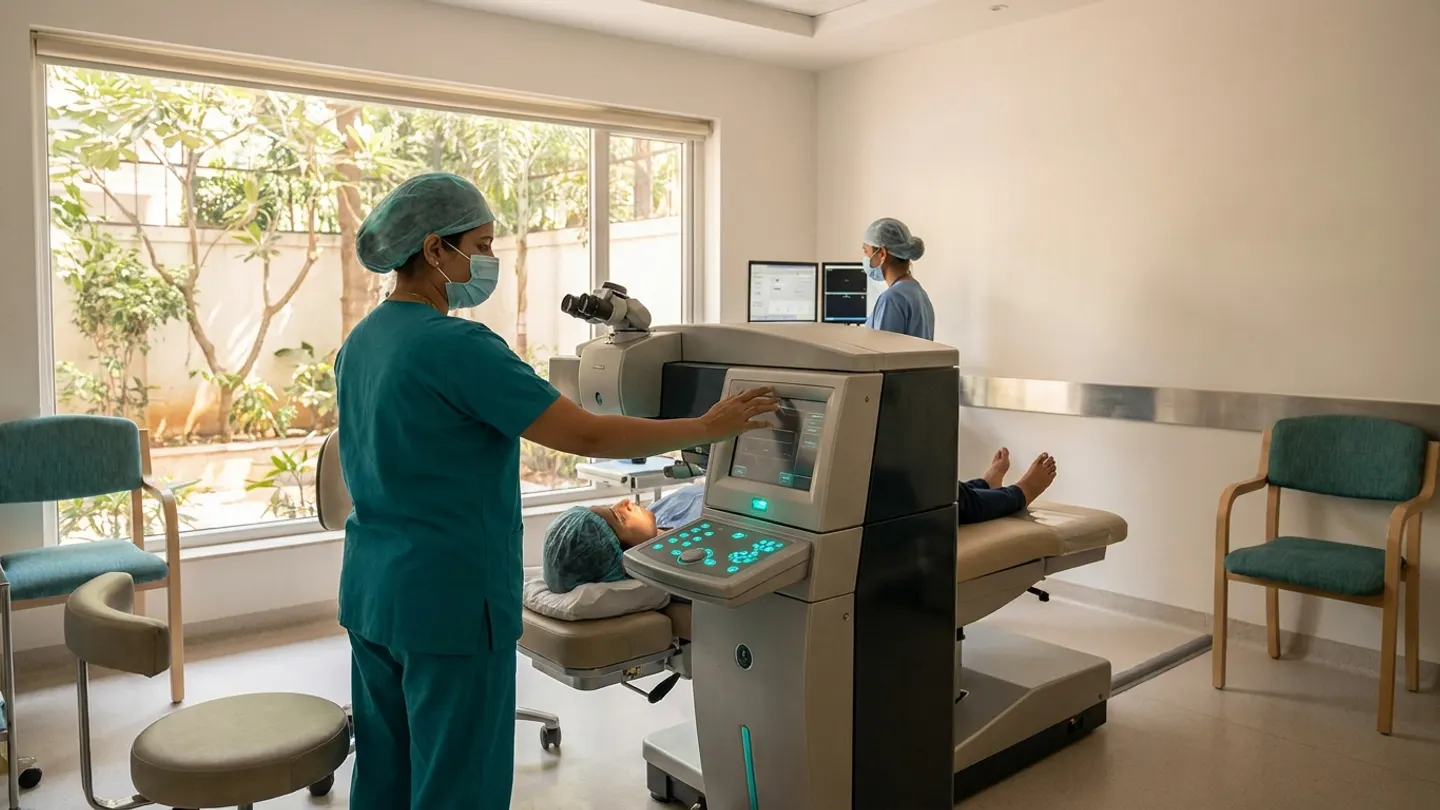
If the idea of clear, unaided vision has been tempting you for years, but the cost at home feels out of reach, you are not alone. And if “LASIK in India” has appeared in your searches and you’ve paused, wondering whether that’s really a safe road to go down, these are exactly the right questions to ask before booking anything.
Is LASIK Safe in India? What the Evidence Says
LASIK in India is safe when performed at an accredited eye hospital equipped with internationally approved laser platforms. India’s top ophthalmology centres consistently report serious adverse event rates below 1%, directly comparable to published outcomes from the United States, United Kingdom, and Australia.
The explanation is simple: the same FDA-cleared and CE-marked laser systems operating in hospitals in New York or Manchester are installed in leading centres in Chennai, Hyderabad, Mumbai, Delhi, and Bengaluru. The surgeons using them often trained abroad and hold international fellowships in refractive surgery. What differs substantially is the price, not the clinical standard.
What Makes an Eye Hospital Trustworthy
JCI and NABH Accreditation: The Quality Filter
When considering surgery abroad, accreditation is the most reliable objective measure of clinical quality. In India, two standards are internationally recognised:
- JCI (Joint Commission International): The same accreditation body that certifies hospitals across the United States. Achieving JCI status requires rigorous independent audits of surgical protocols, sterilisation procedures, patient safety systems, and staff qualifications — repeated every three years.
- NABH (National Accreditation Board for Hospitals): India’s national hospital accreditation programme, recognised by the International Society for Quality in Healthcare (ISQua). NABH standards for eye centres specifically cover equipment calibration, infection control, and post-operative care pathways.
IndoMedTour works exclusively with JCI- or NABH-accredited ophthalmology hospitals. The accreditation filter is applied before any recommendation is made to you.
Laser Technology Used in India’s Leading Eye Centres
India’s top-tier hospitals use the same globally approved platforms that you would find in premium clinics in developed markets:
- Alcon WaveLight EX500 and Allegretto — high-speed ablation with wavefront-guided precision
- VISX Star S4 (Johnson and Johnson Vision) — extensively used in the US, with robust long-term outcome data
- Carl Zeiss MEL 90 — German-engineered, widely adopted across Asia, Europe, and the Middle East
- Femtosecond laser platforms (INTRALASE, VisuMax) for bladeless, all-laser flap creation
- SMILE (Small Incision Lenticule Extraction) — a flapless alternative available at select advanced centres, suited to active patients or those with dry eye concerns
The technology choice matters because it determines the precision of the refractive correction and influences how quickly your vision stabilises after surgery.
LASIK Cost in India vs the Rest of the World
This is where the numbers reliably surprise people.
| Country | LASIK Cost (Both Eyes, Indicative) | Notes |
|---|---|---|
| India | USD 600 – 1,400 total | JCI/NABH hospitals; wavefront-guided available |
| United States | USD 4,000 – 6,000 total | Wide variation by centre and technology |
| United Kingdom | GBP 3,000 – 5,000 total | NHS does not cover refractive surgery |
| Australia | AUD 5,000 – 7,000 total | Most major private centres |
| UAE / Dubai | USD 2,400 – 4,000 total | Premium centres in Dubai and Abu Dhabi |
All figures are indicative 2026 ranges. Exact quotes depend on your prescription, the technology package selected, and the specific hospital. IndoMedTour obtains written itemised quotes before you book travel.
Even after adding return flights and a week’s accommodation, most international patients save 60 to 75% compared to their home country — while accessing the same laser hardware and internationally trained surgeons.
“I was quoted nearly £3,000 for both eyes at a high-street laser clinic in the UK. Flying to Chennai, staying for a week at a serviced apartment, and having the procedure at a NABH-accredited hospital came to under £900 in total. My vision tested at 6/6 at my follow-up. I wish I had looked into this years earlier.” — Representative experience from a UK-based IndoMedTour patient.
Who Is a Good Candidate for LASIK in India?
A reputable eye hospital will conduct a thorough pre-operative assessment before any procedure is scheduled. You are generally a strong candidate if you:
- Are between 21 and 45 years of age with a stable prescription for at least 12 months
- Have adequate corneal thickness confirmed by pachymetry and corneal topography
- Do not have active dry eye syndrome, keratoconus, or progressive myopia
- Have no relevant autoimmune conditions that could affect healing
- Fall within treatable prescription limits (typically -8.00 D to +5.00 D, with some variation by platform)
When LASIK May Not Be the Right Choice
LASIK is not suitable for every patient, and the best Indian eye hospitals will tell you this plainly. Surgeons routinely screen out patients with thin corneas, irregular astigmatism, or prescription strengths outside safe treatment ranges. In those cases, alternatives such as SMILE, PRK (photorefractive keratectomy), or Implantable Collamer Lenses (ICL) may be recommended instead. This careful patient selection is itself a significant part of why safety outcomes at accredited centres remain consistently strong.
What the LASIK Procedure Actually Involves
A standard LASIK procedure at an accredited Indian eye centre takes approximately 15 minutes per eye and follows a consistent internationally validated protocol:
- Detailed pre-operative mapping: corneal topography, wavefront aberrometry, and pachymetry
- Numbing eye drops applied — no injections, no general anaesthesia
- Corneal flap creation — via microkeratome blade (standard) or femtosecond laser (bladeless)
- Precisely calculated laser reshaping of the underlying corneal stroma
- Flap repositioned; it seals naturally without sutures within minutes
- Post-operative drops prescribed; a brief rest period before discharge
Most patients notice measurably clearer vision within 24 hours. Vision typically stabilises over two to four weeks. Before you fly home, the hospital schedules a follow-up examination, and teleconsultations at one week and one month post-procedure are standard practice.
Outcomes: What Honest Expectations Look Like
LASIK consistently carries one of the highest patient satisfaction rates of any elective surgical procedure globally, with peer-reviewed studies placing satisfaction above 95% in large cohorts. India’s accredited eye centres publish outcomes data aligned with these international benchmarks.
When evaluating any hospital, ask specifically for:
- Enhancement rate (percentage of patients requiring a touch-up correction)
- Serious adverse event rate (corneal ectasia, infection, clinically significant vision loss)
- Proportion of patients achieving driving-standard vision without glasses at six months
A note on realistic expectations: LASIK does not guarantee 20/20 vision in every patient. Outcomes depend on your pre-operative prescription, corneal profile, and individual healing. An ethical surgeon will give you a realistic probability estimate — specific to your eye measurements — before you sign a consent form. Be cautious of any clinic that promises a guaranteed outcome.
Planning Your Journey: Practical Points for International Patients
- Contact lens pause: Most centres ask you to stop wearing soft lenses for 5 to 7 days before your pre-operative assessment. Rigid gas-permeable lenses require a longer pause of 3 to 4 weeks.
- Length of stay: Plan for at least 5 to 7 days in India: one day for the pre-op assessment, procedure day, and at least one follow-up before travel.
- Flying after LASIK: Most surgeons clear uncomplicated LASIK patients to fly 48 to 72 hours after surgery, with lubricating drops recommended for cabin dryness.
- Indian e-Visa: Available to nationals of 169 countries, processed online, typically issued within 3 business days.
- Cities with leading accredited eye centres: Chennai, Hyderabad, Mumbai, Delhi NCR, and Bengaluru all have internationally recognised ophthalmology hospitals with established international patient programmes.
Our how it works page explains the full journey from first contact to flying home. To compare partner hospitals by accreditation and technology profile, visit our hospitals. For a side-by-side overview of ophthalmology and other procedures, the treatments and costs page provides indicative pricing across specialties. For in-depth information on procedure options and centre profiles specific to eye care, explore our eye and ophthalmology treatment page.
How IndoMedTour Helps
Start with a free counselling call and we will help you understand whether LASIK is likely to be the right procedure for your prescription and corneal profile, or whether SMILE or ICL might serve you better. We then match you with JCI- or NABH-accredited eye hospitals, secure written itemised quotes before you commit to any travel, and coordinate your visa support, accommodation, and airport transfers. A dedicated care coordinator stays with you from arrival through surgery, attends your follow-up appointment, and remains reachable in the weeks after you return home. You bring the worry. We bring the plan.