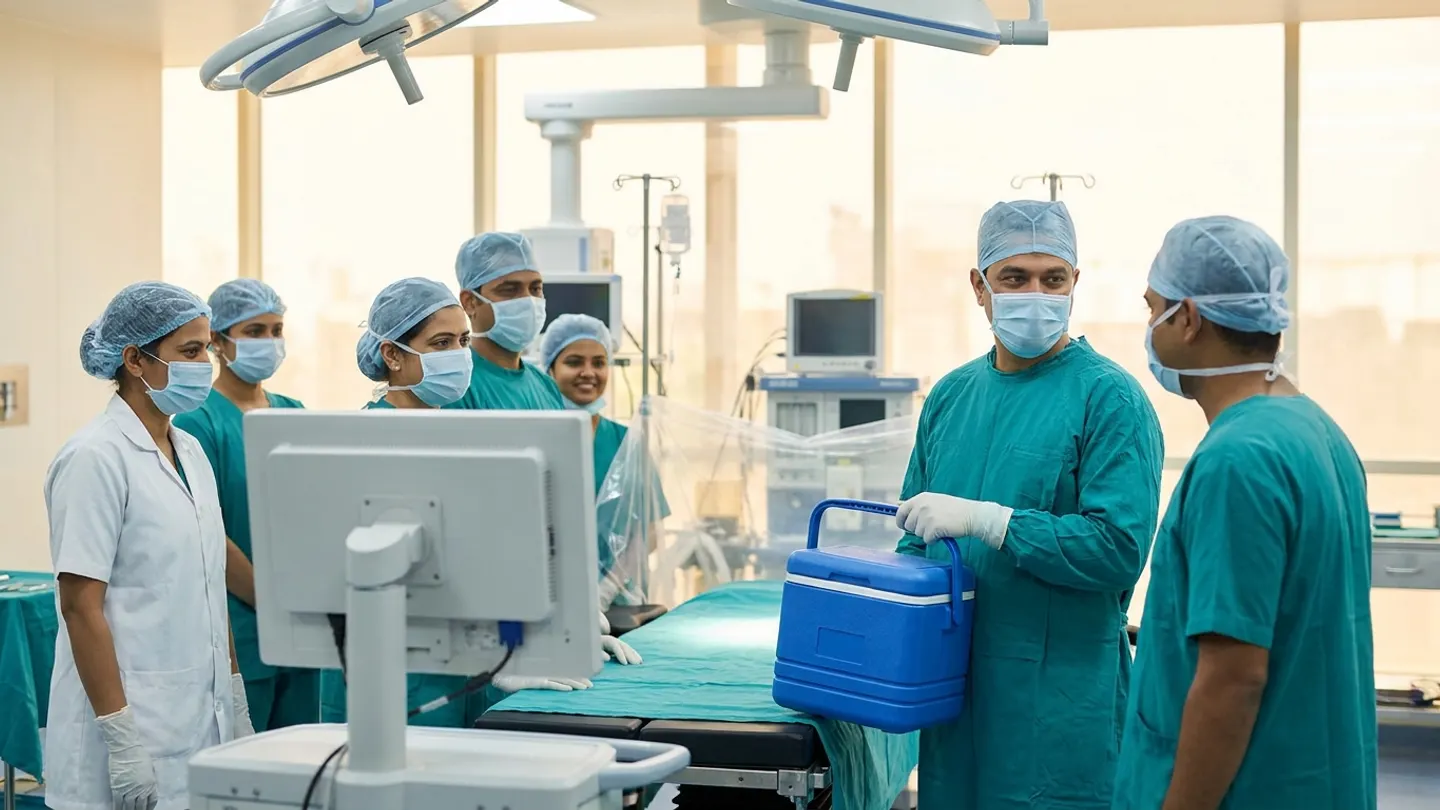
Facing end-stage kidney disease is one of the most frightening situations a person can experience. If you are on dialysis in the Gulf or Middle East, you already know the physical toll — and you may have been told the waiting list for a transplant is years long, or the cost is simply impossible. That fear is real, and it is shared by thousands of families across the UAE, Saudi Arabia, Kuwait, Oman, Bahrain, and Qatar. There is a well-worn, medically respected path forward: a kidney transplant in India.
Kidney Transplant in India for Gulf and Middle East Patients: What You Need to Know First
Kidney transplant in India for Gulf and Middle East patients is one of the most established medical-tourism journeys in Asia. India performs more kidney transplants than any country outside the United States and China, and its top transplant centres hold JCI or NABH accreditation, the same international quality benchmarks recognised by health ministries across the Gulf. The total cost — surgery, hospital stay, immunosuppressants, and follow-up — typically falls between USD 13,000 and USD 22,000, compared with USD 60,000 to USD 120,000 in the UAE or USD 150,000 to USD 300,000 in the United States.
For Gulf families who have been budgeting for a transplant, that gap is life-changing.
Cost Comparison: Kidney Transplant in India vs Gulf and Western Countries
The figures below are indicative ranges based on published hospital data and patient-reported costs as of 2026. Your personalised written quote will reflect your donor situation, the hospital tier you select, and any pre-existing complications.
| Country | Approximate Total Cost (USD) | Average Waiting List (Deceased Donor) |
|---|---|---|
| India | 13,000 – 22,000 | 1 to 3 years (living donor: weeks) |
| UAE / Saudi Arabia | 55,000 – 120,000 | 3 to 7 years |
| United Kingdom | 50,000 – 90,000 (private) | 3 to 5 years (NHS) |
| United States | 150,000 – 300,000 | 3 to 8 years |
| Thailand | 35,000 – 60,000 | Varies; limited deceased-donor pool |
The single biggest financial advantage is how dramatically India compresses the cost without compressing the quality. The same surgical team, the same immunosuppression protocols, and the same post-operative monitoring that you would receive in a premium Gulf hospital are available in India’s top transplant centres at a fraction of the price — partly because of lower overheads and partly because of India’s scale of experience.
Why Gulf and Middle East Patients Choose India for a Kidney Transplant
World-Class Transplant Expertise at Scale
India’s leading transplant programmes have handled thousands of cases, including highly complex re-transplants, paediatric cases, and patients with multiple comorbidities common in the Gulf population — diabetes, hypertension, and obesity-related kidney failure. The surgeons and nephrologists at India’s top centres often trained in the UK, US, or Germany and publish in peer-reviewed international journals. JCI- and NABH-accredited hospitals follow standardised infection control, surgical checklists, and intensive-care protocols that meet global benchmarks. See our hospitals for an overview of the accredited centres IndoMedTour works with.
Short Flight Times and Direct Connections
A key practical advantage for Gulf families is geography. Dubai to Mumbai is under three hours. Riyadh to Chennai is under four. Kuwait to Delhi is under four and a half. These are not long-haul journeys. Travelling companions — spouses, parents, siblings — can fly in for the surgery and recovery without taking extended leave. That matters enormously when the patient’s emotional support system needs to be present for weeks, not just days.
No Language Barrier
All of India’s major transplant hospitals have dedicated international patient departments with Arabic-speaking coordinators or interpreters. Medical records, consent forms, and discharge summaries can be provided in Arabic on request. Gulf patients consistently report feeling less isolated in India than they expected — prayer facilities, halal food, and Gulf-facing support staff are standard features at hospitals with high volumes of Middle Eastern patients.
The Living-Donor Advantage
Because deceased-donor waiting lists in India can also be long, the most efficient path for Gulf patients is to bring a living, related donor. India’s Transplantation of Human Organs and Tissues Act allows relatives — parents, siblings, children, grandparents, and spouses — to donate. An Authorisation Committee reviews the documentation to confirm the relationship and ensure no financial coercion. The process adds two to four weeks to the planning timeline, but it means you can schedule the transplant on your terms rather than waiting years for a cadaveric kidney.
“The paperwork felt overwhelming at first. But the hospital’s transplant coordinator walked us through every form, followed up with the committee on our behalf, and we had approval in eighteen days. By week six my father was on a flight home.” — Composite account representative of the experience many Gulf families describe.
What to Expect: The Step-by-Step Journey
Step 1 — Pre-Travel Evaluation (2 to 4 weeks before departure)
Before you travel, your IndoMedTour coordinator will connect you with the receiving hospital’s nephrology team. You send existing medical records — dialysis logs, recent blood work, imaging, biopsy reports — and the team reviews them. This prevents surprises on arrival and allows the hospital to pre-arrange the immunological matching tests.
Step 2 — Arrival and Work-Up (1 to 2 weeks in India)
Both recipient and donor undergo a comprehensive evaluation: cross-matching, tissue typing, cardiac clearance, infection screening, and psychological assessment. The Authorisation Committee review happens during this window. The hospital manages the scheduling so that the surgery date is confirmed before you have finished your evaluation.
Step 3 — Surgery and Immediate Recovery (approximately 2 weeks)
The transplant surgery itself typically takes three to five hours. The recipient stays in the ICU for one to three days, then moves to a specialised transplant ward. The donor’s laparoscopic nephrectomy is a shorter procedure, and most living donors are discharged within three to five days. The recipient’s team monitors kidney function, creatinine levels, and immunosuppression response daily during the hospital stay.
Step 4 — Post-Operative Monitoring (2 to 4 weeks in India)
This is the most critical window. The transplanted kidney must be watched closely for rejection episodes, infection, and medication side effects. Most international transplant programmes require the patient to stay near the hospital for at least three to four weeks after discharge. Your coordinator will help arrange serviced accommodation close to the hospital for this period.
Step 5 — Discharge and Long-Term Follow-Up
Before you fly home, the hospital provides a complete discharge summary, a detailed immunosuppression protocol, and a tele-follow-up schedule for your nephrologist in the Gulf. Many of India’s transplant hospitals offer remote monitoring consultations via video call for the first year post-transplant.
Checklist: What Gulf Patients Need to Prepare
Before you contact a hospital, gather the following:
- Recent dialysis records (at least three months of logs)
- Cause of kidney failure and full nephrology history
- Current medication list, including any immunosuppressants
- Latest blood group and kidney function panel (eGFR, creatinine, urea)
- Cardiac evaluation report (ECG and echocardiogram if available)
- Donor’s identity documents, passport, and proof of relationship (birth certificate, family book / Khulasat Al Qaid)
- UAE or Gulf residence permit and passport (valid for at least six months beyond travel date)
- Medical travel insurance that covers organ transplantation
Explore treatments and costs and the dedicated organ transplant page for a full breakdown of what is typically included in a transplant package versus what is billed separately.
Is a Kidney Transplant in India Safe for International Patients?
Patient safety at India’s accredited transplant centres is not a matter of trust — it is a matter of audited, documented process. JCI accreditation, held by a growing number of Indian transplant hospitals, requires compliance with the same standards used to evaluate hospitals in the US, Europe, and the Gulf. Infection rates, graft survival rates, and one-year patient survival rates at India’s top-tier programmes are published and competitive with international benchmarks.
What varies, as it does everywhere, is the quality gap between the best centres and the rest. That is precisely why working with a reputable facilitator — rather than booking directly after a web search — matters so much for a procedure of this complexity. Learn how it works when IndoMedTour matches you to the right centre for your specific diagnosis.
How IndoMedTour Helps
A kidney transplant is not a procedure you book online and attend alone. From the moment you call us for a free counselling call, we take responsibility for matching you with an accredited transplant centre that has experience with Gulf patients and your specific donor situation. We collect your records, present your case to the medical team, and return a written cost estimate before you spend a rupee. We help you plan flights, accommodation near the hospital, and the visa letters your embassy needs. Most importantly, you and your family will have a dedicated coordinator — reachable by WhatsApp and phone — who stays beside you from the day you land through every stage of surgery and recovery, until you are safely on a plane home. Read what other families experienced on our success stories page.
You bring the worry. We bring the plan.