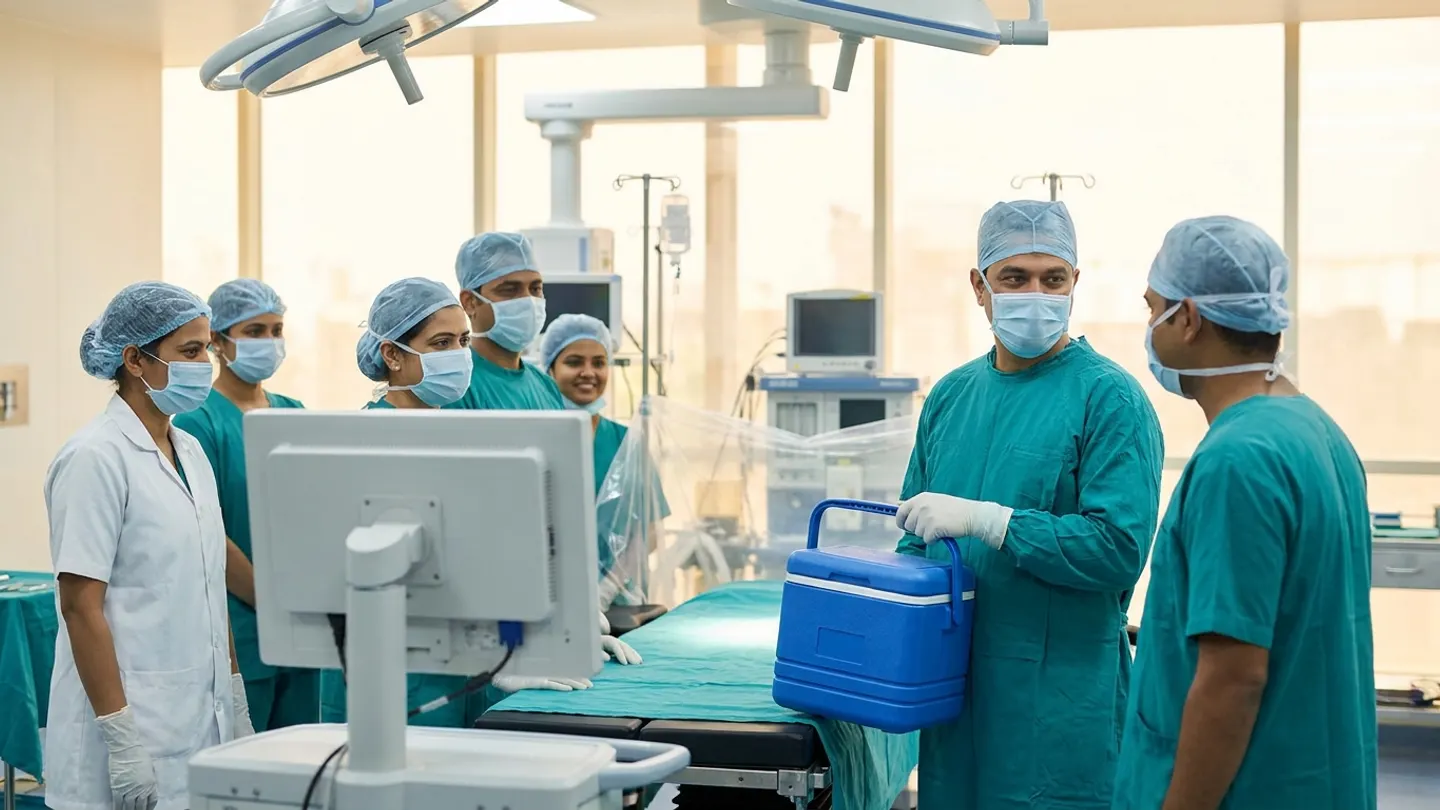
A kidney failure diagnosis turns life upside down overnight. If your nephrologist in Nigeria has told you that a transplant is your best path forward, the first thing you probably searched was the cost — and the numbers from the United States, the United Kingdom, or Germany may have felt crushing. The good news is that India’s transplant centres have been performing kidney transplants for international patients for over two decades, with outcomes comparable to the best hospitals in the world, at a fraction of the price.
Kidney Transplant in India for Nigerian Patients: Cost Breakdown
Kidney transplant in India for Nigerian patients typically costs between USD 13,000 and USD 18,000 for the complete procedure, including surgery, anaesthesia, the standard hospital stay, and early post-operative monitoring. This figure is roughly 70 to 80 percent lower than the cost of the same surgery in the United States, and 60 to 65 percent lower than equivalent centres in Germany or the UAE.
The exact price varies based on three main factors:
- Hospital tier: a metro teaching hospital in Mumbai, Delhi, or Chennai may cost slightly more than a mid-tier centre in Hyderabad or Kochi, but both meet international quality standards.
- Donor type: a living-related donor surgery (where your companion is the donor) is priced differently from a deceased-donor pathway.
- Pre-existing complexity: patients with diabetes, hypertension, or cardiovascular disease may require additional pre-operative tests and specialist consultations that add to the base cost.
Always ask for a written itemised estimate that includes surgeon fees, anaesthesia, ICU stay, medicines for the first month, and the transplant committee approval process.
Indicative Cost Comparison: Kidney Transplant, 2026
| Country | Approximate Total Cost (USD) |
|---|---|
| United States | USD 150,000 – 300,000 |
| United Kingdom | USD 60,000 – 80,000 |
| Germany | USD 50,000 – 70,000 |
| UAE / Gulf | USD 35,000 – 50,000 |
| India | USD 13,000 – 18,000 |
| South Africa | USD 30,000 – 45,000 |
Costs are indicative 2026 ranges and include surgery, hospital stay, and standard post-operative care. They exclude flights, accommodation for companions, and extended immunosuppressant medicines.
Is Kidney Transplant in India Safe for International Patients?
Safety is the right question to ask first, and the answer is yes — provided you choose an accredited centre. India has more JCI-accredited (Joint Commission International) hospitals than any country outside the United States, and the NABH (National Accreditation Board for Hospitals) standard is the domestic equivalent with equally rigorous surgical protocols.
India’s nephrology and transplant programmes have been handling complex cases from Africa, the Middle East, and Southeast Asia for decades. Many of the senior transplant surgeons have trained at institutions in the United Kingdom or the United States, and the post-operative immunosuppression protocols follow the same international guidelines your home nephrologist would recognise.
“The kidney transplant unit reviewed every scan and report I brought from Lagos before I even arrived. By the time I landed, they already had a plan and a timeline. Nothing felt rushed, and nothing felt like I was being treated as a second-tier patient.” — representative account from an IndoMedTour patient, West Africa, 2025.
You can explore our hospitals to see which centres hold JCI or NABH accreditation and have a documented track record with transplant patients from Africa.
Donor Rules for Nigerian Patients Travelling to India
This is one of the most common sources of confusion, and it is important to understand the rules clearly before you travel.
Living-related donors are permitted. Under India’s Transplantation of Human Organs and Tissues Act (THOTA), a Nigerian patient may bring a close blood relative as a living donor. Acceptable relationships include:
- Parent (mother or father)
- Child (son or daughter, adult)
- Sibling (brother or sister)
- Spouse (with additional documentation requirements)
The donor and recipient must both undergo a compatibility assessment, including blood group matching and cross-match tests. The hospital’s Authorisation Committee reviews all documentation and conducts interviews before approving the transplant. This process protects against organ trafficking and is not a bureaucratic hurdle but a genuine patient safeguard.
Deceased-donor transplants for foreign nationals are extremely rare in India. National waiting lists prioritise Indian citizens. Most international patients, including Nigerian patients, travel with a living-related donor already identified.
If you have a willing donor but are not sure about compatibility or the legal process, a free counselling call with our team can walk you through the documentation checklist before you book flights.
Step-by-Step Process for Nigerian Patients
Step 1: Share Your Medical Records
Send your recent nephrologist’s report, dialysis history (if applicable), blood group, latest lab work, and any imaging. IndoMedTour coordinates a remote pre-evaluation with the transplant team at your chosen hospital.
Step 2: Receive a Written Quote
Once the hospital reviews your file, you receive an itemised written estimate covering all likely costs. This is not a binding guarantee, but it gives you a realistic budget to plan around.
Step 3: Obtain Your Medical Visa
Nigeria-to-India medical visas (MV category) require a letter from the Indian hospital confirming your admission. Your companion-donor applies for the same visa. Processing typically takes five to ten working days at the Indian High Commission in Abuja or Lagos. IndoMedTour provides the hospital letter and a visa support pack as standard.
Step 4: Arrive and Complete Pre-Operative Assessment
The first seven to ten days in India are for confirmatory tests: kidney function panels, cardiac clearance, cross-match, tissue typing, and review by the Authorisation Committee. Your donor undergoes independent evaluation during the same period.
Step 5: Surgery and ICU Recovery
The transplant itself takes three to five hours under general anaesthesia. Both donor and recipient are typically in the ICU for 24 to 48 hours, then moved to a standard ward. Most patients are discharged from hospital within ten to fourteen days if recovery is uncomplicated.
Step 6: Outpatient Monitoring Before Flying Home
The transplant team will monitor your new kidney’s function for two to three weeks before clearing you for the long-haul flight back to Nigeria. This period includes immunosuppressant dose calibration — arguably the most critical window in the entire transplant journey.
What to Bring From Nigeria
A useful pre-departure checklist:
- All nephrologist and hospital records from the past 12 months
- Dialysis treatment summary (dates, sessions, machine settings)
- Latest blood work: CBC, LFT, RFT, HbA1c, lipid panel, viral screen (HIV, Hepatitis B and C)
- ECG and echocardiogram report if you have cardiac history
- Current medication list with dosages
- Nigerian passport valid for at least 18 months beyond travel date
- Donor’s documents: same medical set plus proof of relationship (birth certificates, family photographs, sworn affidavit)
- Sufficient foreign currency or a card accepted in India for incidentals
For a detailed look at the costs you should budget, visit our treatments and costs page and our dedicated organ transplant treatment guide.
After the Transplant: Ongoing Care Back in Nigeria
One aspect that Nigerian patients sometimes overlook is the long-term follow-up. Immunosuppressant medicines — typically a combination of tacrolimus, mycophenolate, and prednisolone — must be taken every day for life, and blood levels need monitoring in the early months. Before you leave India, your transplant team will prepare a detailed handover letter for your nephrologist in Nigeria, including target drug levels, monitoring frequency, and the warning signs of rejection to watch for.
Staying on the how it works page of our site, you can see how we stay connected with patients after they return home, including coordinating with their local team if questions arise.
How IndoMedTour Helps
From your first message to your flight home, IndoMedTour provides end-to-end support at no extra cost to you. Start with a free counselling call where our transplant coordinator reviews your records and matches you with the right JCI or NABH-accredited centre for your specific profile. We obtain written cost estimates from shortlisted hospitals, help you prepare the visa documentation pack, and arrange airport transfers and accommodation close to the hospital for you and your family. A dedicated coordinator stays in daily contact from your first day in India through your discharge and clearance to fly, so you are never navigating an unfamiliar system alone.
You bring the worry. We bring the plan.