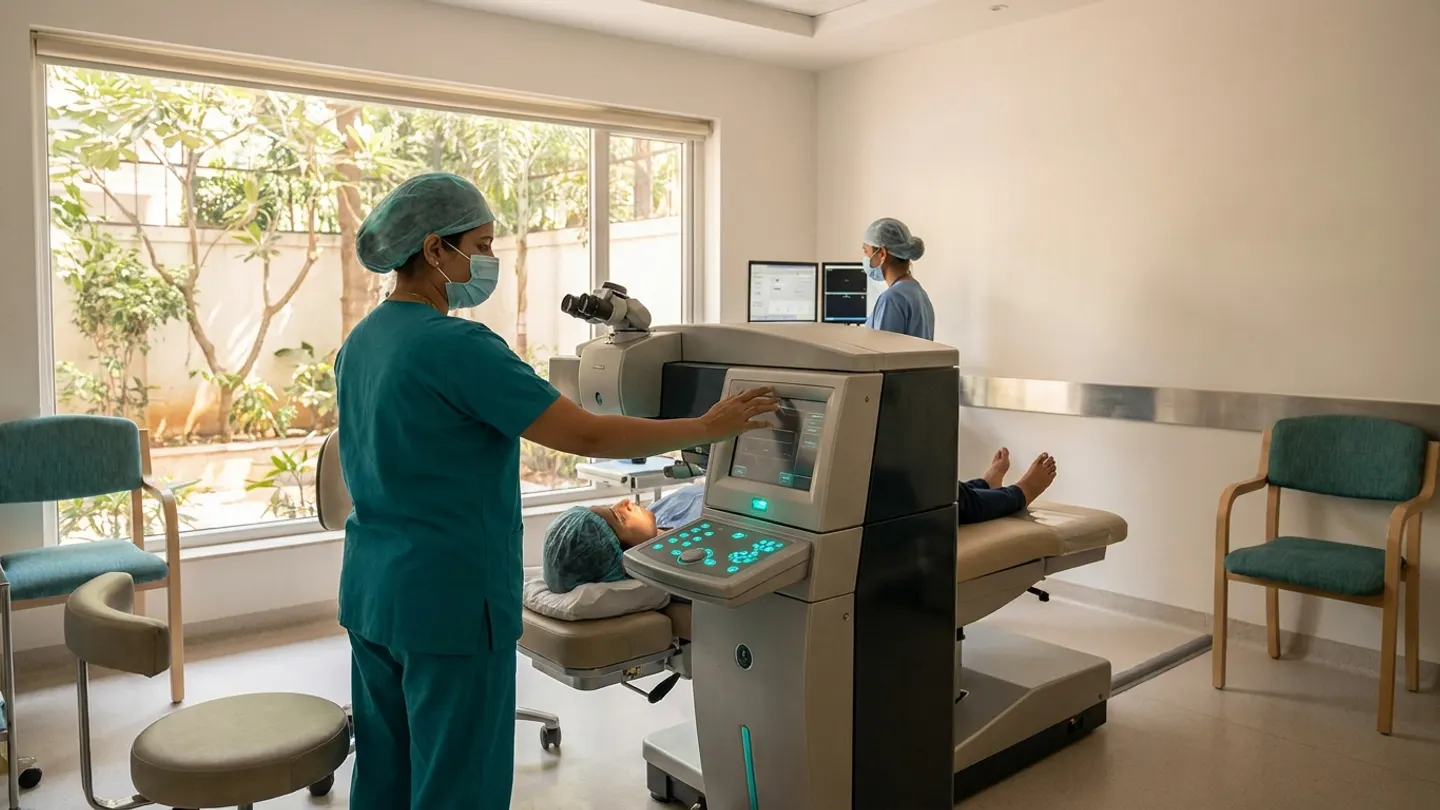
If you have spent years squinting at alarm clocks, swimming in a blur, or budgeting nervously for frames and lenses, you already know the quiet exhaustion of poor eyesight. The good news is that LASIK eye surgery can change all of that in under half an hour — and doing it in India can cost a fraction of what you would pay at home.
LASIK Eye Surgery Cost in India: What to Expect in 2026
LASIK eye surgery in India costs approximately $400 to $1,200 per eye, depending on the technology used, the city, and the hospital tier. That single figure is often enough to make international patients sit up and recalculate: the same procedure in the United States routinely runs $2,000 to $3,500 per eye, and prices in the UK, Australia, and the UAE are not far behind.
The cost difference is not a difference in safety. It reflects India’s lower operational overheads, competitive medical market, and a rupee-to-dollar exchange rate that consistently works in the international patient’s favour.
Why Are Prices So Much Lower in India?
Many patients ask, understandably, what the catch is. There is none. The reasons are structural:
- Lower cost of living and labour means hospital running costs are genuinely lower, not corners being cut.
- High surgical volumes allow eye centres to invest in the latest laser platforms without passing excessive costs onto any single patient.
- Intense competition among quality hospitals keeps pricing honest and motivates continuous technology upgrades.
- Favourable exchange rates amplify savings further for patients paying in US dollars, British pounds, euros, or Australian dollars.
LASIK Cost Comparison: India vs the World (2026)
| Country | LASIK Cost Per Eye (Both Eyes) | SMILE / Advanced LASIK |
|---|---|---|
| India | $400 – $1,200 | $800 – $1,800 |
| United States | $2,000 – $3,500 | $3,000 – $4,500 |
| United Kingdom | $1,500 – $2,500 | $2,200 – $3,500 |
| Australia | $1,800 – $2,800 | $2,500 – $3,800 |
| UAE / Dubai | $1,200 – $2,200 | $1,800 – $3,000 |
| India (% saving vs US) | 60–80% less | 55–75% less |
All figures are indicative 2026 ranges in USD. Final quotes depend on individual prescription, chosen technology, and hospital. Ask IndoMedTour for a written estimate based on your specific case.
Types of LASIK Available in India
India’s leading eye hospitals offer every major variant of laser vision correction, and the technology on the floor is often identical to what you would find in London or Houston.
Standard LASIK
The original blade-cut flap plus excimer laser correction. Still widely performed and effective for straightforward prescriptions. Typically the most affordable option.
Bladeless (All-Laser / Femto-LASIK)
A femtosecond laser creates the corneal flap instead of a mechanical blade, improving precision and reducing the rare risk of flap complications. Prices sit in the mid-range.
SMILE (Small Incision Lenticule Extraction)
The newest generation — no flap at all. A tiny lenticule of corneal tissue is removed through a small keyhole incision. Preferred for patients with thinner corneas or active lifestyles. Priced at the higher end, but still dramatically cheaper than abroad.
Contoura Vision (Topography-Guided LASIK)
Maps the unique contour of each cornea and personalises the laser treatment accordingly. Often produces sharper night vision than standard LASIK. Available at premium eye centres across India.
Is LASIK Safe in India? Understanding the Quality Bar
“The laser does not know which country it is in. What matters is who is operating it, how the equipment is maintained, and what protocols the hospital follows.”
India’s top-tier eye hospitals hold NABH (National Accreditation Board for Hospitals) or JCI (Joint Commission International) accreditation — the same global benchmarks used to evaluate hospitals in the United States and Europe. These accreditations require rigorous audits of surgical protocols, sterilisation standards, equipment calibration, infection control, and patient safety reporting.
The laser platforms you will encounter at accredited Indian eye hospitals include names such as ZEISS VisuMax, Alcon WaveLight EX500, and Johnson & Johnson iDesign — all FDA-cleared or CE-marked devices used worldwide.
Indian ophthalmologists at leading centres frequently completed fellowship training in the UK, US, or Germany, and many have published peer-reviewed research in international journals.
Am I a Candidate for LASIK?
Not everyone qualifies, and any reputable centre will tell you so after a thorough pre-operative evaluation. The assessment — typically done on the day before surgery — checks:
- Corneal thickness (you need enough tissue for the laser to work safely)
- Prescription stability (your power should not have changed significantly in the past year)
- Pupil size in low light
- Corneal topography for irregularities like early keratoconus
- Tear film quality (dry eyes affect healing)
- Overall eye health — ruling out cataracts, glaucoma, or retinal issues
If LASIK is not suitable for your cornea, a well-equipped Indian eye hospital can offer alternatives such as PRK, LASEK, ICL (implantable collamer lens), or refractive lens exchange. See our treatments and costs page for an overview.
What Is Included in the LASIK Package?
When you receive a quote through IndoMedTour, a typical all-inclusive package covers:
- Pre-operative eye mapping and consultation
- The surgical procedure itself (both eyes)
- Post-operative medications and protective eye drops
- Follow-up check the morning after surgery
- Airport transfers within the city
- Assistance with hotel accommodation near the eye centre
Travel costs, flights, and accommodation beyond the clinical package are separate. IndoMedTour will send you a detailed, itemised written quote so there are no surprises.
Planning Your Trip: A Practical Checklist
Organising LASIK abroad is genuinely straightforward when you have the right support. Here is what the process looks like:
- Share your current spectacle / contact lens prescription with IndoMedTour
- Receive a written cost estimate and shortlist of NABH/JCI-accredited eye hospitals
- Book a free counselling call with our patient coordinator to ask every question
- Arrange a medical visa (straightforward for elective eye surgery; our team guides you)
- Arrive in India; undergo the pre-op evaluation on Day 1
- Surgery on Day 2 (takes 15-30 minutes per eye, usually under local anaesthetic drops)
- Follow-up check on Day 3; clear to travel if healing is confirmed
- Return home with restored vision and significant savings
Most patients plan a 4 to 5 day trip, though some extend it to explore India. The recovery is rapid: most people can read a phone screen within 24 hours.
Cities Known for Excellence in Eye Care
Several Indian cities have built strong reputations for ophthalmology and attract medical tourists specifically for laser eye surgery. Delhi, Mumbai, Chennai, Hyderabad, Bengaluru, and Ahmedabad all host internationally accredited eye hospitals equipped with the latest laser platforms. Our team matches you to the right centre based on your prescription, budget, and preferred location — not on commission arrangements.
You can explore the full range of available procedures on our all treatments page and learn exactly how the process works on our how it works page.
Frequently Asked Questions
Will my prescription be corrected completely?
Most patients with mild to moderate prescriptions achieve 20/20 vision or better. Outcomes depend on your starting prescription and corneal anatomy. Your surgeon will give you realistic expectations during the pre-op consultation — never a guarantee, but an honest, evidence-based projection.
Can I wear contact lenses before I travel?
You should stop wearing soft contact lenses at least 5-7 days before the pre-op evaluation, and rigid gas-permeable lenses for at least 3-4 weeks. This allows the cornea to return to its natural shape for accurate mapping.
What about aftercare when I return home?
Your Indian surgeon will provide a detailed discharge summary and aftercare protocol. Our team helps you arrange a follow-up with an ophthalmologist in your home country at the two-week and one-month marks.
How IndoMedTour Helps
We begin with a free counselling call where one of our patient coordinators — a real person, not a chatbot — reviews your prescription and answers every question you have about safety, timing, and cost. We then match you with shortlisted NABH or JCI-accredited eye hospitals, request written quotes in your currency, and handle every logistical detail from visa letters to airport transfers and hotel bookings near your chosen clinic. Your coordinator stays in contact throughout your procedure and follows up after you return home to make sure your recovery is on track. You bring the worry. We bring the plan.
Book your free counselling call today or explore all treatment options to start planning your journey to clear vision.