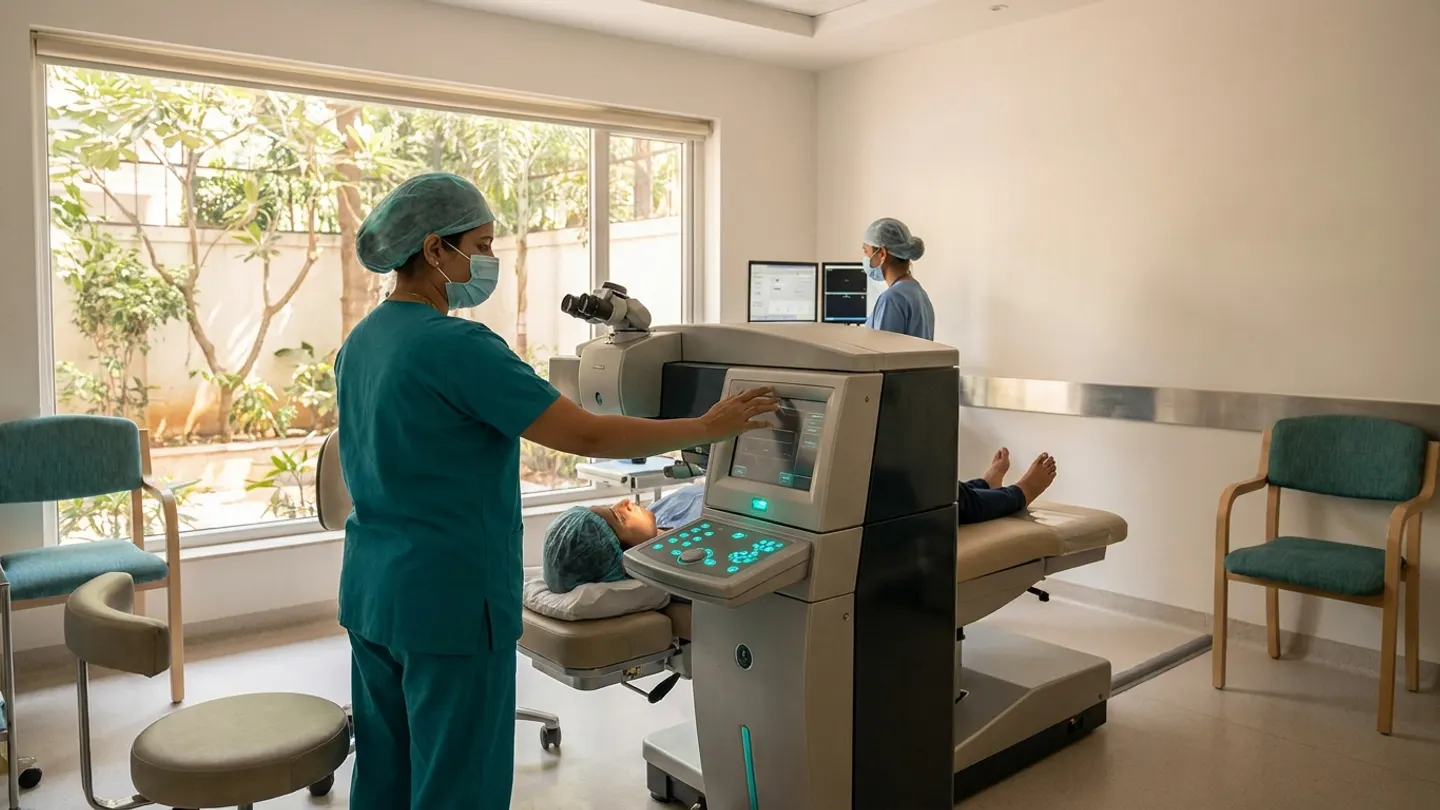
For many Australians, the prospect of paying AUD 5,000 or more to have both eyes corrected feels like choosing between clear vision and financial comfort. If you have been weighing India against Thailand as a more affordable alternative, you are in good company — and the good news is that both destinations can restore your eyesight for a fraction of the cost back home.
LASIK Eye Surgery India vs Thailand Cost: The Numbers That Matter
LASIK eye surgery India vs Thailand cost comparisons consistently show India as the more budget-friendly destination in 2026. Australians can expect to pay approximately AUD 500–1,200 per eye in India and AUD 700–1,500 per eye in Thailand — compared with AUD 2,500–3,500 per eye at home. That gap does not vanish when you add flights and accommodation; most patients still save 60–75% all-in.
2026 Indicative Cost Comparison
| Destination | Standard LASIK (both eyes) | Bladeless Femto-LASIK (both eyes) | SMILE LASIK (both eyes) |
|---|---|---|---|
| Australia | AUD 5,000 – 7,000 | AUD 6,000 – 8,000 | AUD 7,000 – 9,000 |
| India | AUD 1,000 – 2,400 | AUD 1,500 – 3,200 | AUD 1,800 – 3,800 |
| Thailand | AUD 1,400 – 3,000 | AUD 2,000 – 4,000 | AUD 2,500 – 5,000 |
| UAE (Dubai) | AUD 2,400 – 4,200 | AUD 3,000 – 5,500 | AUD 3,500 – 6,000 |
All figures are indicative 2026 ranges. Final costs depend on your prescription, corneal profile, technology platform, and clinic tier. Always request a written, itemised quote before booking.
A return economy flight from Sydney or Melbourne to Mumbai, Delhi, or Chennai currently costs approximately AUD 700–1,200 depending on timing. Add a week of mid-range accommodation (AUD 60–120 per night) and even the most conservative arithmetic leaves most patients several thousand dollars ahead.
Why Australian Patients Are Choosing India for LASIK
India has built one of the world’s most sophisticated refractive-surgery ecosystems over the past two decades, and that reputation is well earned.
Technology on par with Australia. Leading Indian eye hospitals invest in the same laser platforms used in Western countries — WaveLight Allegretto Wave, VISX Star S4 IR, and Carl Zeiss MEL 90 platforms are standard at top-tier centres. SMILE LASIK, the flapless third-generation procedure, is now widely available in all major Indian cities.
Accreditation you can verify independently. The most reputable hospitals hold JCI (Joint Commission International) or NABH accreditation. These are the same international quality marks applied in Australian private hospitals. You can confirm accreditation status on the JCI and NABH public registries before you book.
Corneal subspecialists with exceptional volume. Senior ophthalmologists at India’s major eye hospitals often complete more LASIK procedures in a single month than their Australian counterparts perform in a year. Volume builds precision. Many of these surgeons completed corneal fellowships in the UK, US, or Europe before returning to practice in India.
“I had checked three practices in Sydney, and the cheapest quote was AUD 5,600 for both eyes. After my procedure in Chennai — including flights and a week in a serviced apartment — I spent around AUD 3,000 total. My vision is now 6/6 in both eyes and I have not looked back.” — This is an illustrative account representative of outcomes reported to IndoMedTour. It does not identify a specific patient.
India vs Thailand: A Closer Comparison
Both countries are legitimate, well-regarded medical-tourism destinations. Your decision may come down to factors beyond price.
Cost and Technology Tier
India generally undercuts Thailand, particularly for premium procedures such as SMILE LASIK or Contoura Vision (topography-guided LASIK). When both eyes and a week of accommodation are factored in, India typically costs 20–35% less than Thailand for the same technology tier.
Surgeon Training and Volume
India’s ophthalmology training pipeline is exceptionally deep, with several eye-care chains recognised internationally as corneal centres of excellence. Thailand also employs skilled surgeons, but India’s sheer scale — particularly in Delhi, Hyderabad, Chennai, and Mumbai — gives patients more choice of facility and surgeon profile.
Language and Communication
English is the language of instruction across Indian medical education, and every major hospital has full English-language patient services, written discharge summaries in English, and coordinators who correspond fluently via email and WhatsApp. Thailand’s international hospitals are also well staffed in English, but medical record translation and follow-up communication can occasionally require extra coordination.
Travel Connectivity
Both destinations are well connected from Australia. Qantas, Air India, IndiGo, Thai Airways, and several Middle Eastern carriers operate direct or single-stop services from Sydney, Melbourne, Brisbane, and Perth to Bangkok, Mumbai, Delhi, Chennai, and Hyderabad. Travel times are broadly similar — typically 9–14 hours depending on routing.
Recovery and Tourism
Thailand is naturally appealing if you want a beach holiday alongside your procedure, though doctors advise avoiding pools, dust, and direct sun for the first two weeks after LASIK. India offers heritage cities, yoga retreats, and Ayurvedic wellness centres — all of which suit the gentle, screen-light rest your eyes need in the first few days after surgery.
What Types of LASIK Are Available in India?
If you are exploring the [/treatments/eye-ophthalmology] page, you will find that Indian eye hospitals offer the full modern range of refractive procedures:
- Standard LASIK — microkeratome flap creation; the most affordable option; suitable for most mild-to-moderate prescriptions.
- Bladeless Femto-LASIK — femtosecond laser creates the flap with greater precision; recommended for patients with thinner or steeper corneas.
- SMILE LASIK — flapless, minimally invasive; associated with lower dry-eye rates post-operatively; preferred by people who play contact sports.
- Contoura Vision (Topography-Guided LASIK) — corrects corneal surface irregularities as well as the refractive error; available at premium centres.
For indicative pricing on each type, visit our treatments and costs page.
Is It Safe? A Pre-Booking Checklist
Safety in LASIK depends primarily on three things: the technology platform, the surgeon’s skill, and how meticulously pre-operative screening is performed. A well-screened patient — no thin corneas, no uncontrolled dry eye, no keratoconus risk — should have very similar outcomes whether the procedure takes place in Melbourne or Mumbai.
Before confirming any booking, verify each of the following:
- Hospital or clinic holds JCI or NABH accreditation (check the public online registries)
- Laser platform is FDA-cleared or CE-marked — ask the clinic for the exact equipment model
- Corneal topography and pachymetry are included in pre-op testing, not optional add-ons
- The surgeon’s profile is available and shows ophthalmology subspecialty or corneal fellowship training
- You receive a written, itemised quote in AUD or USD with no hidden charges
- At least one post-operative follow-up appointment is included in the package
- The clinic has a documented protocol for rare complications such as flap dislocation or post-operative infection
You can review our hospitals to see which JCI and NABH-accredited eye centres IndoMedTour partners with, and read success stories from other Australians who have made this journey.
Planning Your Trip: Practical Notes
Most patients spend 6–8 days in India for LASIK. A typical itinerary looks like this: arrive, settle, and rest on day one; pre-operative screening and mapping on days two and three; surgery on day four; a next-morning post-op check on day five; gentle rest days six and seven; fly home on day eight.
Your eyes are comfortable for the flight home, though you will want preservative-free lubricating drops throughout the journey and to avoid overhead air-conditioning vents blowing directly into your face.
A dedicated international patient coordinator at your chosen hospital can arrange airport-to-clinic transfers, accommodation near the eye centre, and insurance documentation. They will also translate your Australian optometrist’s records into the format required for the Indian pre-op report. Find out more about the full support process on our how it works page, or schedule a free counselling call to ask questions before committing to anything.
How IndoMedTour Helps
When you reach out for a free counselling call, our ophthalmology care coordinator reviews your prescription, any existing corneal data, and your budget — then matches you with two or three accredited eye hospitals in India that fit your profile. We request written, itemised quotes on your behalf, help you plan flights and accommodation, and assign you a personal coordinator who is available from the moment you land until you board your return flight. If any question arises after you are back in Australia, we remain your first point of contact. You bring the worry. We bring the plan.