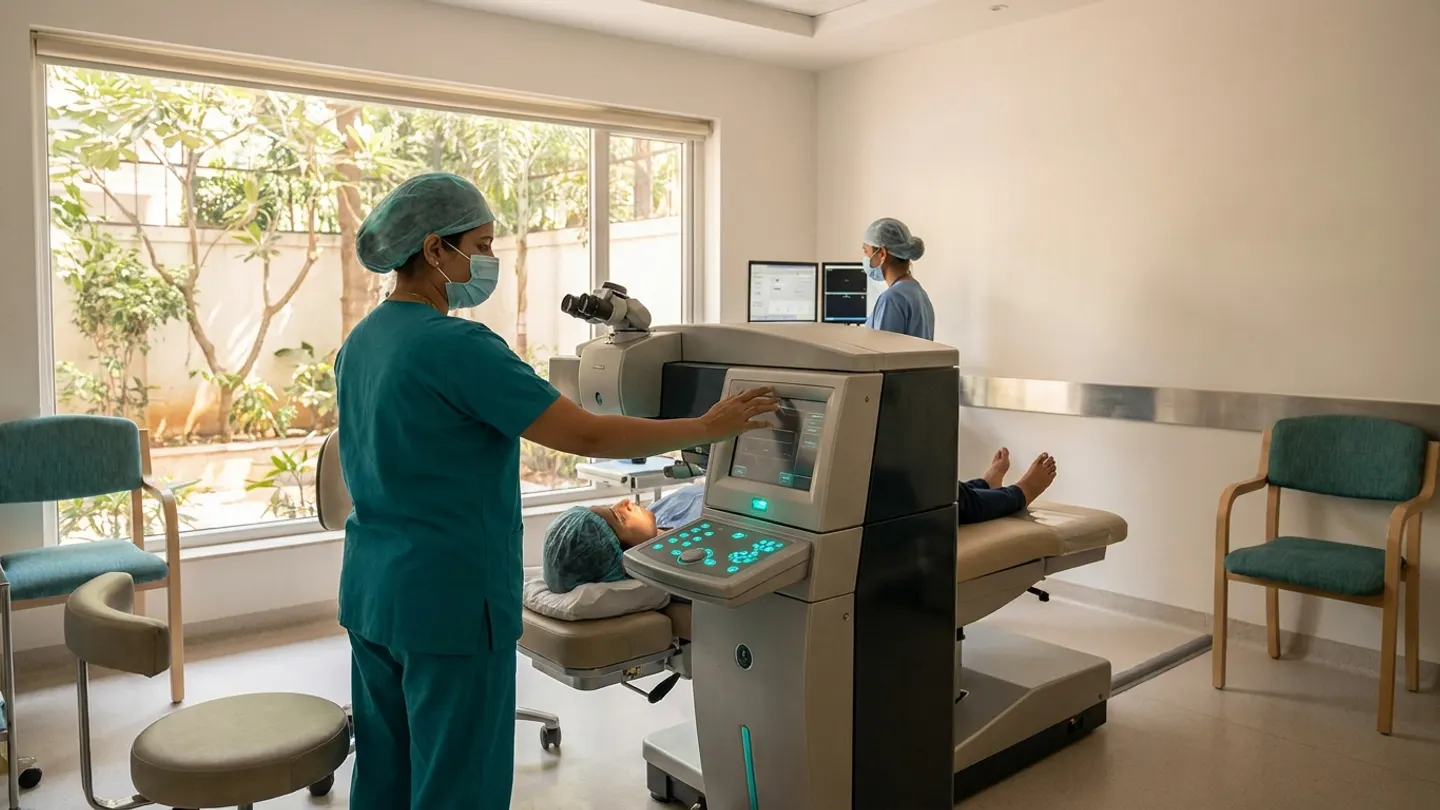
If you have just been quoted £3,000 to £6,000 for LASIK on both eyes at a UK private clinic, you are probably wondering whether there is a more affordable path to clear vision — and there is. Thousands of UK patients travel to India and Turkey every year for laser eye surgery, returning home with excellent results and a significant amount of money saved. The key question is which destination genuinely offers better value for you.
How Much Does LASIK Eye Surgery Cost in India vs Turkey in 2026?
When comparing lasik eye surgery India vs Turkey cost, India is consistently the lower-priced option, with procedures typically starting from approximately £400 to £900 per eye. Turkey sits in a mid-range position, from around £600 to £1,200 per eye — still a substantial saving over UK prices, but not as low as India.
The table below gives a realistic overview of what UK patients can expect across destinations:
| Destination | Standard LASIK (per eye) | Bladeless / SMILE (per eye) | Typical all-in package (both eyes) |
|---|---|---|---|
| UK | £1,500 – £2,500 | £2,000 – £3,500 | £3,000 – £7,000 |
| Turkey | £600 – £1,200 | £900 – £1,600 | £1,200 – £2,400 |
| India | £400 – £900 | £650 – £1,400 | £800 – £1,800 |
| UAE | £900 – £1,800 | £1,200 – £2,200 | £1,800 – £3,600 |
All figures are indicative 2026 ranges. Final cost depends on your prescription strength, chosen laser platform, and hospital. Packages often include pre-operative tests and post-operative drops.
Even after accounting for flights, accommodation, and three to five days abroad, most UK patients save between £1,500 and £4,500 by choosing India over a domestic private clinic.
Why Is LASIK So Much More Affordable in India and Turkey?
The price difference does not reflect a compromise in clinical standards. It reflects a difference in operating costs, surgeon salaries relative to local purchasing power, and the sheer volume of procedures performed.
Lower overheads, not lower standards
In India, ophthalmologists complete the same internationally recognised training pathways, yet clinic overheads and real-estate costs are a fraction of those in London or Manchester. The rupee-to-pound exchange rate amplifies the saving further. India’s domestic demand for laser eye correction is enormous, which means specialist centres process very high volumes — and high volume in a focused surgical centre tends to produce highly refined teams and lower per-patient costs.
Turkey benefits from a similarly competitive private healthcare market, a large pool of internationally trained surgeons, and a medical-tourism infrastructure that has matured rapidly over the past decade. Neither country cuts corners on laser hardware: leading eye hospitals in both destinations invest in the same platforms used across Western Europe.
Quality and Safety: Is LASIK Abroad as Safe as at Home?
This is the question that matters most, and it deserves a frank answer.
Leading eye hospitals in India hold NABH accreditation — India’s national quality body, broadly equivalent to the UK’s CQC — and the top-tier centres additionally carry JCI (Joint Commission International) accreditation, the global benchmark used to assess hospitals in the US, Europe, and the Middle East. Turkey’s leading private eye clinics similarly hold JCI or equivalent ISO certifications.
“Accreditation does not guarantee any specific individual outcome, but it does confirm that an independent body has inspected and approved the hospital’s protocols, laser equipment maintenance schedules, infection-control procedures, and patient safety systems. For laser eye surgery, these systems are directly relevant to your risk profile.”
When you choose a JCI- or NABH-accredited facility through a verified facilitator, you are not accepting a lesser version of the procedure. You are accessing the same clinical safeguards under a different flag. You can explore our hospitals to see which accredited eye centres IndoMedTour partners with.
LASIK Technology Available in India and Turkey
Both destinations offer the full modern range of laser vision correction procedures. There is no need to accept outdated technology because you are travelling abroad.
- Standard LASIK — the most widely available and affordable option, suitable for most myopia, hyperopia, and astigmatism prescriptions
- Bladeless (all-laser) LASIK — uses a femtosecond laser to create the corneal flap rather than a microkeratome blade, reducing flap-related risk; available at most accredited centres in both countries
- SMILE (Small Incision Lenticule Extraction) — a flapless technique preferred for patients with dry-eye tendencies or higher myopia; available at premium centres in India and Turkey
- PRK and LASEK — surface ablation techniques recommended when corneal thickness makes a flap procedure unsuitable
- Wavefront-guided LASIK — customised to each eye’s unique aberration map; available at leading centres in both destinations
India’s specialist eye hospital networks, particularly in cities such as Chennai, Hyderabad, Mumbai, and Delhi, perform exceptionally high volumes of procedures annually. Surgical volume at a focused specialist centre is one of the strongest predictors of consistently low complication rates. For more detail on what to expect, see our eye and ophthalmology treatments page.
Travelling for LASIK: Practical Differences Between India and Turkey
This is where the two destinations genuinely diverge, and your personal circumstances will guide the choice.
Flight time from the UK: Turkey is roughly three to four hours from most UK airports. India is eight to ten hours. If a long-haul flight feels daunting, Turkey has a practical advantage here.
Length of stay required: For standard LASIK, most patients need only four to six days abroad — a pre-operative assessment, the procedure itself (typically 20 to 30 minutes per eye), and at least one post-operative check before flying home. Both destinations can comfortably accommodate this schedule.
English language: English is widely spoken in major Indian private hospitals; patient coordinators, consultants, and nursing staff are routinely English-fluent. International hospitals in Turkey also provide English-speaking staff at the coordinator level, though day-to-day communication outside the clinic can be more limited.
Cost of living during your stay: Accommodation, meals, and local transport are generally cheaper in India than in Istanbul. A comfortable hotel close to a specialist eye hospital in Hyderabad or Chennai will typically cost considerably less than equivalent lodging near Turkey’s medical district, adding another layer of saving.
Post-operative experience: Both destinations allow you to rest and recover comfortably. If you plan to extend your trip for leisure, Turkey offers a European-style city or coastal environment. India offers remarkable variety, from heritage hotels in Rajasthan to ayurvedic retreats in Kerala, though any sightseeing involving bright sunlight or dusty environments should wait until after your eyes have fully stabilised.
What to Check Before You Book Either Destination
Whether you choose India or Turkey, work through this checklist before committing to any clinic or deposit:
- Confirm the hospital holds JCI or NABH accreditation — ask for the certificate number and verify it independently
- Receive a fully itemised written quote: surgeon fee, laser platform used, pre-operative testing, post-operative drops, and any follow-up appointments
- Confirm that a pre-operative assessment is performed before the procedure is finalised (no reputable clinic skips this step)
- Ask specifically how many LASIK and SMILE procedures the treating surgeon performs per year
- Understand the clinic’s enhancement and retreatment policy if your vision does not stabilise as expected
- Check that your travel insurance covers complications arising from elective procedures abroad
- Bring a copy of your most recent UK optometrist’s prescription and any previous corneal mapping data
A trustworthy medical facilitator will help you verify every item on this list before you spend anything. Read how it works to understand what that process looks like end-to-end.
India vs Turkey for LASIK: Which Should UK Patients Choose?
If maximising your saving is the priority and you are comfortable with a longer flight, India offers the strongest combination of price, specialist hospital volume, and accreditation. The saving over Turkey is typically £400 to £800 per patient for the procedure alone, and the lower cost of living during your stay adds further value.
If you prefer a shorter journey, a familiar European atmosphere, or simply find Turkey more accessible given your schedule, it remains a thoroughly legitimate and safe option — provided you select an accredited facility rather than booking through a price-comparison site with no clinical vetting.
What both destinations share is the ability to give you a life-changing improvement in vision for a fraction of UK costs, with no meaningful reduction in safety when you choose the right hospital. Compare indicative treatments and costs across procedures, or read success stories from patients who have made this journey before you.
For a broader overview of eye care options available through India’s specialist centres, visit our treatments and costs page or browse the full eye and ophthalmology treatments section.
How IndoMedTour Helps
When you book a free counselling call with our team, we take the time to understand your prescription, your concerns, and your schedule before recommending a shortlist of JCI- or NABH-accredited eye hospitals that specialise in exactly your case. We send you written quotes with no hidden fees, arrange your visa invitation letter, coordinate your travel and accommodation, and assign a dedicated patient coordinator who accompanies you from the first query through surgery, your overnight rest, and your follow-up check before you fly home. You bring the worry. We bring the plan.
Medical costs shown are indicative ranges based on 2026 market data. Individual quotes will depend on prescription, technology selected, and hospital choice. LASIK and related procedures carry inherent medical risks; outcomes cannot be guaranteed. Always consult a qualified ophthalmologist before making a treatment decision.