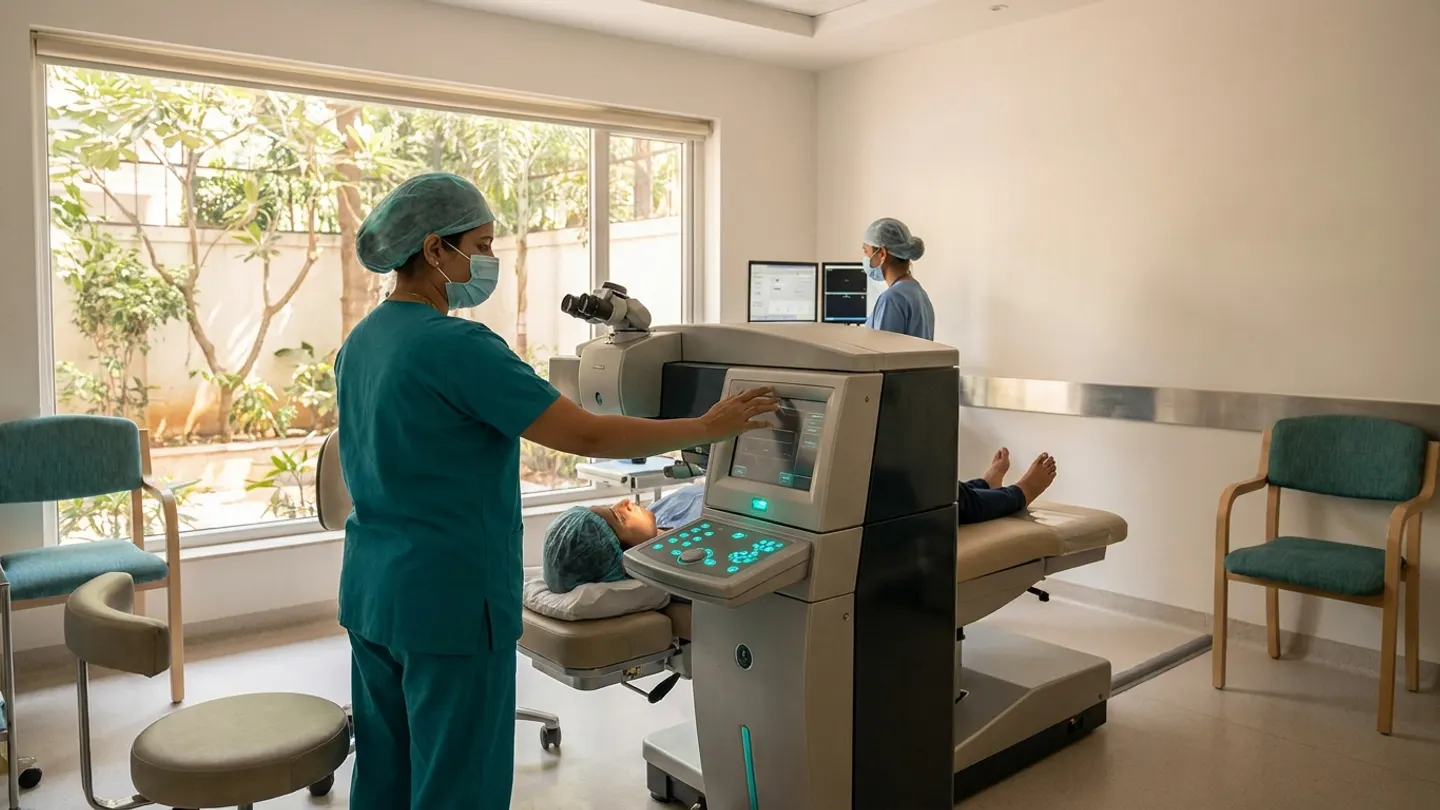
You have worn glasses or contact lenses for years and finally decided it is time for LASIK — only to be told the price in Dubai is steep enough to make you pause. Or perhaps you have already been quoted a figure and are quietly wondering whether the same outcome is possible somewhere more affordable, without sacrificing safety. You are not alone in asking that question.
LASIK in India for UAE Patients: The Direct Answer on Cost and Quality
LASIK in India for UAE patients typically costs between $400 and $900 USD per eye — a saving of 60 to 70 percent compared with equivalent procedures in Dubai or Abu Dhabi. The lower price is not a signal of lower standards: India’s top eye hospitals use the same FDA-cleared excimer laser platforms found in Gulf clinics, the surgeons hold internationally recognised credentials, and the facilities carry JCI or NABH accreditation. For many UAE residents, a short flight to Mumbai, Chennai, or Hyderabad turns an expensive local procedure into an affordable, well-supported journey.
Why the Price Difference Exists
Dubai healthcare operates under high real-estate, staffing, and regulatory overhead costs that are reflected in procedure fees regardless of which laser or which surgeon is involved. Indian eye hospitals serving international patients carry the same equipment and often the same calibre of surgeon, but the operating environment is significantly less expensive to run. That structural difference is passed directly to the patient.
It is also worth noting that the lower cost does not mean a stripped-down experience. Many hospitals catering to medical tourists in India provide private rooms, English-speaking coordinators, airport transfers, and pre-operative workups as part of the package — services that attract additional charges elsewhere.
Dubai vs India LASIK Price Comparison (2026)
| Procedure | Dubai / UAE | India (top-tier hospital) |
|---|---|---|
| Standard LASIK (both eyes) | $2,400 – $5,000 | $800 – $1,800 |
| Bladeless / Femto-LASIK | $3,500 – $6,000 | $1,200 – $2,200 |
| SMILE (minimally invasive) | $4,000 – $7,000 | $1,500 – $2,800 |
| PRK / Surface ablation | $2,000 – $4,500 | $700 – $1,500 |
| Pre-op corneal mapping & workup | Often charged separately | Usually included in package |
| Post-op drops kit | Charged separately | Usually included |
All figures are indicative 2026 ranges for guidance only. Final quotes depend on refractive error, corneal thickness, chosen laser platform, and hospital tier.
Which LASIK Technique Is Right for You?
Not everyone is a candidate for the same procedure, and a good Indian eye hospital will tell you this honestly after a thorough pre-operative assessment rather than upselling you into the most expensive option.
Standard LASIK
The most widely performed technique. A thin corneal flap is created with a microkeratome blade, the laser reshapes the underlying tissue, and the flap is replaced. Recovery is fast — most patients see clearly within 24 hours.
Bladeless Femto-LASIK (All-Laser LASIK)
A femtosecond laser creates the flap instead of a blade, giving the surgeon more precision over flap thickness and diameter. Preferred for patients with thinner corneas or higher prescriptions.
SMILE (Small Incision Lenticule Extraction)
The newest and most minimally invasive option. No flap is created; instead, a small lenticule of corneal tissue is removed through a tiny keyhole incision. Faster healing, fewer dry-eye side effects, and suitable for active patients. Costs a little more but is now widely available at Indian centres serving international patients.
PRK / Surface Ablation
Recommended when corneal thickness rules out LASIK or SMILE. Recovery takes a few extra days but long-term outcomes are equivalent. A good option for UAE patients who are involved in contact sports.
“I had been putting off LASIK in Dubai for two years simply because of the cost. The same Wavelight Allegretto platform used in my Dubai quote was available in Chennai at less than a third of the price — including flights, hotel, and all drops. My coordinator was reachable on WhatsApp from the moment I landed.” — Representative patient experience, Gulf region
Is It Safe? What Quality Accreditation Actually Means
The two quality benchmarks UAE patients should look for are JCI (Joint Commission International) and NABH (National Accreditation Board for Hospitals). Both require documented protocols for infection control, patient safety, surgical outcomes tracking, and equipment calibration — the same frameworks used to evaluate hospitals in Europe and North America.
Laser equipment is the same as you would encounter at home. The Wavelight Allegretto, VISX Star S4, Carl Zeiss MEL 90, and VisuMax (used for SMILE) are FDA-cleared devices operated under the same manufacturer protocols worldwide. The skill of the individual surgeon matters more than geography, and India’s leading eye centres attract surgeons who trained in the UK, US, Germany, or Australia and return to India to operate at volume — meaning they often perform more procedures in a week than a mid-sized Gulf clinic manages in a month.
See our hospitals to read about the accreditation standards we use when matching patients to centres.
What the Journey Looks Like for a UAE Patient
Before You Travel
- A tele-consultation with the eye centre (we arrange this) to review your latest spectacle prescription and discuss suitability.
- If you have had a corneal topography or keratometry done in Dubai, share those results — it saves time.
- Stop wearing soft contact lenses at least 5 days before your pre-op assessment (rigid lenses, 2 weeks). This is not optional; it affects the accuracy of your corneal map.
In India (Typical 4-Day Itinerary)
Day 1: Arrive. Airport transfer to hotel or hospital guesthouse. Rest.
Day 2: Full pre-operative assessment — corneal mapping, pupil dilation, IOP measurement, tear-film evaluation, and a final candidacy decision.
Day 3: Procedure day. The laser treatment itself takes under 15 minutes per eye. You rest in the clinic for an hour, then return to your room.
Day 4: First post-op check. Most patients are cleared to fly home that afternoon or the following morning.
What to Bring
-
Checklist for UAE patients travelling for LASIK:
- Valid passport and Indian e-Visa (processed online in 3-5 days; IndoMedTour can guide you)
- Your current spectacle prescription and any recent eye test reports
- List of all medications, eye drops, or supplements you currently use
- Sunglasses (wraparound style, for post-op light sensitivity)
- Comfortable clothes — hospitals are cold; bring a light layer
- Travel insurance that covers elective procedures abroad (check your policy carefully)
Common Questions from UAE Patients
Will my Dubai-based ophthalmologist accept the Indian post-op records?
Yes. Reputable Indian eye hospitals provide a detailed discharge summary, operative notes, laser settings used (which feeds directly into your refractive record), and a prescribed drop regimen. Your Dubai eye doctor can continue follow-up care using these documents.
What if I am not a LASIK candidate?
Not every cornea qualifies. If the pre-op assessment in India rules out LASIK, you will not be charged for a procedure that was not performed. Alternative options such as ICL (implantable collamer lens) or PRK may still be suitable. See treatments and costs for a broader overview of vision correction procedures available in India.
Can I combine LASIK with other treatment in India?
Absolutely. UAE patients often combine an eye procedure with a dental visit, a general health check, or a dermatology consultation. We coordinate the scheduling so that everything fits into a single trip. Explore how it works for more on combined-treatment planning.
How IndoMedTour Helps
When you book a free counselling call with our team, we review your prescription and existing eye test reports, then match you to a JCI or NABH-accredited eye hospital with the laser platform best suited to your corneal profile. We obtain written, itemised quotes so you can compare transparently, and we handle your Indian e-Visa guidance, airport transfer, and hotel or hospital guesthouse booking. A dedicated coordinator stays in contact with you from the moment you land until you are cleared to fly home, and remains available for questions once you are back in the UAE. Explore our hospitals and success stories to understand the standard of care that awaits you.
You bring the worry. We bring the plan.