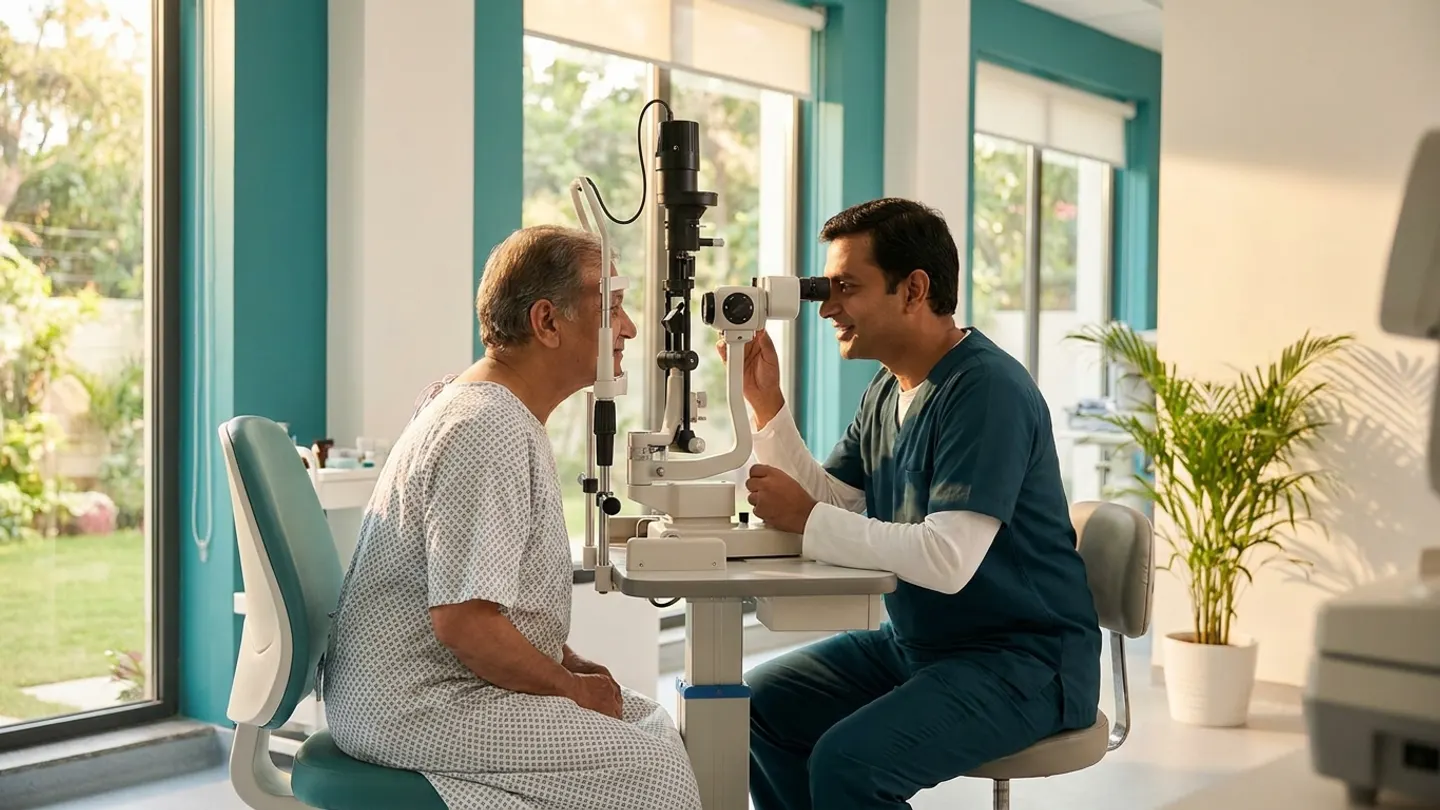
When you see the cost of lens replacement surgery at home, whether that is a $10,000-plus quote in the United States or a two-year wait on a public waiting list in the UK, the idea of travelling to India for treatment feels equal parts hopeful and daunting. You are asking exactly the right questions, and this page is written to answer them honestly.
What Does Lens Replacement Surgery Cost in India in 2026?
Lens replacement surgery cost in India typically starts from approximately $800 per eye for a standard refractive lens exchange (RLE) and rises to around $2,500 per eye for premium multifocal or Extended Depth of Focus (EDOF) lenses. That represents a saving of 60 to 70 percent compared with equivalent procedures in the United States, the United Kingdom, or Australia, with no compromise on lens technology or surgical skill.
| Procedure | India (per eye) | USA (per eye) | UK (per eye) | UAE (per eye) |
|---|---|---|---|---|
| RLE — standard monofocal IOL | from $800 | from $3,500 | from £2,500 | from $3,000 |
| RLE — multifocal or EDOF IOL | $1,500 – $2,500 | $5,000 – $8,000 | £3,500 – £5,500 | $4,500 – $7,000 |
| ICL / Phakic IOL (both eyes) | $2,000 – $3,500 | $5,000 – $8,000 | £3,000 – £5,000 | $4,000 – $6,500 |
| Cataract surgery with premium IOL | $600 – $1,800 | $3,000 – $6,000 | £2,000 – £4,000 | $2,500 – $5,000 |
All figures are indicative 2026 estimates. Final costs depend on your individual prescription, choice of lens, hospital tier, and city. Always request an itemised written quote before committing.
These savings are not the result of cheaper materials. India’s leading eye hospitals implant the same Alcon, Johnson and Johnson, and Carl Zeiss lens brands used in New York, London, and Sydney. The difference is the overhead structure of a developing economy with an exceptionally high volume of eye surgery — India performs more cataract and IOL procedures annually than any other country in the world.
Visit our treatments and costs page for a fuller breakdown by procedure and lens brand.
Types of Lens Replacement Surgery Available in India
Refractive Lens Exchange (RLE)
RLE is the procedure most people mean when they search for lens replacement surgery. The eye’s natural crystalline lens is removed through a small incision and replaced with an artificial intraocular lens (IOL). It permanently corrects long-sight, short-sight, astigmatism, and presbyopia (the age-related loss of reading vision), and it eliminates any future risk of cataracts because the natural lens is no longer present.
RLE is usually recommended for patients over 45 who are not ideal candidates for laser procedures such as LASIK or SMILE, or for anyone whose prescription falls outside the range that laser correction can safely handle.
Indian ophthalmologists perform RLE using phacoemulsification under topical anaesthetic as a day procedure. Most patients are discharged within a few hours and are back in their hotel by the afternoon.
ICL Surgery (Implantable Collamer Lens)
ICL, sometimes called Phakic IOL surgery, is designed for younger patients, typically between 21 and 45, who have high prescriptions that LASIK cannot fully correct. Unlike RLE, the natural lens is left in place. A thin biocompatible lens is inserted between the iris and the natural lens, providing sharp and stable vision without the dry-eye side effects that sometimes follow laser correction.
The EVO Visian ICL, the most widely implanted phakic lens worldwide, is available at accredited Indian eye hospitals at a fraction of the cost in the West. The procedure takes approximately 15 to 20 minutes per eye and is reversible, which many patients find reassuring.
Multifocal and EDOF Lens Implants
If your goal is freedom from both distance glasses and reading spectacles after 50, a premium multifocal or EDOF IOL is worth discussing with your surgeon. Lenses from brands such as Zeiss AT LARA, Alcon PanOptix, and Johnson and Johnson Tecnis Symfony are available at leading Indian eye centres. These lenses are significantly more expensive than standard monofocal IOLs, but even at the premium end of the Indian price range, costs remain well below mid-range pricing in the US or Europe.
See our dedicated guide to eye and ophthalmology treatments in India for more on lens options and expected outcomes.
What Factors Affect the Cost of Lens Replacement Surgery in India?
The written quote you receive will depend on several variables. Knowing them in advance helps you compare hospitals fairly:
- Type of IOL — monofocal (basic vision correction), toric (astigmatism-correcting), multifocal, or EDOF lenses each carry different costs
- Lens brand — imported premium lenses from Alcon or Zeiss cost more than quality domestic alternatives
- City — Delhi, Mumbai, and Bangalore tend to be modestly higher than Hyderabad, Chennai, or Ahmedabad
- Hospital tier — JCI/NABH-accredited hospitals command a slight premium that still sits far below international prices
- Surgeon’s experience — fellowship-trained refractive or corneal specialists may charge more
- Pre-operative diagnostics — corneal topography, biometry, and OCT scans may be bundled or billed separately depending on the hospital
- Unilateral vs. bilateral surgery — most hospitals offer a discount when both eyes are treated during the same visit
Always ask for an itemised written quote in your home currency. IndoMedTour provides this as standard before you book anything.
Is Lens Replacement Surgery in India Safe?
“I was nervous about trusting an overseas surgeon with my eyes. But the hospital in Chennai was cleaner than any clinic I had visited at home, the pre-operative checks were more thorough than I expected, and my surgeon had completed the same corneal fellowship training as specialists I had seen in London. I can read a restaurant menu for the first time in fifteen years.” — Representative patient experience. Not a specific identifiable individual.
Safety concerns are entirely reasonable when considering eye surgery abroad. Here is what the evidence looks like in practice.
India’s top eye hospitals, particularly those with international patient departments, hold accreditation from either the Joint Commission International (JCI) or the National Accreditation Board for Hospitals and Healthcare Providers (NABH). These are the same quality and infection-control standards applied to hospitals in the US, UAE, and Europe. Surgical technique, sterile protocols, equipment calibration, and patient outcome tracking are all audited against internationally benchmarked criteria.
Ophthalmologists at these centres are typically graduates of AIIMS, JIPMER, or other nationally ranked medical institutions, many of whom have completed additional fellowships in refractive and corneal surgery in the UK, Germany, or the United States. Large Indian eye hospitals perform cataract and IOL procedures at volumes that most Western private clinics cannot match, meaning surgical teams are exceptionally well-practised.
Browse our partner hospitals to review accreditation status and international patient services at each centre.
What Does a Typical Lens Replacement Trip to India Look Like?
For most international patients, the complete journey from arrival to departure takes between seven and ten days. A general outline:
- Day 1: Airport transfer, hotel check-in, orientation with your IndoMedTour coordinator
- Day 2: Full pre-operative assessment — biometry, corneal topography, OCT scan, and any blood tests required
- Day 3 or 4: Surgery (both eyes are often treated on the same day or on consecutive days)
- Days 5 to 7: Supervised recovery, post-operative review, prescribed drop regimen
- Day 8 or 9: Final surgical clearance and sign-off
- Day 10: Departure
Recovery days are spent comfortably in a hotel. Most patients eat out, walk in the city, and rest between check-ups. Prescribed eye drops and polarised sunglasses are the main requirements. India’s warm, relatively dry climate suits post-operative eye recovery well outside the monsoon months.
Read more about the full process on our how it works page, including visa requirements and travel logistics.
Am I a Candidate for Lens Replacement Surgery in India?
You may be a suitable candidate for RLE or ICL if:
- You are over 45 with presbyopia and want to reduce dependence on reading glasses
- Your prescription is too high for LASIK or SMILE to correct safely
- Your corneas are too thin for laser surgery
- You have early lens changes that rule out laser treatment
- You want a permanent, glasses-free result that also eliminates future cataract risk
An online consultation with one of IndoMedTour’s ophthalmic advisors, using scans from your local optometrist or ophthalmologist, can give you a useful preliminary indication without you needing to travel. Book a free counselling call to start the conversation.
How IndoMedTour Helps
Book a free counselling call and our patient coordinators will review your prescription details and existing diagnostic scans, then match you with two or three JCI or NABH-accredited partner hospitals that specialise in your procedure type. Within a few days you will receive itemised written quotes in your home currency, with no hidden costs on arrival. We arrange your medical visa invitation letter, airport transfers, and hotel accommodation near the hospital. A dedicated coordinator stays beside you from the day you land, through every post-operative review appointment, until your surgeon clears you to fly home. You bring the worry. We bring the plan.