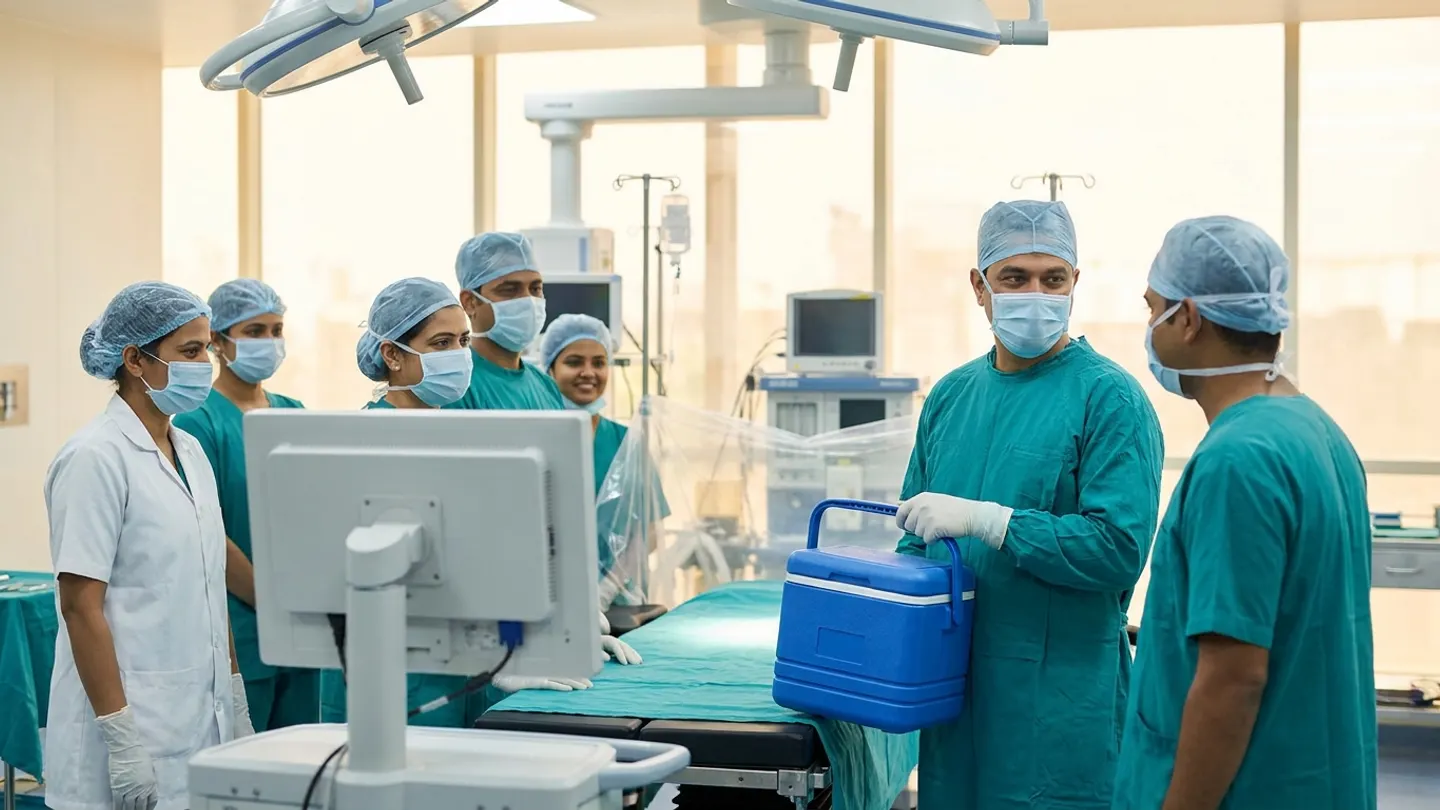
When a doctor tells you or someone you love that a kidney transplant is the only real path forward, the conversation shifts from medical to deeply personal very quickly. You start thinking about who might donate, whether India is a realistic option, what the law actually allows, and whether you will have to navigate it all alone. This guide answers those questions honestly and completely.
Living Donor Kidney Transplant India Requirements: The Core Rules
Living donor kidney transplant India requirements are governed by the Transplantation of Human Organs and Tissues Act (THOTA), 1994, amended most recently in 2014. Under this law, a living donor must be a ‘near relative’ of the recipient, or alternatively, they may donate through an authorised swap programme. The rules exist specifically to prevent organ trafficking and protect both donor and recipient.
Here is what the law defines as a qualifying near relative:
- Spouse
- Son or daughter (natural or adopted)
- Father or mother
- Brother or sister
- Grandfather or grandmother
- Grandson or granddaughter
Non-relatives — including close friends or distant cousins — may still donate, but they must clear an additional review layer through a State Authorization Committee (SAC), which assesses the nature of the relationship, emotional bond, and absence of any financial transaction.
Who Can Be a Living Kidney Donor in India?
Beyond the relationship requirement, every prospective donor must satisfy a medical and legal checklist before the hospital will proceed.
Legal requirements:
- Minimum age of 18 years (donors under 65 are generally preferred, though there is no hard upper cut-off)
- Voluntary, written, informed consent — given without coercion and renewed at multiple stages
- Absence of any commercial arrangement (a financial gift, debt write-off, or property transfer linked to donation is illegal and criminal)
- Valid government-issued identity proof confirming the relationship
Medical requirements:
- Two healthy, functioning kidneys confirmed on imaging
- Compatible blood group (ABO-compatible or, increasingly, ABO-incompatible with desensitisation protocols at specialist centres)
- No active infections, including HIV, hepatitis B, or hepatitis C
- No uncontrolled diabetes, hypertension, or chronic kidney disease
- Normal kidney function tests (GFR typically above 80 ml/min/1.73m²)
- No significant cardiovascular disease or malignancy
- Body mass index within an acceptable range (most centres assess BMI individually)
- Psychological assessment confirming the donor acts freely and understands the risks
“Donating a kidney is one of the most generous acts a person can make. India’s regulatory system is deliberately rigorous because it must protect the donor, who gives up something irreplaceable, every bit as much as it protects the recipient.”
The medical workup for a donor typically takes five to ten days and includes blood typing, crossmatch tests, CT angiography of the renal vasculature, cardiac evaluation, and a psychiatric interview. No donor clearance means no surgery — this is non-negotiable.
The Authorization Committee Process for International Patients
International patients face one additional step that domestic patients may not: review by a State Authorization Committee (SAC). This committee sits in the state where the transplant hospital is located.
The SAC evaluates:
- Proof of the donor-recipient relationship (birth certificates, marriage certificate, passport pages)
- Evidence that the donor and recipient have known each other over time (photographs, travel records, communication history)
- A declaration that no money or property has changed hands in connection with the donation
- Independent psychological and social-work reports on both parties
- In non-relative cases: the detailed history of the emotional bond
Most reputable transplant hospitals have a dedicated transplant coordinator and legal team that prepares the SAC dossier for you. The process typically adds two to four weeks to the pre-transplant timeline. Your IndoMedTour coordinator will guide this end-to-end so nothing is missed.
What About Kidney Swap (Paired Exchange) Programmes?
If a donor is medically suitable but blood-group incompatible with their intended recipient, several large Indian transplant hospitals now run paired exchange programmes. In a swap, two incompatible donor-recipient pairs exchange donors so that each recipient receives a compatible kidney. Both transplants happen simultaneously. Swap programmes are fully legal under THOTA and are increasingly common at high-volume centres.
Cost Comparison: Living Donor Kidney Transplant in India vs Other Countries
The cost difference between India and Western destinations is substantial — and for many patients, it is what makes the transplant possible at all.
| Country | Approximate All-in Cost (USD) | Notes |
|---|---|---|
| India | $13,000 – $22,000 | Includes surgeon fees, hospital stay, immunosuppressants (first 30 days), donor workup |
| UAE | $80,000 – $120,000 | Limited living-donor programme; regulatory constraints |
| United Kingdom | $90,000 – $130,000 | Available only through NHS for residents; private route very expensive |
| United States | $150,000 – $400,000 | Hospital and surgeon fees alone; immunosuppressants billed separately |
| Australia | $80,000 – $150,000 | Medicare covers citizens; international patients pay full private rates |
Prices are indicative 2026 ranges for planning purposes. Your written quote from an Indian hospital will itemise every component.
What the Indian package typically includes:
- Full donor evaluation and clearance workup
- SAC documentation support (at major hospitals)
- Operating theatre, surgical team, and anaesthesia for both donor and recipient
- ICU stay for recipient (usually two to four days)
- Ward stay for recipient (typically ten to fourteen days total)
- Donor surgery and post-operative monitoring (donors are usually discharged in four to five days)
- Immunosuppression medications for the first 30 days
- Discharge summary and follow-up protocol for your home physician
What is usually billed separately or varies:
- Travel and accommodation for the donor, recipient, and a companion
- Visa fees
- Immunosuppressant medications beyond the first 30 days (these are lifelong)
- Any complication management
For a detailed, itemised estimate based on your specific case, use our treatments and costs page or speak with our team directly.
Choosing a Hospital: Why Accreditation Matters
India has dozens of hospitals offering kidney transplantation, and quality varies considerably. For an international patient, the only reliable baseline is accreditation.
Look for:
- JCI (Joint Commission International) accreditation — the global gold standard, recognised by insurers and governments worldwide
- NABH (National Accreditation Board for Hospitals) accreditation — India’s national equivalent, with rigorous standards for surgical safety, infection control, and patient rights
Beyond accreditation, high-volume matters in transplant surgery. A programme that performs 150 to 300 kidney transplants per year will have lower complication rates, stronger donor support protocols, and better-established SAC relationships than one performing 20 to 30. Ask your hospital coordinator directly how many living-donor kidney transplants they performed last year.
Explore our hospitals page for a curated list of accredited transplant centres we work with.
What the Timeline Looks Like: A Realistic Plan
Most international patients underestimate how much preparation is involved before the surgery date is confirmed. Here is a realistic timeline once you have a willing, eligible donor:
Weeks 1-2: Initial remote consultation with the transplant team; submission of existing medical records (recipient) and preliminary donor health history; hospital confirms whether they can take your case.
Weeks 3-4 (in India): Comprehensive donor workup — blood tests, imaging, cardiology, psychiatry; recipient evaluation and crossmatch; SAC dossier preparation and submission.
Weeks 5-6: SAC hearing and approval (timing depends on the state and committee schedule); final surgical planning; pre-operative preparation.
Surgery and recovery: Transplant surgery day; recipient ICU stay (typically two to four days); ward recovery (ten to fourteen days total); donor monitored and discharged around day four or five; recipient discharged with a written protocol.
After discharge: Weekly blood tests for the first month (these can be done at a laboratory near your accommodation or home country on a shared protocol); follow-up teleconsultation at four weeks and three months.
Build in a minimum of six weeks in India, and plan for eight if you want comfortable buffer time. Read our how it works page for a step-by-step overview of the full patient journey.
Common Concerns International Patients Raise
“Will the donor need to stay in India for a long time?” Donors who are otherwise healthy are typically cleared to fly home seven to ten days after surgery, subject to their surgeon’s individual assessment. Most donors feel well enough to travel by day seven but should not fly long-haul for two to three weeks.
“What if our blood groups are incompatible?” Ask the hospital specifically about their ABO-incompatible transplant programme. Several leading centres in India have established desensitisation protocols that allow ABO-incompatible living-donor transplants. Alternatively, ask about the paired exchange (swap) programme. Both options are available and legal.
“What about the donor’s long-term health?” Reputable centres provide every donor with a long-term follow-up plan and should counsel them that living with a single kidney requires modest lifestyle adjustments (hydration, blood pressure monitoring, avoiding nephrotoxic medications). The research literature shows that careful donors who are well-selected have a normal life expectancy.
Check our success stories for accounts from patients who have completed the process with our support.
How IndoMedTour Helps
Navigating living donor kidney transplant India requirements is complex enough that having a single, experienced point of contact makes an enormous difference. We begin with a free counselling call to understand your situation — donor details, medical history, timeline, and budget — and then match you with the right JCI- or NABH-accredited transplant centre for your specific case. We arrange written cost estimates before you book anything, coordinate your medical visa documentation, and assign a dedicated patient coordinator who is reachable throughout the donor workup, SAC process, surgery, and recovery. You will never be navigating an unfamiliar hospital system alone.
Book a call at /contact or explore your options at /treatments/organ-transplant.
You bring the worry. We bring the plan.