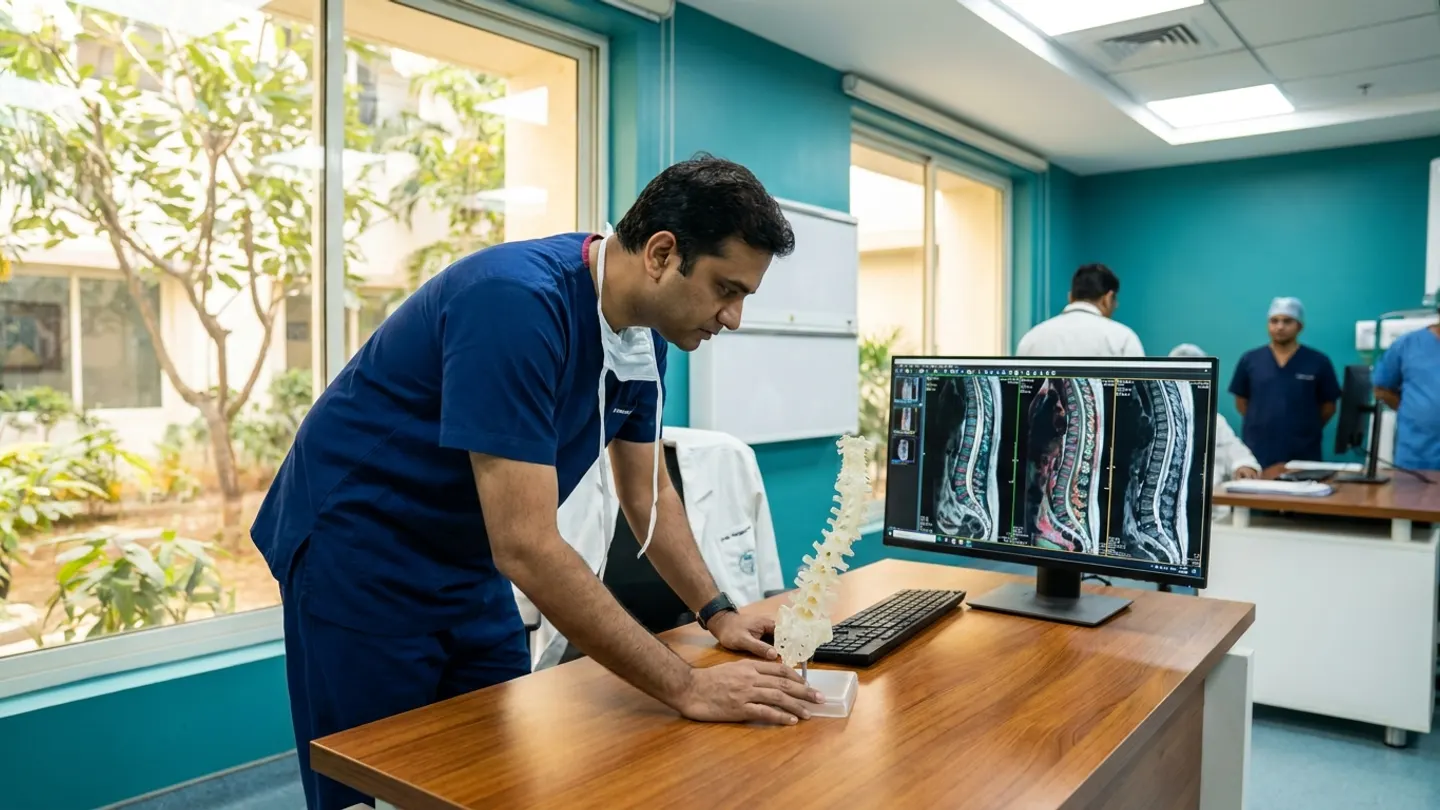
Being told you need lumbar disc replacement surgery is frightening enough. Then you look up the cost in your home country and the fear doubles — or triples.
If you are reading this comparing bills, waiting-list letters, or insurance rejection emails, you are in the right place. Thousands of patients from the US, UK, Australia, and the UAE are choosing to have total disc replacement (TDR) surgery in India every year — not out of desperation, but because they discover that world-class spine care does not have to cost a world-class fortune.
Lumbar Disc Replacement Cost in India: The Direct Answer
Lumbar disc replacement cost in India typically ranges from $5,000 to $9,000 for a single-level procedure, covering surgery, implant, anaesthesia, hospital stay, and routine post-operative care. That is 85-90 % less than what the same surgery costs in the United States, where total bills routinely exceed $60,000-$100,000. Even compared to countries with universal healthcare systems, where waiting times for elective spine surgery can stretch to 18-24 months, India offers a compelling alternative that keeps your life moving.
How India Compares to Other Countries (2026 Indicative Prices)
| Country | Single-Level Lumbar TDR (Approx. All-In) |
|---|---|
| India | $5,000 – $9,000 |
| United States | $55,000 – $120,000 |
| United Kingdom | $25,000 – $40,000 (private) |
| Australia | $30,000 – $55,000 (out-of-pocket) |
| UAE (Dubai) | $18,000 – $32,000 |
| Thailand | $12,000 – $20,000 |
All figures are indicative 2026 ranges in USD. Prices vary by hospital tier, implant brand, number of levels treated, and individual clinical complexity. Always request a written itemised quote before committing.
Multi-level procedures (replacing two discs) cost proportionally more — typically $8,000-$14,000 in India — but remain a fraction of equivalent Western pricing.
What Is Lumbar Disc Replacement (TDR)?
Total disc replacement, or artificial disc replacement (ADR), is an alternative to spinal fusion for patients with degenerative disc disease at one or two lumbar levels (most commonly L4-L5 or L5-S1). Instead of fusing two vertebrae together permanently, the surgeon removes the damaged disc and inserts an artificial implant that preserves natural movement at that spinal segment.
The key advantages over traditional fusion are motion preservation, a lower risk of adjacent-segment degeneration over the long term, and — for many patients — a faster return to normal activity.
Am I a Candidate for Lumbar Disc Replacement?
TDR is not suitable for everyone. Your surgeon will typically recommend it when:
- You have single- or two-level degenerative disc disease (DDD) causing chronic low-back pain, with or without leg symptoms
- Conservative treatment (physiotherapy, injections, pain management) has been tried for at least six months without adequate relief
- Imaging confirms disc degeneration at the affected level(s) without significant facet joint arthritis, instability, or osteoporosis
- You are in good general health and do not have prior lumbar fusion at the same level
If you have already received a surgical recommendation at home, your existing MRI and CT reports are usually sufficient for an Indian specialist to provide an opinion and a written quote — no repeat scans required in most cases.
Why Do International Patients Choose India for Spine Surgery?
“I waited 14 months on the NHS list. My pain was a 9 out of 10 every morning. A friend told me about India. I flew to Delhi, had the surgery, and was back home walking properly in three weeks. I genuinely wish I had known sooner.” — Representative patient experience, name withheld.
Cost is the opening door, but it is rarely the only reason people travel for lumbar TDR. Here is what patients consistently report:
- Short waiting times. Most patients are scheduled within 2-4 weeks of receiving their written quote and hospital approval.
- Experienced spine surgeons. India’s leading spine centres perform high volumes of TDR procedures annually. Many surgeons have fellowship training from Europe or North America.
- Modern implant technology. Hospitals use globally recognised artificial disc systems from manufacturers such as Medtronic, DePuy Synthes, and Globus Medical — the same devices used in the US and Europe.
- Personalised care ratios. Private hospitals in India typically offer better nurse-to-patient ratios than equivalent-tier hospitals in the West.
- English-language care. All major medical-tourism hospitals operate entirely in English.
Quality and Accreditation: The Safety Bar You Must Insist On
Safety is non-negotiable. When evaluating any hospital for spine surgery abroad, the minimum standard you should require is either JCI (Joint Commission International) or NABH (National Accreditation Board for Hospitals) accreditation. These are independent, internationally recognised quality certifications that assess infection control, surgical safety protocols, patient rights, and clinical outcomes.
India has more JCI-accredited hospitals than any other country in Asia. Our hospital network includes only accredited centres, and we provide accreditation certificates as part of every information pack.
What Is (and Is Not) Typically Included in the Quoted Price?
Before you compare quotes, make sure you are comparing the same things. A reputable hospital will provide an itemised breakdown. Here is what a comprehensive lumbar TDR package in India should include:
Typically included:
- Pre-operative tests (blood work, X-rays, MRI review)
- Surgeon, anaesthesiologist, and assistant surgeon fees
- The artificial disc implant (verify the brand)
- Operating theatre and ICU/HDU time if required
- Hospital stay (typically 3-5 nights)
- Physiotherapy sessions during the hospital stay
- Meals and nursing care
Typically excluded (plan for these separately):
- International flights and airport transfers
- Hotel accommodation before/after discharge
- Travel insurance and emergency medical cover
- Post-discharge physiotherapy (usually 5-10 sessions recommended)
- Any complications requiring additional intervention (rare, but always confirm coverage)
Questions to Ask Before You Confirm Your Surgery
- Is this a fixed-price package, or an estimate that can increase?
- Which implant brand and model will be used?
- What is the surgeon’s specific TDR case volume per year?
- Is the hospital JCI or NABH accredited?
- What happens if there is a complication — is that cost covered?
- Can I speak with a previous international TDR patient from this hospital?
- Who is my dedicated coordinator for the duration of my stay?
Planning Your Trip: What the Timeline Looks Like
For most patients travelling from abroad, the practical timeline is straightforward:
- Week 1 (remote): Share your MRI/CT reports and medical history. Receive a written surgical opinion and itemised quote within 3-5 business days.
- Week 2-4 (planning): Confirm hospital and surgeon, apply for a medical visa (India’s e-Medical Visa is typically granted in 3-7 business days), and book flights.
- Arrival day: Airport pickup, hotel check-in or direct hospital admission.
- Day 1-2 (India): Pre-operative assessments and consultant meeting.
- Day 3: Surgery (typically 2-3 hours under general anaesthesia).
- Days 4-7: Hospital recovery, first physiotherapy sessions, pain management.
- Days 8-14: Hotel-based recovery with outpatient physio; team monitors your progress daily.
- Day 14-15: Medical clearance to fly. Follow-up plan shared with your home doctor.
Most patients report being able to walk independently within 24-48 hours of surgery and return to desk work within 4-6 weeks of reaching home. Physical labour and high-impact activities typically resume at 3-6 months, guided by your rehabilitation programme.
See how it works for a full walkthrough of the end-to-end process, and explore treatments and costs for a broader comparison across procedure types.
For more detail on the surgical approach and what recovery involves, visit our neurosurgery and spine treatments page.
How IndoMedTour Helps
We start with a free, no-obligation counselling call — book yours here — where a care coordinator listens to your diagnosis, answers your questions honestly, and explains your options without any sales pressure. From there, we match you to two or three accredited hospitals that are the best clinical fit for your specific disc levels and health profile, and we obtain written itemised quotes from each so you can compare fairly. We handle your medical visa letter, airport transfers, hotel options near the hospital, and a detailed pre-travel checklist. Once you land, a dedicated coordinator stays beside you through every step — from pre-op prep to discharge and the flight home. For any question that comes up in the weeks after you return, we remain reachable. You bring the worry. We bring the plan.
For related reading, explore our success stories from patients who have made this journey before you.