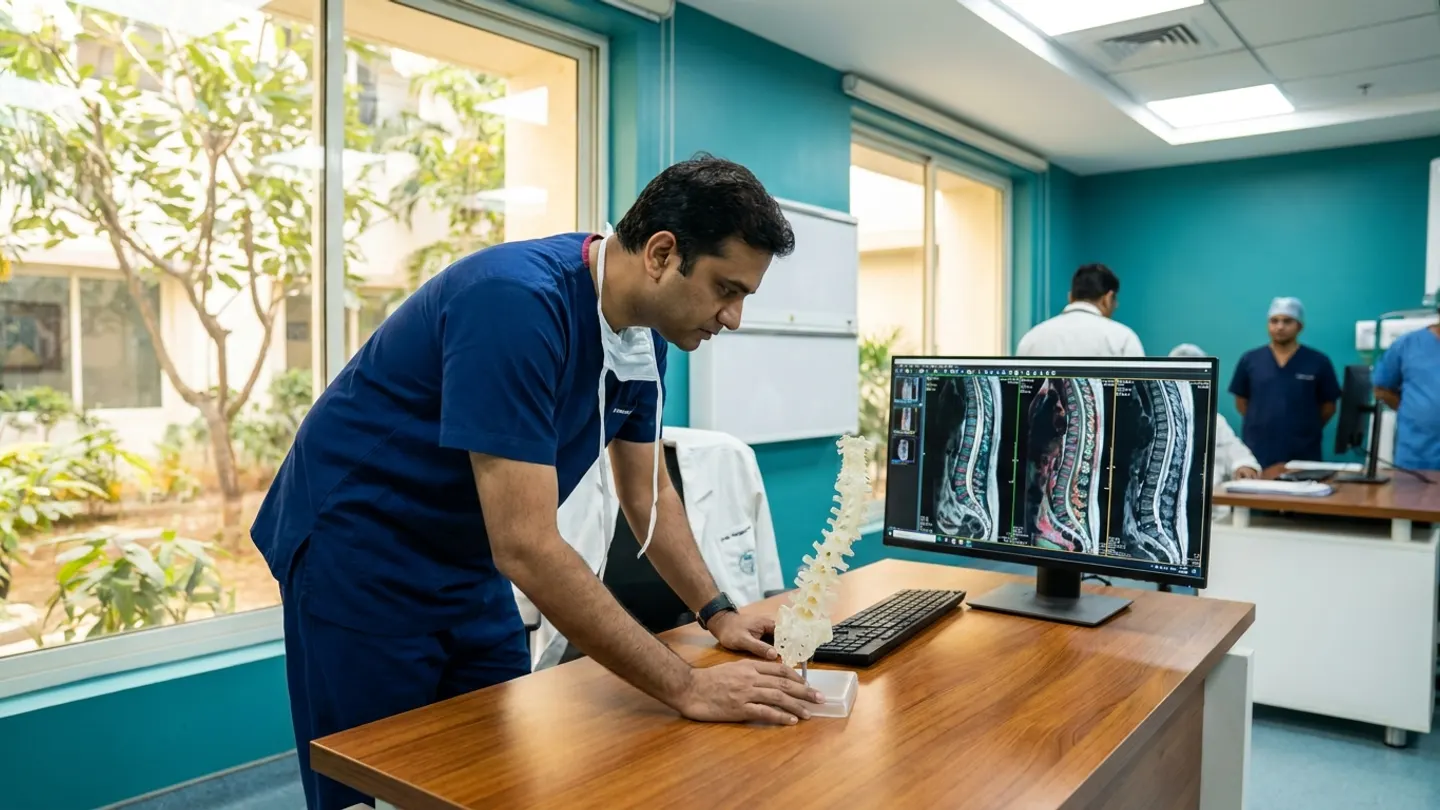
Living with lumbar spinal stenosis means navigating the narrowing of a passageway that your spinal cord and nerve roots absolutely depend on. The leg pain, numbness, and weakness that force you to stop and rest every few minutes — and the dawning realisation that surgery may be the only real answer — can feel overwhelming. Add a hospital quote from your home country that runs to $30,000 or more, or a public waiting list measured in months, and the anxiety compounds.
The good news is that thousands of international patients choose India for this exact surgery every year, returning home with significant relief and substantial savings intact.
Lumbar Spinal Stenosis Surgery Cost in India: The Direct Answer
Lumbar spinal stenosis surgery in India costs approximately $3,500 to $9,000 at a high-quality, internationally accredited hospital. That covers the full surgical episode: pre-operative investigations, surgeon and anaesthesia fees, the operating room, implants or consumables where needed, and the post-operative ward stay. The figure is 70 to 85 percent lower than comparable care in the United States or Australia — not because of any compromise in surgical skill or equipment, but because India’s lower overhead costs and different healthcare economics make world-class spine care genuinely affordable.
India vs the World: Indicative Cost Comparison
The table below covers the most common surgical interventions for lumbar spinal stenosis — open laminectomy and minimally invasive decompression — as well as lumbar fusion when instability is also present. All figures are indicative 2026 ranges in USD, inclusive of hospital stay and standard implants where applicable.
| Country | Laminectomy / Decompression | Lumbar Fusion (1-2 levels) | Typical Public Wait |
|---|---|---|---|
| India | $3,500 – $6,500 | $5,500 – $9,000 | 3–7 days |
| United States | $25,000 – $55,000 | $40,000 – $85,000 | 2–6 weeks (insured) |
| United Kingdom | $12,000 – $22,000 (private) | $20,000 – $35,000 (private) | 6–18 months (NHS) |
| Australia | $14,000 – $28,000 (private) | $22,000 – $45,000 (private) | 6–12 months (public) |
| UAE | $8,000 – $16,000 | $14,000 – $24,000 | 1–3 weeks |
| Thailand | $5,000 – $10,000 | $8,000 – $14,000 | 1–2 weeks |
Even after return airfares and two to three weeks of accommodation, most patients from the US, UK, or Australia save $20,000 to $60,000 compared to care at home.
What Drives the Cost Range Within India
The difference between a $3,500 quote and an $8,000 quote is real and depends on several clinical and logistical factors.
Type of Surgical Procedure
Not all spinal stenosis surgery is the same. The approach your spine surgeon recommends will depend on the severity of your stenosis, the number of levels affected, and whether the vertebrae show any signs of instability.
- Minimally invasive decompression (MID): A keyhole approach targeting a single level, using a tubular retractor and microscope or endoscope. Shorter hospital stay, faster recovery, lower overall cost. Suitable for straightforward single-level stenosis without significant instability.
- Open laminectomy: Removal of the lamina (the back of the vertebral arch) to widen the spinal canal. Often the preferred route when multiple levels are involved or the anatomy makes minimally invasive access difficult.
- Laminectomy with spinal fusion: When stenosis is accompanied by spondylolisthesis (one vertebra slipping forward over another) or significant instability, fusion with pedicle screws and rods is added to prevent the spine from collapsing further. This adds implant costs and a longer hospital stay.
- Endoscopic foraminotomy: A highly targeted technique for foraminal stenosis (where the nerve exit tunnel rather than the central canal is narrowed). Available at specialist spine centres and often results in same-day or next-day discharge.
Number of Spinal Levels
Stenosis affecting a single level (most commonly L4-L5 or L5-S1) costs less than surgery addressing two or three levels. Each additional level increases operating time, implant costs if fusion is required, and complexity. Your neurosurgeon or orthopaedic spine surgeon will specify the levels on your MRI report.
Hospital Tier and City
India’s metropolitan hospitals occupy a meaningful quality spectrum. Tier-1 referral centres in cities such as Delhi, Mumbai, Chennai, Hyderabad, and Bengaluru carry higher room rates and surgeon fees than hospitals in smaller cities. Both tiers can deliver excellent clinical outcomes; the choice often comes down to personal preference for amenities and the specific surgeon you want to work with.
Implant Brand and Grade
Where fusion is needed, the choice between domestic and internationally branded pedicle screw systems affects cost. Premium imported implants add to the bill but remain far less expensive than identical brands at US hospital rates.
What Indian Hospitals Include in the Price
A quoted package price at an accredited Indian spine centre typically includes:
- Pre-operative blood work, MRI review, and anaesthesia fitness assessment
- Operating room, anaesthesia, and surgeon’s fees
- Implants and consumables (screws, rods, bone graft substitute where applicable)
- ICU or high-dependency stay (usually one night after complex cases)
- Shared or private ward accommodation for the post-operative period
- Physiotherapy sessions before discharge and discharge medications
Items billed separately: airport transfers, companion accommodation, visa assistance fees, and follow-up imaging requested after discharge.
“I had been on the NHS waiting list for eleven months. My pain was worsening every week and I could barely walk to the corner shop. Within three weeks of contacting IndoMedTour I had a surgery date, a warm ward bed, and a team that spoke to me like a person, not a file number. Six weeks after surgery I was walking my dog again.”
— Margaret, 61, Scotland (representative patient experience)
This account is illustrative and representative of patient feedback received. It does not refer to a specific, identifiable individual.
Is Lumbar Spinal Stenosis Surgery in India Safe?
This question deserves a direct, honest answer.
India’s leading spine hospitals hold JCI (Joint Commission International) and NABH (National Accreditation Board for Hospitals) accreditation — the same quality standards applied in the US and Europe. Complication rates for spinal decompression and fusion at accredited Indian centres are consistent with published international benchmarks.
What to Look for When Choosing a Hospital
- JCI or NABH accreditation certificate (verify directly on the JCI and NABH websites)
- A dedicated neuro-spine unit with a full ICU
- Neurophysiological monitoring (SSEP/MEP) available during complex or multi-level fusion procedures
- A spine surgeon with at least 300 procedures per year in your specific technique
- Transparent, itemised written cost estimates before you commit to travel
Our hospitals page lists only facilities that meet these criteria.
The Recovery Timeline for International Patients
Planning your travel around realistic recovery milestones protects both your health and your investment.
Days 1–3 (in hospital): Physiotherapy-supervised mobilisation begins within 24 to 48 hours. Pain is managed intravenously, then transitioned to oral medication before discharge.
Days 4–10 (hotel or recovery apartment): Short walks are encouraged. Your coordinator arranges physiotherapy sessions at the hotel and the surgeon’s outpatient review around day 7 or 10.
Days 11–18 (pre-departure): A final clinical review confirms fitness to fly. Economy-class seating is generally acceptable for minimally invasive cases; a business-class upgrade may be recommended after multi-level fusion.
Weeks 3–12 (at home): Outpatient physiotherapy at home is the most critical phase. Your Indian surgical team provides detailed discharge summaries and remains reachable for follow-up questions.
Lumbar Spinal Stenosis Surgery Checklist: Before You Travel
Use this list to confirm you are properly prepared:
- Obtain and share your full MRI report (DICOM files preferred, not just the radiologist’s written summary)
- Get a written second opinion from your home country neurosurgeon confirming the surgical recommendation
- Request an itemised, written cost estimate from your IndoMedTour-matched hospital before booking flights
- Confirm your travel insurance covers surgery abroad and any complications that require extended stay
- Arrange for a companion if your post-operative mobility will be limited in the first week
- Discuss your anticoagulant or diabetes medications with your Indian surgeon before travel — adjustments are often needed in the peri-operative period
- Plan your return flight for a minimum of 14 days after surgery (18+ days for fusion cases)
For a full walkthrough of the process, read our how it works guide.
When Surgery Is — and Is Not — the Right Step
Surgery is not always the first answer. Many patients with moderate stenosis benefit from a structured non-surgical pathway first: epidural steroid injections, physiotherapy-directed core strengthening, and activity modification. Your spine surgeon in India will review your MRI and clinical history honestly. If conservative management is still appropriate, a good surgeon will say so. If surgery is genuinely indicated, the goal is a procedure that gives you back reliable, pain-free walking distance. Learn more on our neurosurgery and spine treatments page or browse patient success stories from people who came to India for spinal surgery and have returned to active lives.
How IndoMedTour Helps
We start with a free counselling call where a care coordinator listens to your full history and answers your questions without any pressure or sales script. We then match you with two or three appropriate, accredited spine centres, gather written itemised quotes on your behalf, and send you a clear side-by-side comparison. Our team handles medical visa documentation, airport transfers, and hotel or recovery-apartment booking near your hospital. During your stay, a dedicated coordinator is reachable around the clock and accompanies you to every hospital appointment. After you return home, we stay in touch through your recovery and liaise with your Indian surgical team on your behalf if questions arise.
Check our treatments and costs page for a broader overview of what medical travel to India involves, then book your free call when you are ready.
You bring the worry. We bring the plan.