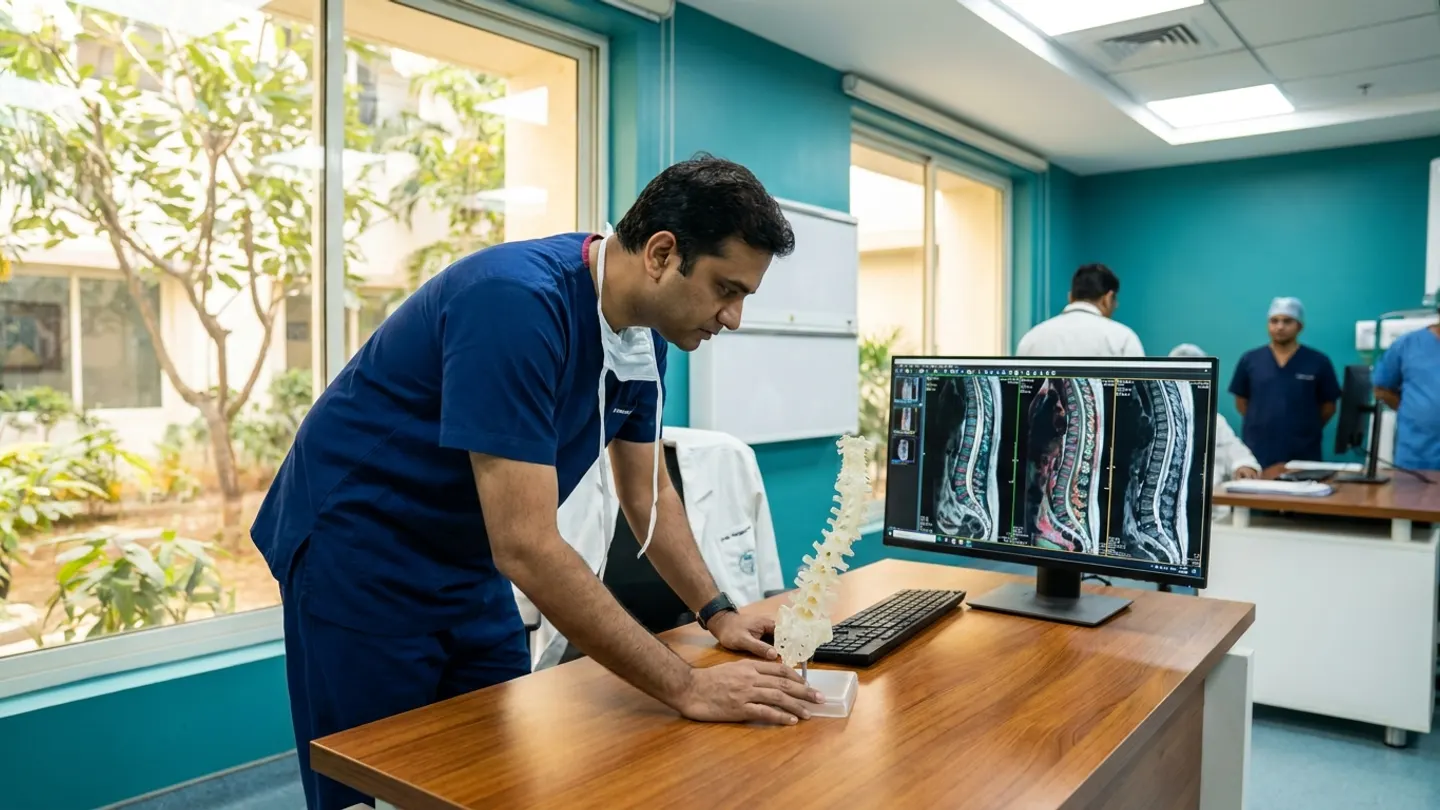
Chronic back or leg pain that has stolen your sleep, your mobility, and your sense of normal life is frightening enough on its own. Discovering that the surgery your spine specialist recommends costs $50,000 or more at home — with a six-to-twelve-month wait — can feel like a second blow. If you are reading this while weighing your options, you are in the right place.
Minimally Invasive Spine Surgery Cost in India: The Direct Answer
Minimally invasive spine surgery in India costs approximately $3,500 to $9,000 at a high-quality, internationally accredited hospital. That is 70 to 85 percent less than the same procedure in the United States, United Kingdom, or Australia. The difference is not in surgical skill or equipment — India’s leading spine centres use the same Karl Storz endoscopes, O-arm imaging systems, and neuromonitoring technology found in the world’s best hospitals. The savings come from structurally lower hospital overheads and the absence of the billing mark-ups that characterise Western healthcare systems.
What the Numbers Look Like: India vs the World
The table below shows indicative 2026 total-package costs covering surgeon fees, anaesthesia, OT charges, implants or consumables (where applicable), hospital stay, and standard post-operative physiotherapy sessions. Flights, hotel, and personal expenses are not included.
| Procedure | India | United States | United Kingdom | Australia | UAE |
|---|---|---|---|---|---|
| Microdiscectomy (single level) | $3,500 – $5,500 | $20,000 – $40,000 | $15,000 – $28,000 | $18,000 – $35,000 | $12,000 – $20,000 |
| Endoscopic spine surgery | $4,000 – $7,000 | $25,000 – $50,000 | $18,000 – $35,000 | $20,000 – $40,000 | $14,000 – $22,000 |
| TLIF / PLIF (single level) | $5,500 – $9,000 | $40,000 – $80,000 | $25,000 – $50,000 | $28,000 – $55,000 | $18,000 – $30,000 |
| XLIF / LLIF (lateral approach) | $6,000 – $9,500 | $45,000 – $100,000 | $28,000 – $55,000 | $30,000 – $60,000 | $20,000 – $35,000 |
| Vertebroplasty / Kyphoplasty | $3,000 – $5,000 | $20,000 – $35,000 | $12,000 – $22,000 | $15,000 – $28,000 | $10,000 – $18,000 |
All figures are indicative ranges for 2026. Final costs depend on hospital tier, city, implant brand, number of spine levels treated, and individual medical complexity. Get a written, itemised quote for your case.
Why Minimally Invasive? Key Advantages Over Open Surgery
Minimally invasive spine surgery (MISS) uses small incisions — often under 2 cm — tubular retractors, and high-definition cameras or endoscopes to access the spine with minimal disruption to the surrounding muscles and soft tissue. Compared with traditional open surgery, this translates to:
- Significantly less blood loss during the procedure
- Lower risk of post-operative infection
- Shorter hospital stay (often 1 to 3 days versus 5 to 7 days for open procedures)
- Less post-operative pain and reduced reliance on strong painkillers
- Faster return to walking, light activity, and work
- Smaller, less visible scars
For patients travelling internationally, the faster recovery also means a shorter overall stay in India — an important practical consideration.
Which Spine Conditions Are Treated With MISS in India?
India’s best spine hospitals treat a wide range of conditions using minimally invasive approaches. The most common include:
Disc Herniation (Slipped or Bulging Disc)
A herniated disc pressing on a nerve root causes radiating pain, numbness, or weakness down the arm or leg (sciatica). Endoscopic discectomy or microdiscectomy removes the offending disc material through a tiny incision, decompressing the nerve with minimal muscle disruption.
Spinal Stenosis
Narrowing of the spinal canal puts pressure on the spinal cord or nerve roots, causing pain, cramping, and weakness — particularly when walking. Minimally invasive decompression (laminotomy or foraminotomy) widens the canal without destabilising the spine.
Spondylolisthesis and Instability
When one vertebra slips forward over another, the spine loses stability and nerves are compressed. Minimally invasive fusion procedures — TLIF (Transforaminal Lumbar Interbody Fusion) or XLIF (Extreme Lateral Interbody Fusion) — stabilise the affected segment through small side incisions, using titanium cages and pedicle screws rather than a large posterior opening.
Compression Fractures
Osteoporotic vertebral compression fractures cause sudden, severe back pain. Kyphoplasty (a minimally invasive procedure in which a small balloon is inflated inside the fractured vertebra to restore height, then filled with bone cement) is routinely performed as a same-day or overnight procedure in Indian hospitals.
Degenerative Disc Disease
For carefully selected patients with chronic discogenic pain that has not responded to conservative care, minimally invasive interbody fusion can provide lasting relief by eliminating motion at the painful segment.
Explore the full scope of procedures at [/treatments/neurosurgery-spine].
What Drives the Cost of Minimally Invasive Spine Surgery in India?
Several factors move the final price up or down:
- Number of levels treated: Single-level procedures are significantly less expensive than two-level or three-level surgery requiring multiple implants.
- Approach and technique: Pure endoscopic procedures (such as TESSYS or PELD) sometimes cost slightly less than open-hybrid minimally invasive fusions because implant costs are lower.
- Implant brand: Titanium cages and pedicle screws vary in cost depending on whether a premium international brand (Medtronic, DePuy Synthes) or a high-quality Indian-manufactured equivalent is used. Your surgeon will guide you on the best option for your anatomy.
- Hospital tier and city: Premium multi-specialty hospitals in Mumbai, Delhi, or Chennai typically charge 15 to 25 percent more than equivalent-quality hospitals in Hyderabad, Pune, or Bangalore — though all JCI or NABH accredited centres maintain the same clinical standards.
- Pre-operative investigations: MRI, CT myelogram, nerve conduction studies, and blood tests are required before surgery. These add approximately $300 to $600 to the total.
- Physiotherapy and rehabilitation: Post-operative physiotherapy is essential for a good outcome and is usually included in hospital packages for the inpatient stay. Outpatient sessions during your recovery window in India are inexpensive by international standards.
Quality Assurance: Why India’s Hospitals Are Safe for Spine Surgery
“The best spine surgeons in India did not get there by accident. They trained at leading institutions in the US, Germany, or the UK, brought those techniques home, and now perform a volume of procedures that gives them an edge even over their Western peers.” — A common reflection from patients who’ve done their research.
When evaluating a hospital for spine surgery abroad, the two quality benchmarks to look for are JCI accreditation (the international gold standard, awarded by the same body that accredits US hospitals) and NABH accreditation (India’s national quality standard, recognised by the International Society for Quality in Health Care). India has more JCI-accredited hospitals than any other Asian country, and spine surgery is one of the disciplines where Indian hospitals have accumulated the highest international volumes.
Key quality indicators to ask about:
- Does the hospital have a dedicated spine unit with a multi-disciplinary team (neurosurgeon, orthopaedic spine surgeon, neuro-anaesthetist, neuromonitoring technician, physiotherapist)?
- Is intraoperative neuromonitoring (IOM) used during fusion or decompression procedures?
- What is the hospital’s annual volume for the specific procedure you need?
- Is there an ICU with neurocritical care capability on the same campus?
Browse our matched hospitals to see accreditation details and specialisation profiles.
What Is Typically Included in an India Spine Surgery Package?
Most hospitals offering packages for international patients include:
- Pre-operative consultation with the lead spine surgeon
- All pre-operative investigations (blood work, imaging review)
- Surgeon, assistant surgeon, and anaesthetist fees
- Operation theatre and neuromonitoring charges
- Implants, consumables, and specialised equipment (endoscope, tubular retractors)
- Hospital room (private or shared — your choice) for the agreed duration
- Nursing care, meals, and basic medications during the inpatient stay
- Post-operative physiotherapy sessions during hospitalisation
- Discharge summary, imaging, and medical records in English
Items typically not included: international flights, local airport transfers, hotel accommodation outside the hospital, and extended outpatient physiotherapy after discharge. Ask your IndoMedTour coordinator for a clear breakdown before you commit.
A Checklist: Questions to Ask Before You Travel
Before confirming your surgery date, make sure you can answer yes to all of the following:
- I have shared my complete MRI/CT reports and the treating surgeon’s notes with the Indian hospital for a remote opinion.
- I have a written, itemised cost estimate covering all surgical and in-hospital fees.
- I know which implant brand and grade will be used and why.
- I understand the expected length of hospital stay and the minimum in-country recovery period recommended before flying home.
- I have arranged travel insurance that covers medical complications and medical repatriation.
- I know who my dedicated coordinator is and have their direct contact number.
- I have a follow-up plan with my home doctor for ongoing care after I return.
Download our step-by-step guide on how it works if you want a fuller picture of the journey from first enquiry to flying home.
Is a Medical Visa Straightforward for Spine Surgery?
Yes. India’s e-Medical Visa is designed for exactly this purpose. You apply online, upload your hospital appointment confirmation, and typically receive approval within 3 to 5 business days. The visa allows up to three entries and a 60-day stay, with the possibility of extension if a longer recovery is needed. An IndoMedTour coordinator will provide the hospital’s invitation letter, which is required as part of the application. One accompanying attendant may apply for an e-Medical Attendant Visa on the same timeline.
How IndoMedTour Helps
From the moment you reach out through a free counselling call, our team reviews your MRI reports and clinical history, then matches you with the most appropriate spine centre and surgeon for your specific condition — not just the cheapest option, but the right clinical fit. We obtain written, itemised quotes from two or three hospitals so you can compare transparently, and we handle every logistics detail: visa letters, airport transfers, hotel recommendations close to the hospital, and coordination with the surgical team. Throughout your hospital stay and your recovery window in India, a dedicated coordinator remains reachable around the clock. When you fly home, we stay connected to make sure your local follow-up is on track.
You bring the worry. We bring the plan.
For more on spine and neurological care options, visit [/treatments/neurosurgery-spine] or read patient experiences from people who have walked this path before you.