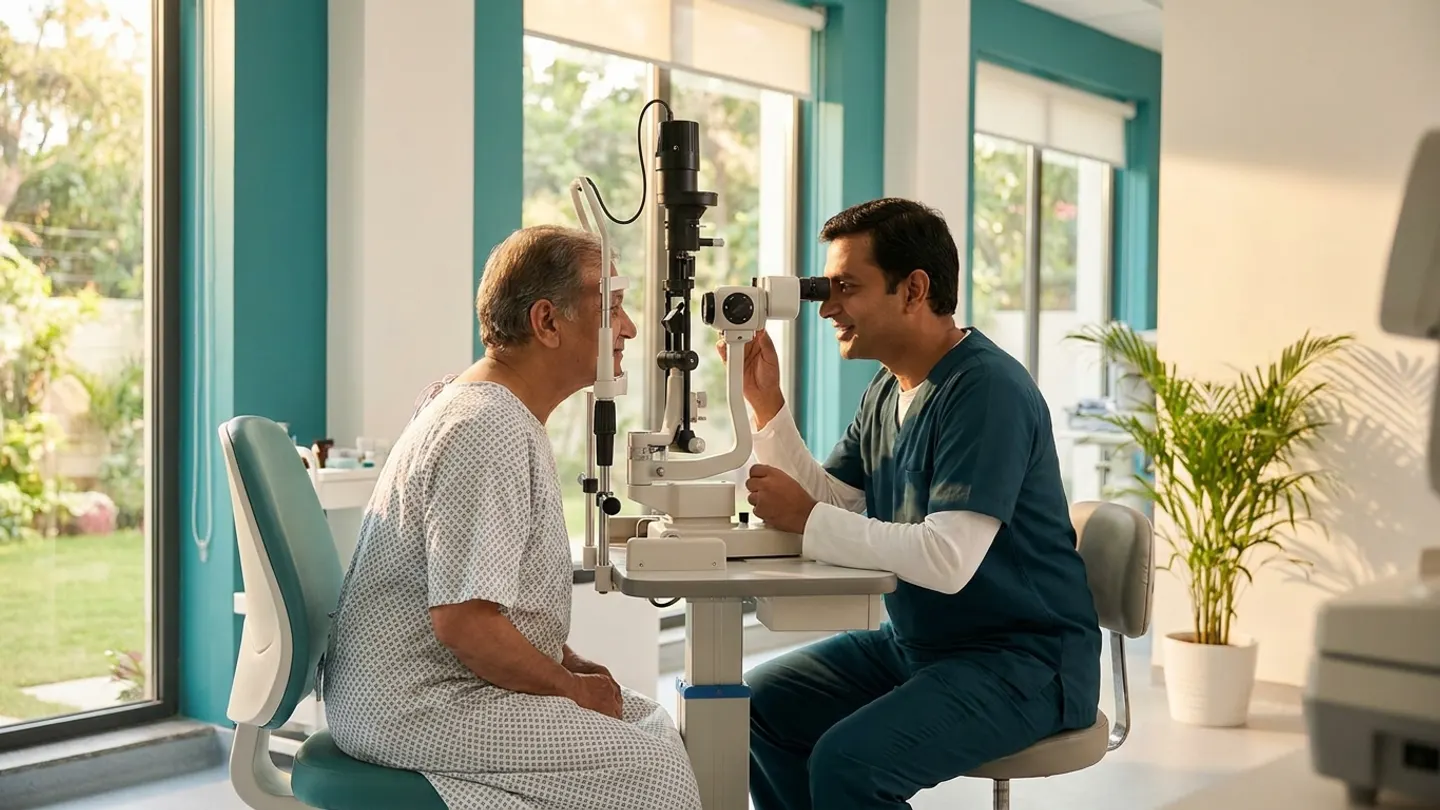
Blurry vision creeping in over months, colours fading, headlights turning into starbursts at night — cataract is unsettling even before you see the surgery quote. If your ophthalmologist at home has told you that the lens choice alone could add thousands to your bill, or if a waiting list is stretching your discomfort further, you are not alone. Many patients from the US, UK, Australia, and the Middle East are now choosing to have their cataract surgery in India — and coming home seeing clearly without the financial strain.
Multifocal vs Monofocal Lens for Cataract in India: The Core Difference
When comparing multifocal vs monofocal lens for cataract in India, the deciding factors are lifestyle, budget, and how much you want to depend on glasses afterward. A monofocal intraocular lens (IOL) corrects vision at one focal point — typically distance — so you will likely still need reading glasses. A multifocal IOL splits incoming light across near, intermediate, and far focal points, giving most patients functional vision at all distances without spectacles. India offers both lens types at a fraction of Western prices, performed by highly trained surgeons in internationally accredited eye hospitals.
What Is a Monofocal IOL?
A monofocal IOL replaces your eye’s natural clouded lens with a single-focus artificial lens. It is the most widely used IOL type worldwide and has decades of safety data behind it. Most patients choose to optimise for distance vision and then use reading glasses for close work such as books, phones, and menus. The optics are simpler, which means fewer optical side effects like glare or halos — an important consideration if you drive regularly at night.
Monofocal lenses are also available in a toric variant that corrects astigmatism at the same time, keeping the single-focus simplicity while reducing dependence on distance glasses for people with a corneal curvature issue.
What Is a Multifocal IOL?
A multifocal IOL uses concentric rings etched into the lens surface to simultaneously focus light at near, intermediate, and far distances. The brain learns to select the relevant focal point for any given task within a few weeks of surgery. For most recipients, the result is genuine spectacle independence — reading a book, working at a laptop, and recognising faces across a room, all without reaching for glasses.
The trade-off is that some patients notice glare, halos, or reduced contrast sensitivity in very low light, particularly in the first weeks post-surgery. Modern premium designs have narrowed this gap considerably, but it is worth discussing your night-driving habits candidly with your surgeon.
What About EDOF and Trifocal Lenses?
Extended-depth-of-focus (EDOF) lenses are a middle ground: they extend the range of clear vision rather than creating distinct focal points, which typically means better intermediate vision with fewer halos than a standard multifocal. Trifocal lenses add a dedicated intermediate focal zone. Both are available in India through the same international brands used globally, and Indian pricing makes trialling a premium lens far more accessible than it would be at home.
Cost Comparison: Multifocal vs Monofocal IOL in India vs Other Countries
The table below shows indicative all-in costs per eye for 2026, including surgeon’s fee, facility charges, the IOL itself, anaesthesia, and a standard post-operative follow-up. Individual quotes will vary depending on the hospital tier, the exact lens brand selected, and whether laser-assisted (femtosecond) phacoemulsification is chosen.
| Country | Monofocal IOL (per eye) | Premium Multifocal IOL (per eye) |
|---|---|---|
| India | $400 – $900 | $900 – $2,500 |
| United States | $3,500 – $5,500 | $5,000 – $8,000 |
| United Kingdom (Private) | $2,800 – $4,500 | $4,500 – $7,000 |
| Australia | $2,500 – $4,000 | $4,000 – $7,500 |
| UAE (Dubai) | $1,500 – $3,000 | $3,000 – $5,500 |
| Thailand | $800 – $1,600 | $1,500 – $3,000 |
All figures are indicative. Bilateral surgery (both eyes) is commonly done one to two weeks apart. Most international patients save enough on a bilateral multifocal procedure in India to cover flights, accommodation, and a brief recovery stay — and still come home thousands ahead.
Who Should Choose Which Lens?
There is no universally correct answer, which is why an honest consultation matters so much. The checklist below helps you frame the conversation with your surgeon.
Choose a monofocal IOL if you:
- Are comfortable wearing reading glasses and already do so
- Have significant night-driving needs and are cautious about halos
- Have certain corneal conditions (dry eye, irregular cornea) that can amplify multifocal side effects
- Are prioritising the lowest possible cost
- Have had previous laser refractive surgery (LASIK/PRK), which can complicate multifocal IOL calculations
Choose a multifocal or EDOF IOL if you:
- Strongly dislike wearing glasses and want to minimise dependence on them
- Lead an active lifestyle involving near and far tasks throughout the day
- Have a healthy cornea and no history of refractive surgery
- Are willing to accept a short adjustment period for the brain to adapt to the new optics
- Want the lifestyle benefit and find the cost difference manageable — especially given India’s pricing
“The best IOL is the one that matches your actual daily life, not just your prescription. A monofocal can be the perfect answer for one person and the wrong choice for another. A thorough biometry workup and an honest conversation about your habits are more important than any brand name.” — IndoMedTour clinical advisory note
Quality and Safety: What JCI and NABH Accreditation Mean for Your Eyes
A reasonable fear when considering surgery abroad is whether the standard of care matches what you would receive at home. In India’s leading eye hospitals, the honest answer is that it does — and the proof is institutional.
JCI (Joint Commission International) accreditation is the global gold standard for hospital quality, and NABH (National Accreditation Board for Hospitals) is India’s equivalent rigorous national standard. Hospitals holding these accreditations undergo regular external audits covering surgical protocols, infection control, equipment maintenance, and patient safety systems. The phacoemulsification technique used to remove the cataract and implant the IOL is identical in these hospitals to what is used in top-tier Western facilities. The IOL brands themselves — Alcon AcrySof, Johnson and Johnson Tecnis, Zeiss AT Lara, and similar — are the same products available globally.
Recovery time is also reassuringly quick. Most patients are discharged the same day or within a few hours of the procedure, with vision improving noticeably within 24 to 48 hours. A standard international patient programme involves a pre-operative assessment on day one, surgery on day two or three, and a follow-up check before flying home. Total stay in India is typically five to eight days for a single eye, or ten to fourteen days if both eyes are done sequentially.
Explore the full range of eye and vision care services available through our hospitals and learn more on the eye and ophthalmology treatments page.
Planning Your Trip: Practical Steps
Once you have a recommendation in hand, the logistics of travelling to India for cataract surgery are more manageable than most patients expect. A few things to organise in advance make the experience smooth.
- Obtain a copy of your current spectacle prescription and any previous eye reports or scans
- Confirm with your treating team at home whether there are any corneal conditions that should influence lens choice
- Arrange a medical visa (e-MedVisa for India) with a confirmed hospital appointment letter
- Plan for a companion if you are having both eyes done, as vision in the operative eye is temporarily patchy in the first day or two
- Confirm post-operative drops are available for purchase in India (they are, at a fraction of home pharmacy prices)
- Schedule a follow-up with your local ophthalmologist roughly four to six weeks after returning home
For a fuller picture of what to expect at every stage, read through how it works and browse patient success stories from people who have made this journey before you.
If cost is your first question, treatments and costs gives country-by-country comparisons across all major procedures, and you can book a free counselling call to get a written quote personalised to your prescription and preferred lens type.
How IndoMedTour Helps
IndoMedTour coordinates every step so that the medical part is the only thing you need to think about. From the first free counselling call, we match you with a JCI- or NABH-accredited eye hospital suited to your diagnosis and budget, arrange written cost quotes from two or three centres so you can compare honestly, and handle your medical-visa invitation letter and travel planning. Once you arrive, a dedicated patient coordinator stays beside you from airport pickup through surgery and post-operative review — and remains reachable by phone until you are safely back home with clear vision. You bring the worry. We bring the plan.