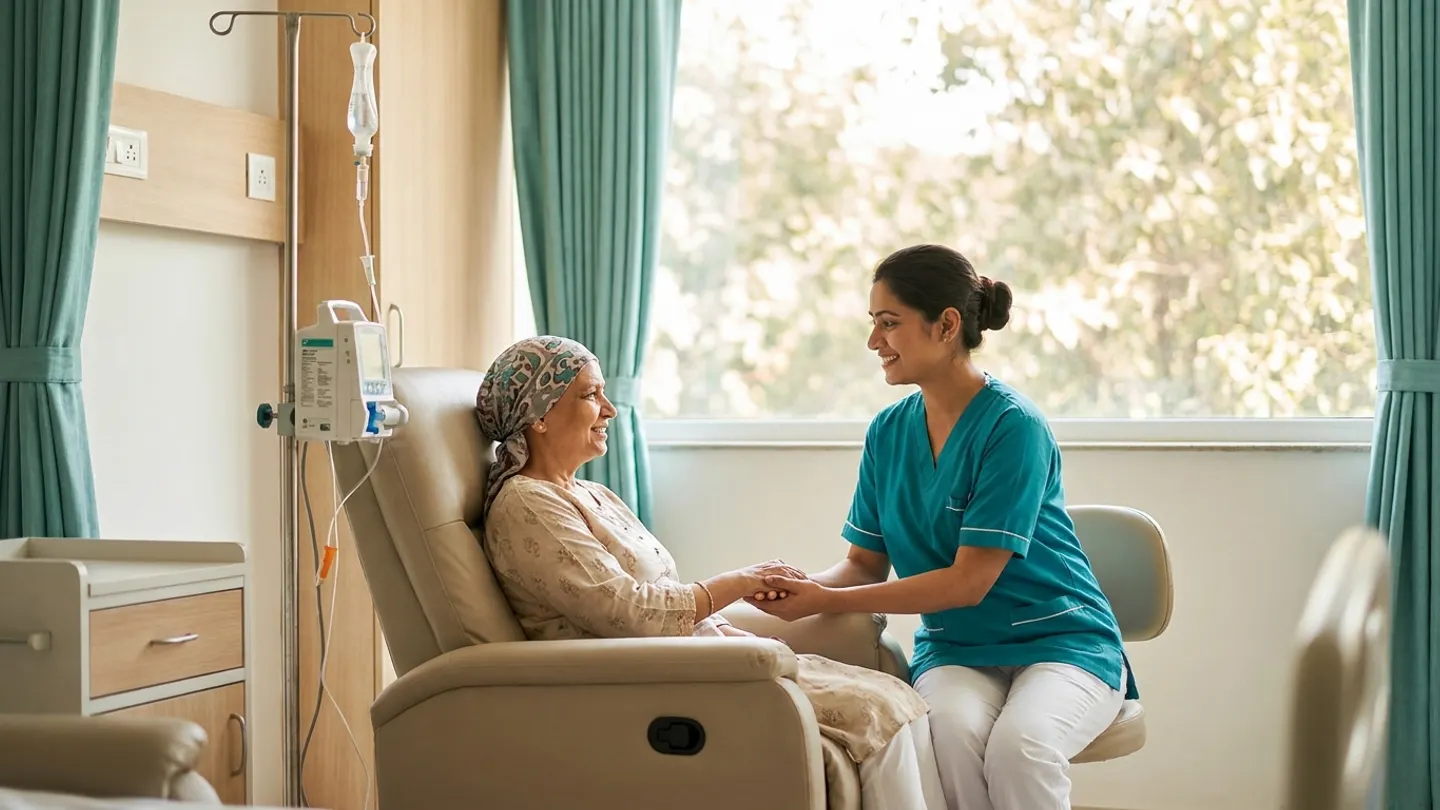
The moment you or someone you love hears the words “blood cancer,” the ground shifts. Everything you had planned suddenly looks uncertain, and the question that follows is not “what next?” but “where?” — especially when the specialist care you need is limited, painfully expensive, or months away.
This is the story of Emeka, a 38-year-old accountant from Lagos, Nigeria. It is a story about fear, hard decisions, and the quiet relief of finding world-class haematology care in Delhi.
This is a representative patient story based on the composite experiences of international patients who have received blood cancer treatment in India. It does not identify any specific individual.
Blood Cancer Treatment from Nigeria to India: What the Journey Looks Like
Blood cancer treatment in India, at JCI- and NABH-accredited oncology centres, costs approximately USD 12,000 to USD 35,000 for a full induction-and-consolidation protocol. That is roughly one-third to one-fifth of equivalent treatment costs in the UK, US, or Australia. For Nigerian patients who face both high private-sector costs at home and limited specialist infrastructure for conditions like leukaemia and lymphoma, India has become a trusted and increasingly well-travelled destination for haematology care.
Emeka did not plan to go to India. He planned to handle everything in Lagos.
The Diagnosis and the Long Wait
Emeka had been tired for months. The kind of tiredness that sleep does not fix. He noticed bruises he could not explain and a persistent low fever that antibiotics never quite touched. In November 2024, a haematologist at a private hospital in Lagos gave him the diagnosis: Acute Lymphoblastic Leukaemia (ALL).
The doctor was honest with him. The drugs for the aggressive induction protocol Emeka needed were not consistently available locally. A bone-marrow transplant, which might become necessary depending on how he responded to chemotherapy, was not available in Nigeria at all. The specialist had contacts abroad and listed the costs: the UK was quoting approximately £70,000 for the first phase alone. The US figure was higher still. A cousin who had travelled to Chennai for a different procedure suggested India. Emeka had never considered it.
“I thought India was for tourists,” he said later. “I did not know it had hospitals that looked like five-star hotels and oncologists who had trained in the UK and the US and had come home to build something remarkable.”
Making the Decision to Travel for Blood Cancer Care
Emeka spent two weeks reading everything he could find about blood cancer treatment in India. The numbers were striking — not because they were alarming, but because they were genuinely affordable. He reached out to IndoMedTour and received a free counselling call within 24 hours.
His coordinator walked him through the process step by step. Within a week, Emeka had received written cost estimates from two Delhi oncology hospitals, both internationally accredited. He shared his medical records electronically and received a formal opinion from a senior haematologist before he ever boarded a plane.
“I was scared to travel while I was sick. What I did not expect was how organised everything would be from the moment I landed. Someone was waiting at the airport with my name on a board. I felt, for the first time in weeks, that someone had a plan.”
That feeling mattered enormously. When you are frightened and unwell, uncertainty is almost as exhausting as the illness itself.
What Treatment in Delhi Actually Looked Like
Emeka arrived in Delhi in January 2025. His treatment began within 48 hours of arrival. His oncology team included a senior haematologist, a bone-marrow transplant specialist, an oncology pharmacist who monitored his drug levels daily, and a ward nurse who spoke enough Yoruba phrases to make him smile during the hardest days.
His induction chemotherapy lasted six weeks. He stayed in a private room with climate control, a television, and halal meal options at every mealtime. His wife flew out to be with him in the third week, and the hospital’s international patient desk helped arrange her accommodation nearby at a negotiated rate.
By week eight, his bone-marrow biopsy showed complete remission.
He returned to Lagos to recover, came back to Delhi for two consolidation cycles, and was eventually discharged with a maintenance protocol his local haematologist at home could oversee. Today he describes himself, carefully and gratefully, as “in good health and watching carefully.”
How Much Did It Cost? A Realistic Comparison
For international patients researching blood cancer treatment in India, here are indicative cost ranges for 2026. These figures cover hospital fees, oncology consultations, chemotherapy drugs, and standard diagnostics. They do not include flights, accommodation, or visa fees.
| Treatment Stage | India (approx.) | UK (approx.) | US (approx.) | Australia (approx.) |
|---|---|---|---|---|
| ALL Induction Chemotherapy | USD 12,000–18,000 | USD 55,000–80,000 | USD 90,000–130,000 | USD 50,000–75,000 |
| Allogeneic Bone Marrow Transplant | USD 22,000–40,000 | USD 90,000–130,000 | USD 150,000–250,000 | USD 80,000–120,000 |
| Lymphoma (CHOP / R-CHOP Protocol) | USD 8,000–15,000 | USD 30,000–55,000 | USD 60,000–100,000 | USD 35,000–60,000 |
| Multiple Myeloma (initial treatment) | USD 10,000–20,000 | USD 40,000–70,000 | USD 80,000–150,000 | USD 45,000–80,000 |
All figures are indicative and subject to individual clinical requirements. Always request a written cost estimate before committing to any treatment plan. See our treatments and costs page for more guidance.
Even accounting for return flights from Lagos to Delhi (approximately USD 700 to USD 1,200 economy return), the total cost of Emeka’s treatment in India was less than one-quarter of the lowest UK quote he had received.
What to Look for in an Indian Blood Cancer Hospital
Not every hospital in India offers the same standard of care. When researching your options, look for these markers of genuine quality:
- JCI or NABH accreditation — JCI (Joint Commission International) and NABH (National Accreditation Board for Hospitals) are the internationally recognised benchmarks for patient safety and clinical standards
- A dedicated haematology and bone-marrow transplant unit, not just a general oncology ward
- A transparent international patient services team that provides written cost estimates before you travel
- Multidisciplinary tumour board reviews, where haematologists, transplant specialists, and oncology pharmacists assess each case together
- An ISO-certified blood bank on site with reliable platelet and blood product availability
- Clear protocols for outpatient follow-up coordination with your doctor at home
Emeka’s hospital met every item on this list. You can explore the hospitals IndoMedTour works with on our hospitals page, and learn more about blood cancer and haematology care on our cancer treatment page.
The Things Nobody Tells You Before You Go
Emeka’s advice to other Nigerian patients considering blood cancer treatment in India is practical and hard-won.
Get your medical visa early. India’s e-Medical Visa for cancer patients is straightforward, but processing typically takes ten to fifteen working days. Do not wait until you have a confirmed hospital admission date to apply.
Take a companion if you possibly can. The treatment itself is manageable in a well-equipped centre, but the emotional weight of being ill in a foreign country is real. A familiar face makes every difficult day lighter.
Trust the oncology nurses. They have cared for hundreds of international patients and they understand, without needing it explained, that you are far from home and that you are frightened.
Ask every question you have, no matter how small it seems. At every step of Emeka’s journey, the best answers came from the people already in the room. The hospitals welcome informed patients. Your coordinator is there to help you frame the questions.
You can read about how the IndoMedTour process works and explore success stories from other patients who have taken a similar path.
How IndoMedTour Helps
Your first step is a free counselling call — no commitment, no pressure, just an honest conversation about your diagnosis, your options in India, and what the process looks like from first enquiry to safe return home. From there, we match you with NABH- and JCI-accredited hospitals that have the specific haematology expertise your case requires, arrange written cost estimates from multiple centres so you can compare clearly, and manage your e-Medical Visa support, airport transfer, and in-hospital coordination. Your dedicated patient coordinator stays beside you from the day you land to the day you fly home, and remains available for every follow-up cycle after that.
You bring the worry. We bring the plan.