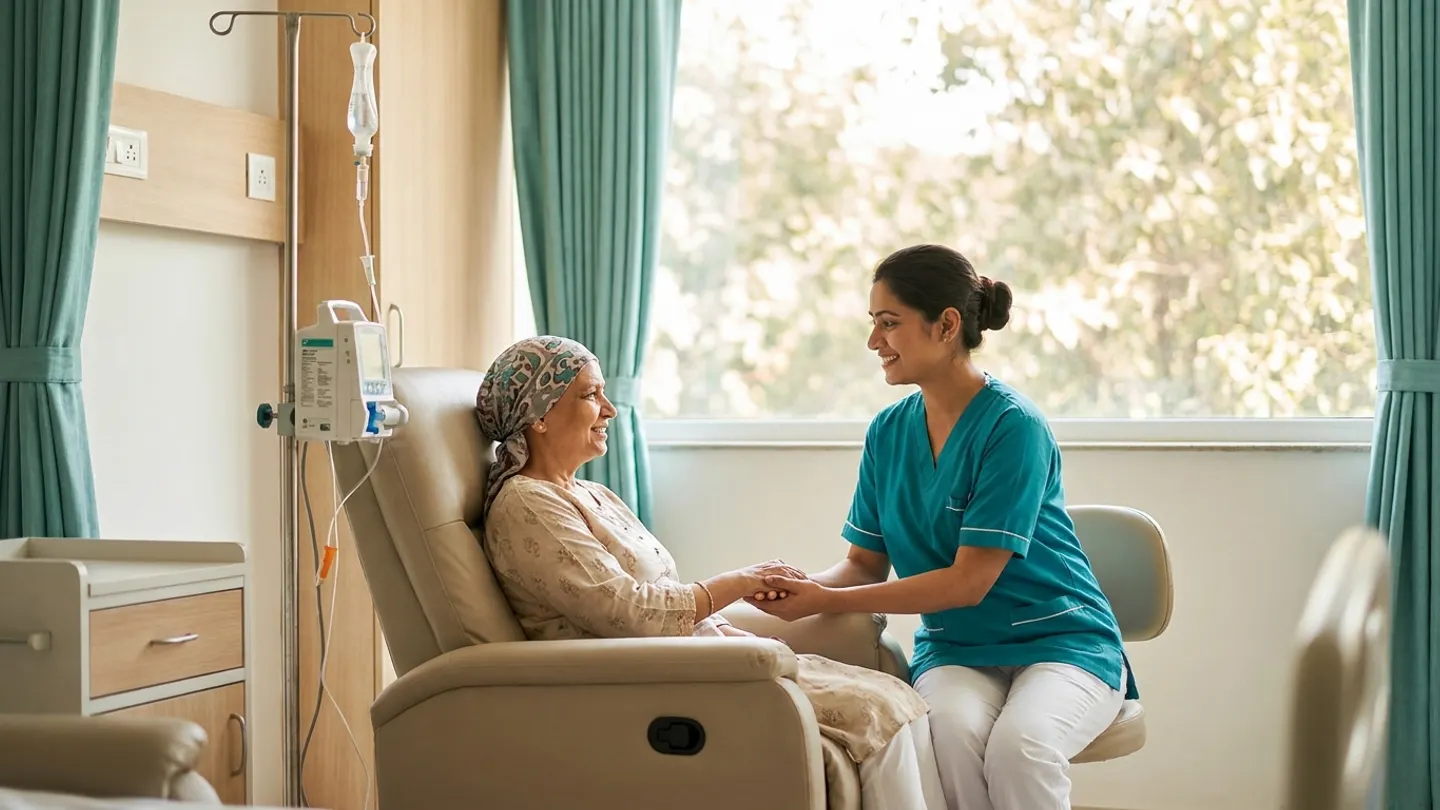
A cancer diagnosis does not give you time to think. If you are reading this from Lagos, Port Harcourt, Accra, or anywhere across West Africa, you may already be holding a pathology report in shaking hands, staring at a treatment cost that feels impossible, or wondering whether flying to India for cancer care is real or just another promise that will not hold.
Emeka’s story is real. And it is for you.
This is a representative patient narrative based on the collective experience of IndoMedTour clients from Nigeria. It does not identify any specific individual.
Why Nigerian Patients Are Choosing Cancer Treatment in India
Cancer treatment in India is the fastest-growing choice for patients from Nigeria and across West Africa because world-class oncology care is available at 60 to 80 per cent less than comparable treatment in the UK, UAE, or the United States — with no waiting list and no compromise on clinical standards. India’s leading cancer hospitals hold JCI (Joint Commission International) or NABH accreditation, the same quality benchmarks used to evaluate hospitals in the US and Europe, and they treat thousands of international patients every year. The number arriving from Nigeria has grown steadily for the past five years.
The Diagnosis That Changed Everything
Emeka was 34 years old, a logistics manager in Lagos, when he first noticed a painless swelling on the right side of his neck. He attributed it to stress and a run of long working weeks. When a GP finally ordered a biopsy six weeks later, the result stopped him cold: Hodgkin lymphoma, a cancer of the lymphatic system.
The news was frightening. But his oncologist was also direct: Hodgkin lymphoma caught at Stage II is among the most treatable cancers in oncology. The problem was not the disease. The problem was access. The full treatment protocol — multiple chemotherapy cycles, serial PET/CT scans, and close-monitored follow-up — required equipment and a consistent drug supply chain that was difficult to guarantee locally. Private treatment abroad was the realistic path.
Searching for an Affordable Path Forward
Emeka’s family began calling clinics in the UK. A rough quote came back for the equivalent of approximately USD 38,000 for the full course of treatment. No insurance covered it. The wait for an NHS appointment, even as a self-paying patient, stretched to several months.
A colleague mentioned that a friend had gone to Mumbai for surgery and returned impressed. Emeka searched online, found IndoMedTour, and made a call — mostly out of desperation, half expecting another dead end.
It was not.
Cancer Treatment Costs: India vs Nigeria, UK, UAE, and the US
One of the first questions every patient and family asks is whether the savings are real or whether corners are being cut somewhere. They are real, and nothing is cut. The table below shows indicative total costs for a full Hodgkin lymphoma treatment course — covering diagnosis confirmation, six chemotherapy cycles, PET/CT scans, and one year of follow-up consultations:
| Country | Approximate Total Cost (USD) | Typical Time to Start Treatment |
|---|---|---|
| India | $6,000 – $15,000 | 1 – 2 weeks |
| United Arab Emirates | $30,000 – $55,000 | 2 – 4 weeks |
| United Kingdom (private) | $35,000 – $65,000 | 4 – 8 weeks |
| United States | $60,000 – $120,000 | 2 – 6 weeks |
| Nigeria (private, imported drugs) | Variable; often incomplete availability | Immediate but supply-constrained |
Prices are indicative for 2026 and vary by hospital tier, disease stage, and individual treatment plan. Airfare and accommodation are not included.
For Emeka, the gap between the UK quote and the final Mumbai invoice was more than USD 30,000. That money stayed with his family and paid for three years of his daughter’s school fees.
The Journey: Lagos to Mumbai
After a free counselling call with an IndoMedTour coordinator, Emeka received three written quotes from shortlisted Mumbai hospitals within 48 hours. He chose a large oncology hospital with a dedicated international patient wing and English-speaking nurses. The how it works process was straightforward from that point.
Getting to India was simpler than he had feared. The Indian government issues an e-Medical Visa specifically for patients travelling for treatment. IndoMedTour prepared the hospital invitation letter. Emeka’s visa was approved in four working days. His wife travelled alongside him on a Medical Attendant Visa.
Arriving in a City He Had Never Visited
“I expected to feel alone and frightened in a city I did not know, while already sick. Instead, a coordinator met us at the airport holding a board with my name. From that moment, someone was always one call away.”
The oncology team reviewed Emeka’s Lagos biopsy slides on arrival and ordered a fresh PET/CT scan to confirm staging. Within two days, a clear treatment plan was in his hands. He understood every step. His questions were answered in full, not brushed aside.
Treatment began in week two.
Six Months of Treatment, Far From Home
Emeka’s oncologist prescribed a standard ABVD chemotherapy protocol — six cycles over approximately six months. Hodgkin lymphoma is one of the most chemotherapy-responsive cancers, and the team spoke to Emeka openly about cure as the goal, not simply disease management.
Each cycle was administered as a day procedure every two weeks. Between sessions, Emeka and his wife stayed in a furnished apartment arranged through the hospital’s international services team, close enough to walk to the ward. His coordinator checked in by WhatsApp every few days. After a difficult round of nausea following cycle three, a support nurse arrived at the apartment within the hour.
Blood counts were monitored closely before every infusion. Dietary guidance was provided in both English and Yoruba for Emeka’s wife, who was managing his meals.
What Emeka’s Life Looks Like Now
After six cycles and a clear end-of-treatment PET scan, Emeka flew home to Lagos. Follow-up scans every six months are done in Nigeria; the reports are read electronically by his Mumbai oncologist, who remains available by video call if results need discussion.
At the one-year mark, his scans were clear. At eighteen months, they remain clear. He is back at work. His daughter was born three months after he returned home. He named her Hope.
Quality and Safety: What JCI and NABH Accreditation Actually Mean for You
The most common worry IndoMedTour hears from Nigerian patients is not the cost or the flight. It is a quieter fear: Is this really good medicine? Or is it just cheap medicine?
Accreditation is the objective answer. JCI (Joint Commission International) is the global gold standard for hospital quality — the same body that certifies hospitals in the US, Europe, and the Gulf. NABH (National Accreditation Board for Hospitals) is India’s national equivalent, equally rigorous. Both require regular audits of clinical protocols, infection control, medication safety, and patient rights.
India has more JCI-accredited hospitals than any other country in Asia. Every hospital IndoMedTour recommends sits within this accredited pool. You can review our hospitals to see partner centres and the specific accreditations each holds. For a full overview of what Indian oncology centres offer for blood cancers and solid tumours, visit our cancer and oncology treatment page.
Checklist: What to Prepare Before You Travel to India for Cancer Treatment
If Emeka’s story sounds like yours, here is a practical starting list:
- Gather all recent pathology reports and biopsy slides, plus any scan images on disc or in high-resolution digital format
- Prepare a complete list of all current medications and dosages
- Obtain a brief summary letter from your local oncologist or GP confirming the diagnosis, staging, and any treatment already received
- Verify your passport is valid for at least six months beyond your planned travel date
- Plan for one family companion — India’s medical visa system actively supports one attendant travelling with a patient
- Budget for accommodation near the hospital; IndoMedTour recommends serviced apartments at realistic costs, typically USD 25 to 60 per night depending on Mumbai neighbourhood
- Save the WhatsApp number for your IndoMedTour coordinator before you board the plane
You do not need to organise all of this alone before you reach out. The free counselling call is the first step, and it commits you to nothing.
How IndoMedTour Helps
IndoMedTour connects patients from Nigeria and across Africa with JCI- and NABH-accredited cancer hospitals in India, with no agency fee charged to the patient. On your free call, a care coordinator listens to your diagnosis, answers your questions honestly, and — if India is the right match — sends written treatment quotes from two or three shortlisted hospitals within 48 hours. We handle the hospital invitation letter needed for your medical visa, help you plan travel and accommodation, and assign a dedicated on-ground coordinator who stays with you from the moment you land through discharge and into your follow-up schedule. For a full picture of treatments and costs, or to read more about the journey, visit our success stories.
You bring the worry. We bring the plan.