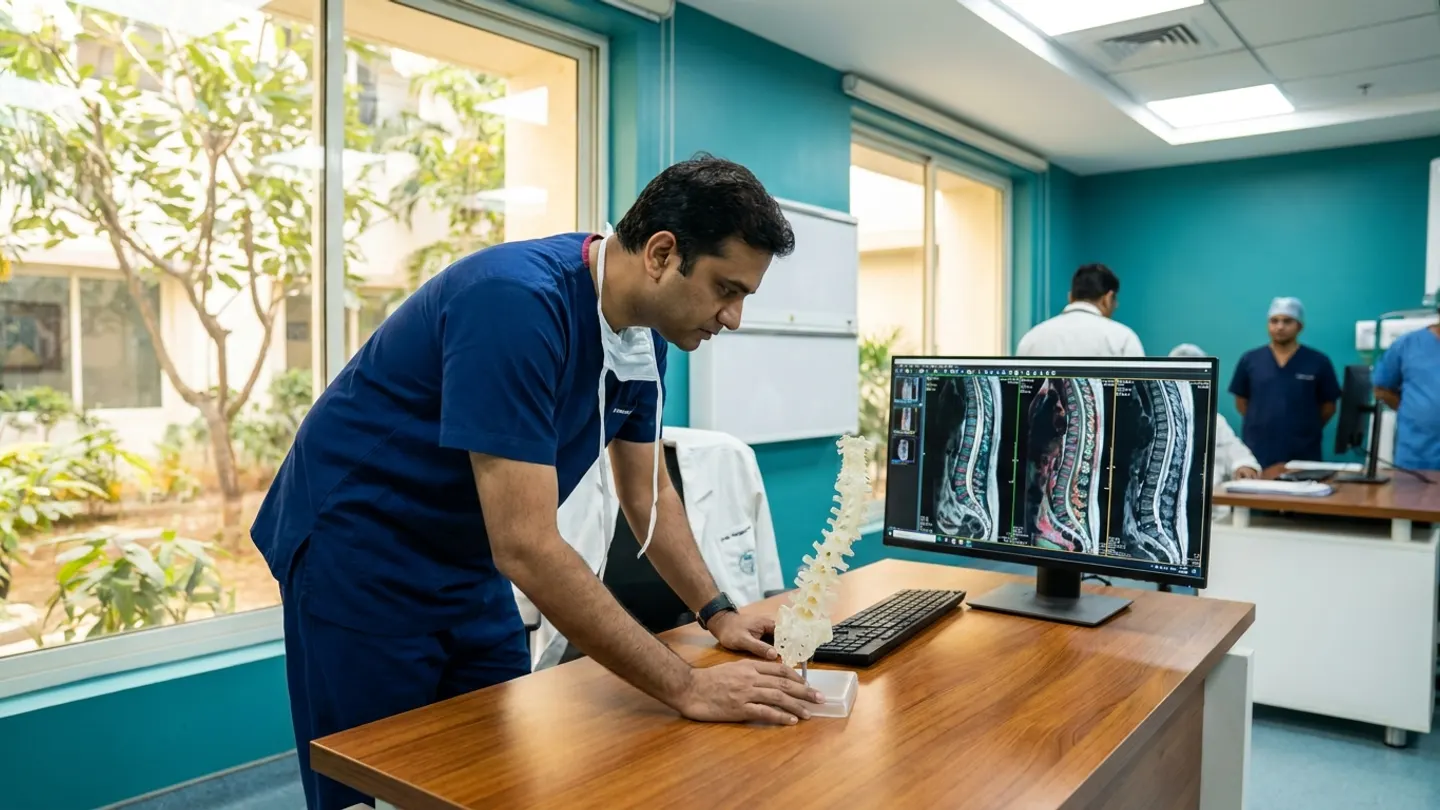
Two years of waking up in pain is two years too many. If you are sitting in the UK right now, weighing an NHS waiting list that stretches past 18 months against a private quote that could empty your savings, James from Islington knows exactly how that feels.
Spine Surgery Patient Story: UK to India — James’s Journey
Spinal fusion surgery in India typically costs between £4,500 and £6,500 all-inclusive, compared to £19,000–£22,000 at a UK private hospital. James, a 47-year-old secondary school teacher from north London, chose to travel to Chennai for a one-level lumbar fusion, saved over £13,000, and was walking pain-free within two weeks.
By early 2023, a degenerating L4–L5 disc had compressed the nerve roots in James’s lower spine to the point where standing through a full lesson had become impossible. His GP referred him to an NHS spinal clinic. The expected wait for a first consultant appointment: 14–18 months. Surgery, if recommended, could come another year beyond that.
“I couldn’t wait two years,” James says. “I was losing my job, losing my sleep, losing myself.”
A private London surgeon quoted him between £19,000 and £22,000 for a one-level posterior lumbar interbody fusion. His health insurance covered only a fraction. A colleague at school had mentioned medical tourism in India. James typed “spine surgery patient story UK to India” into a search engine and, after reading several accounts, booked a free counselling call with IndoMedTour.
The Cost Comparison That Changed Everything
The numbers told a clear story. Here is how James’s options compared:
| Procedure / Item | UK Private (approx.) | India — Chennai (approx.) | Estimated Saving |
|---|---|---|---|
| One-level lumbar spinal fusion | £19,000–£22,000 | £4,500–£6,500 | ~£13,000–£17,500 |
| Hospital stay (5–7 nights) | Included above | Included above | — |
| Post-op physiotherapy (10 sessions) | £600–£900 extra | Included in package | ~£700 |
| Post-op imaging (MRI/X-ray) | £400–£700 extra | Included | ~£550 |
| Return flights + accommodation (est.) | N/A | £1,200–£1,800 | — |
| Estimated net saving | ~£12,000–£16,000 |
All prices are indicative 2026 ranges and vary by hospital tier, implant choice, and patient complexity. Always obtain a written, itemised quote before making any decision.
Even after 16 nights in Chennai, including flights and a recovery apartment, James estimated his net saving at approximately £13,000. He used part of that to fly his wife out for the final week of his recovery.
Finding the Right Hospital in Chennai
IndoMedTour matched James with two hospitals in Chennai, both NABH-accredited and operating to a standard comparable to JCI-certified international facilities. His full medical records, including three years of MRI scans and a referral letter from his NHS neurologist, were reviewed by both hospitals within 48 hours. Within five days of his first call, James held two written, itemised quotes, consultant profiles, and provisional surgery dates in hand.
“I was terrified of being alone in a foreign country after major back surgery. What actually happened was the complete opposite. I had a coordinator called Priya who met me at the airport, was reachable at any hour, and sat outside the operating theatre while I was inside.”
James selected the hospital that offered an integrated physiotherapy wing and a spinal surgeon with 18 years of experience in complex lumbar procedures, including a fellowship completed in Germany. He had never heard of Chennai before this journey began. It became, he says, “the city that gave me my life back.”
What the Surgery Involved
James underwent a posterior lumbar interbody fusion (PLIF) at L4–L5 under general anaesthesia, lasting approximately three and a half hours. Titanium interbody cages and pedicle screws were used to stabilise the segment, sourced from the same global implant manufacturers used in UK operating theatres. There were no intraoperative complications.
He was mobilised with physiotherapy support within 36 hours of surgery. By day three, his pain scores had dropped significantly.
Recovery in Chennai: Days 1–15
After a six-night hospital stay, James moved to a serviced recovery apartment a short walk from the hospital, arranged through IndoMedTour. He attended outpatient physiotherapy every morning for eight days, working on core strengthening, gait retraining, and nerve recovery exercises.
By day 12 post-surgery, he was walking two kilometres without stopping.
On day 15, he was cleared to fly home following a final X-ray and a face-to-face discharge meeting with his surgeon. His NHS GP in Islington received a complete discharge summary, operative notes, implant records, and a structured six-month physiotherapy plan before James’s flight had even landed at Heathrow.
Is It Safe to Have Spine Surgery in India? What UK Patients Need to Know
This is the first question every family member asks, and it deserves a direct answer.
India has more than 30 JCI-accredited hospitals and several hundred NABH-certified centres. Many of the spinal surgeons practising in India’s top-tier private hospitals completed postgraduate training in the UK, the United States, or Germany and return regularly for continuing professional development. The implants, anaesthetic protocols, and infection-control standards at accredited hospitals operate to benchmarks comparable to leading UK private facilities.
Spine surgery carries inherent risks wherever it is performed, including infection, nerve injury, implant failure, and blood clots. What determines outcomes is the quality of the surgical team, the hospital’s track record, and the standard of post-operative care. Patients who choose accredited hospitals and plan their recovery with proper coordination consistently report outcomes that match or exceed their expectations.
Before committing to any spine treatment abroad, work through this checklist:
- Confirm the hospital holds NABH or JCI accreditation and request the certificate reference number
- Ask for the named consultant’s qualifications and the annual volume of similar procedures they perform
- Obtain a written, itemised quote in GBP or USD, not just a headline all-in figure
- Clarify how post-operative complications are managed and what the emergency escalation protocol involves
- Verify that your UK travel insurance covers medical treatment abroad, and consider a supplementary medical travel policy
- Share all planned treatment details with your NHS GP before you depart so they can support your recovery on your return
James worked through every point on this list before boarding his flight. IndoMedTour also included a complication-management protocol in his care plan, confirming which facility he would attend if any concern arose after discharge from the main hospital.
Eight Months Later
James is back in the classroom full-time. He cycles to work three days a week. He has not needed a prescription painkiller since his second month home.
His NHS spinal clinic appointment eventually arrived in the post: 19 months after his original GP referral. He wrote back to politely decline it.
This account is a representative narrative based on the typical experiences of patients who travel from the UK to India for spinal fusion surgery. It does not represent a specific identifiable individual.
Read further accounts on our success stories page, or explore what neurosurgery and spine treatments cost in India. You can also learn how the IndoMedTour process works and browse our partner hospitals to understand the standard of care available.
How IndoMedTour Helps
When you book a free counselling call with IndoMedTour, a medical coordinator reviews your scans and history within 24–48 hours and matches you with accredited hospitals suited to your exact diagnosis. You receive written, itemised quotes with no obligation before you book a single flight. We handle visa guidance, airport transfers, accommodation close to the hospital, and a dedicated coordinator who stays beside you from arrival to departure. For spinal procedures, we also arrange a structured handover to your home GP so your recovery continues seamlessly the moment you land.
You bring the worry. We bring the plan.