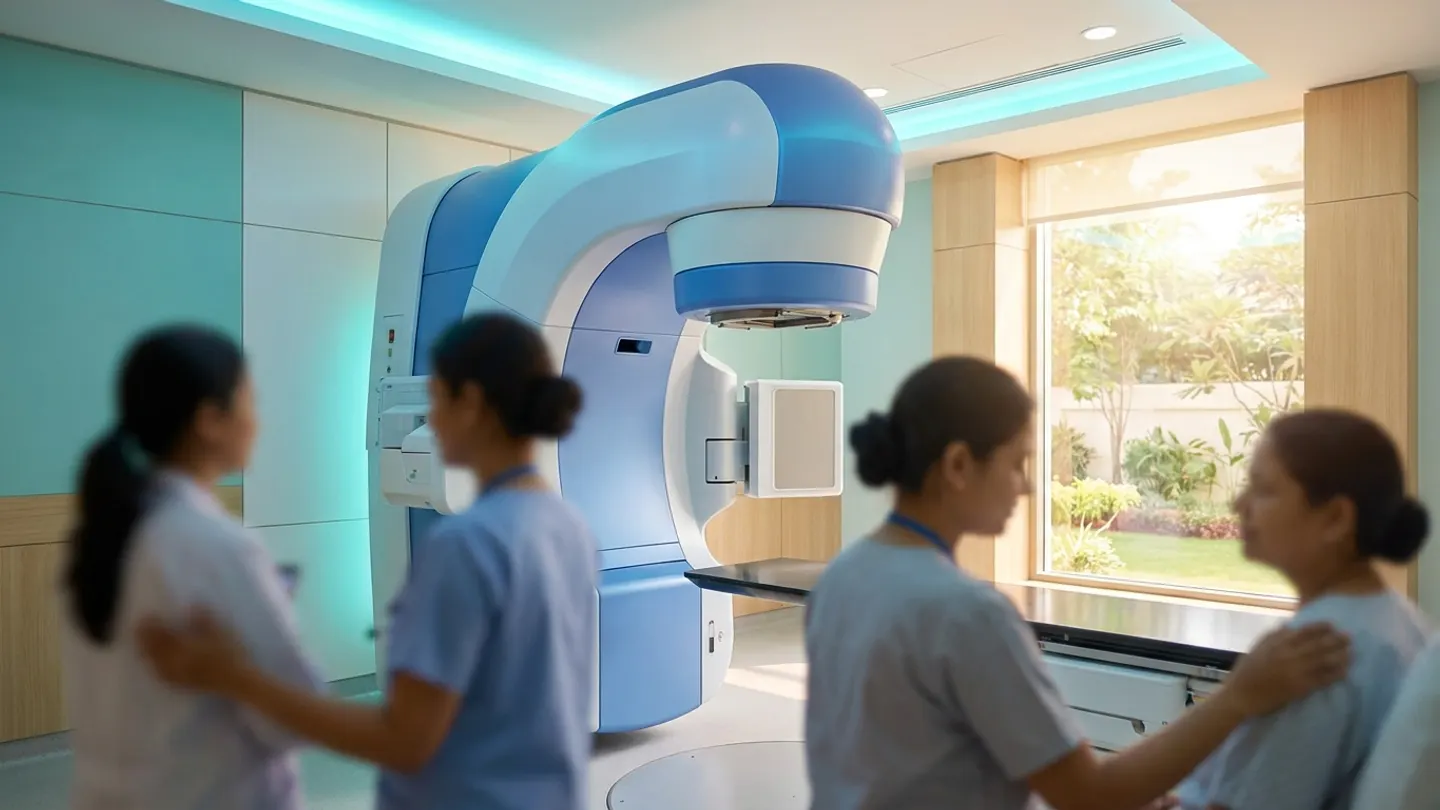
A cancer diagnosis is frightening enough without the weight of a six-figure treatment bill landing on top of it, or a waiting list that runs well into next year. If you are here comparing options, that is not desperation; it is practical thinking. Thousands of international patients receive radiation therapy in India every year and return home having paid a fraction of what they were quoted at home, without sacrificing the technology or the expertise that matters most.
Radiation Therapy Cost in India for Cancer: What You Will Actually Pay in 2026
Radiation therapy cost in India for cancer typically ranges from approximately $3,000 to $12,000 USD for a complete course of treatment, depending on the technology used and the number of sessions prescribed. That figure is 60 to 80 percent lower than comparable treatment in the United States, United Kingdom, or Australia, and it is delivered on machines manufactured by the same global brands used in world-class Western cancer centres.
The price range is wide because the treatment itself varies enormously. A patient receiving 10 palliative fractions for bone pain sits at one end; a patient completing a 35-fraction curative IMRT course for head-and-neck cancer sits at the other. The breakdown below covers the three advanced modalities you are most likely to be comparing.
IMRT Cost in India (Intensity-Modulated Radiation Therapy)
IMRT is the most widely used advanced radiation technique for cancers of the breast, prostate, head and neck, and cervix. It shapes the radiation beam to conform tightly to the tumour, sparing surrounding healthy tissue. In India, a full IMRT course of 25 to 35 fractions costs approximately $3,500 to $6,500 USD for international patients. The same course in the United States is typically billed at $30,000 to $60,000, often charged per fraction and not as a bundled package.
IGRT Cost in India (Image-Guided Radiation Therapy)
IGRT adds real-time imaging before each session to account for the natural movement of tumours caused by breathing, organ filling, or subtle shifts in patient position. It is particularly valuable for prostate, liver, and lung cancers where precision matters over weeks of treatment. In India, a full IGRT course costs approximately $4,500 to $8,000 USD, compared to $40,000 to $70,000 in the US or £25,000 to £45,000 in the UK.
SBRT Cost in India (Stereotactic Body Radiation Therapy)
SBRT, sometimes called CyberKnife or VMAT-based radiosurgery, delivers very high radiation doses in just 3 to 5 sessions, targeting small tumours with sub-millimetre accuracy. It is widely used for early-stage lung cancer, spine metastases, liver lesions, and localised prostate cancer. In India, an SBRT course costs approximately $5,000 to $12,000 USD. In the United States, the equivalent treatment typically runs $25,000 to $50,000 per course.
Radiation Therapy Cost Comparison: India vs US, UK, Australia & UAE (2026)
| Treatment Type | India | United States | United Kingdom | Australia | UAE |
|---|---|---|---|---|---|
| IMRT (full course, ~30 fractions) | $3,500 – $6,500 | $30,000 – $60,000 | £20,000 – £40,000 | AUD 15,000 – 35,000 | AED 45,000 – 90,000 |
| IGRT (full course) | $4,500 – $8,000 | $40,000 – $70,000 | £25,000 – £45,000 | AUD 20,000 – 45,000 | AED 55,000 – 110,000 |
| SBRT / CyberKnife (3–5 fractions) | $5,000 – $12,000 | $25,000 – $50,000 | £18,000 – £35,000 | AUD 18,000 – 40,000 | AED 40,000 – 80,000 |
| 3D-CRT palliative (10 fractions) | $1,200 – $3,000 | $10,000 – $20,000 | £8,000 – £18,000 | AUD 7,000 – 15,000 | AED 18,000 – 35,000 |
All prices are indicative 2026 ranges for international patients and may vary by hospital tier, city, and individual treatment plan. Contact IndoMedTour for a written quote tailored to your case.
What Is Included in the Radiation Therapy Cost in India?
The total quoted price at reputable Indian oncology centres for international patients typically covers:
- Initial radiation oncologist consultation and review of your overseas medical records
- CT simulation scan and treatment planning (dosimetry)
- All radiation fractions across the full prescribed course
- Weekly on-treatment review appointments with your radiation oncologist
- Nursing care and radiation therapy technologist support during each session
- Standard monitoring blood tests during the course
- A written end-of-treatment summary and imaging report to share with your home oncologist
It does not usually include international flights, accommodation, concurrent chemotherapy if prescribed, or additional diagnostic scans ordered during treatment. Your IndoMedTour coordinator will help you build a clear, itemised budget before you commit to travelling, so there are no unwelcome surprises.
Is Radiation Therapy in India Safe? Quality Standards That Matter
For international patients, quality and safety are the first questions that need answers before cost comparisons mean anything.
India’s leading cancer hospitals hold JCI (Joint Commission International) or NABH (National Accreditation Board for Hospitals) accreditation, the same internationally recognised quality benchmarks that govern equipment maintenance schedules, radiation safety protocols, infection control, and patient rights. These are not honorary certificates; they require regular on-site audits and recertification.
The linear accelerators in use at these centres are manufactured by Varian, Elekta, and Accuray, the same global brands found in cancer centres across the United States, Canada, and Europe. Treatment planning software, dosimetric verification, and quality assurance protocols are drawn from international guidelines published by bodies such as the ICRU and AAPM.
India’s top-tier oncology hospitals operate the same generation of linear accelerators found in leading US and European cancer centres. What changes when you choose India is the cost and the waiting time, not the calibre of the technology or the clinical rigour behind it.
Radiation oncologists at JCI- and NABH-accredited hospitals in India typically hold fellowships or post-doctoral training from institutions in the United States, United Kingdom, or Europe, and many contribute to peer-reviewed international oncology research. You can explore the hospitals we work with on our hospitals page.
Which Cancers Are Treated with Radiation Therapy in India?
India’s oncology centres offer radiation therapy across a broad range of cancer types. The most common include:
- Breast cancer — adjuvant IMRT after lumpectomy or mastectomy, and post-mastectomy chest wall irradiation
- Prostate cancer — definitive IMRT or IGRT as a curative option, or SBRT as an ultra-short course
- Head and neck cancers — concurrent chemoradiation as the primary curative treatment
- Lung cancer — SBRT for early-stage disease; IMRT or IGRT for locally advanced cases
- Cervical and endometrial cancer — external beam radiation combined with brachytherapy boost
- Brain tumours — whole-brain radiotherapy or stereotactic radiosurgery (SRS) for single or multiple lesions
- Spine and bone metastases — palliative radiation for pain control and structural stability
- Liver, pancreatic, and rectal cancers — IGRT or SBRT for locally advanced or oligometastatic presentations
For a full overview of how India’s cancer centres approach each of these, visit our cancer and oncology treatment page.
How Many Sessions Will I Need, and How Long Must I Stay?
The number of fractions and your required stay in India depend almost entirely on the type of radiation treatment prescribed and the intent of treatment (curative versus palliative):
| Treatment Intent and Modality | Typical Fractions | Approximate India Stay |
|---|---|---|
| Palliative (bone/brain lesions) | 1 – 10 sessions | 1 – 2 weeks |
| SBRT (curative, early-stage) | 3 – 5 sessions | 2 – 3 weeks |
| Standard IMRT / IGRT (curative) | 25 – 35 daily sessions (Mon–Fri) | 7 – 9 weeks |
| Concurrent chemoradiation (head/neck, cervical) | 30 – 35 sessions | 7 – 8 weeks |
Patients typically arrive 2 to 3 days before the first treatment fraction for a CT simulation scan and treatment planning. Daily sessions themselves last 15 to 30 minutes once planning is complete.
For a detailed overview of the journey from enquiry to discharge, see how it works.
What Else Affects Radiation Therapy Cost in India?
Several variables shift the final price within the ranges shown above:
- Technology chosen: SBRT costs more per session than conventional 3D-CRT, but fewer total sessions may bring the overall cost closer or even lower for eligible patients
- Hospital tier and city: Premier cancer institutes in Mumbai, Chennai, Delhi, and Hyderabad typically carry higher facility fees than centres in Pune or Ahmedabad, though the clinical quality gap is smaller than the price difference
- Concurrent chemotherapy: If radiosensitising chemotherapy is given alongside radiation, it is quoted and billed separately
- Number of treatment sites: Treating a single tumour site costs less than planning and delivering radiation to multiple anatomical regions simultaneously
- Additional imaging during treatment: PET-CT or MRI scans ordered to monitor response may be billed additionally
The most reliable way to know your true all-in cost is to receive a written, itemised quote directly from matched hospitals before you travel. You can read about the experiences of patients who have made this same journey on our success stories page, and see indicative cost summaries on our treatments and costs overview.
How IndoMedTour Helps
When you book a free counselling call with IndoMedTour, we review your pathology reports, treatment history, and the radiation therapy plan recommended by your home oncologist, then match you with two or three JCI- or NABH-accredited cancer centres whose technology, specialist expertise, and pricing suit your specific diagnosis. We obtain written, itemised cost quotes in your currency, arrange your medical visa support letter, and build your full travel itinerary. A dedicated patient coordinator accompanies you through every step of the process in India, from the simulation scan on day one to the discharge report and follow-up plan you carry home. You never navigate a foreign healthcare system alone.
You bring the worry. We bring the plan.