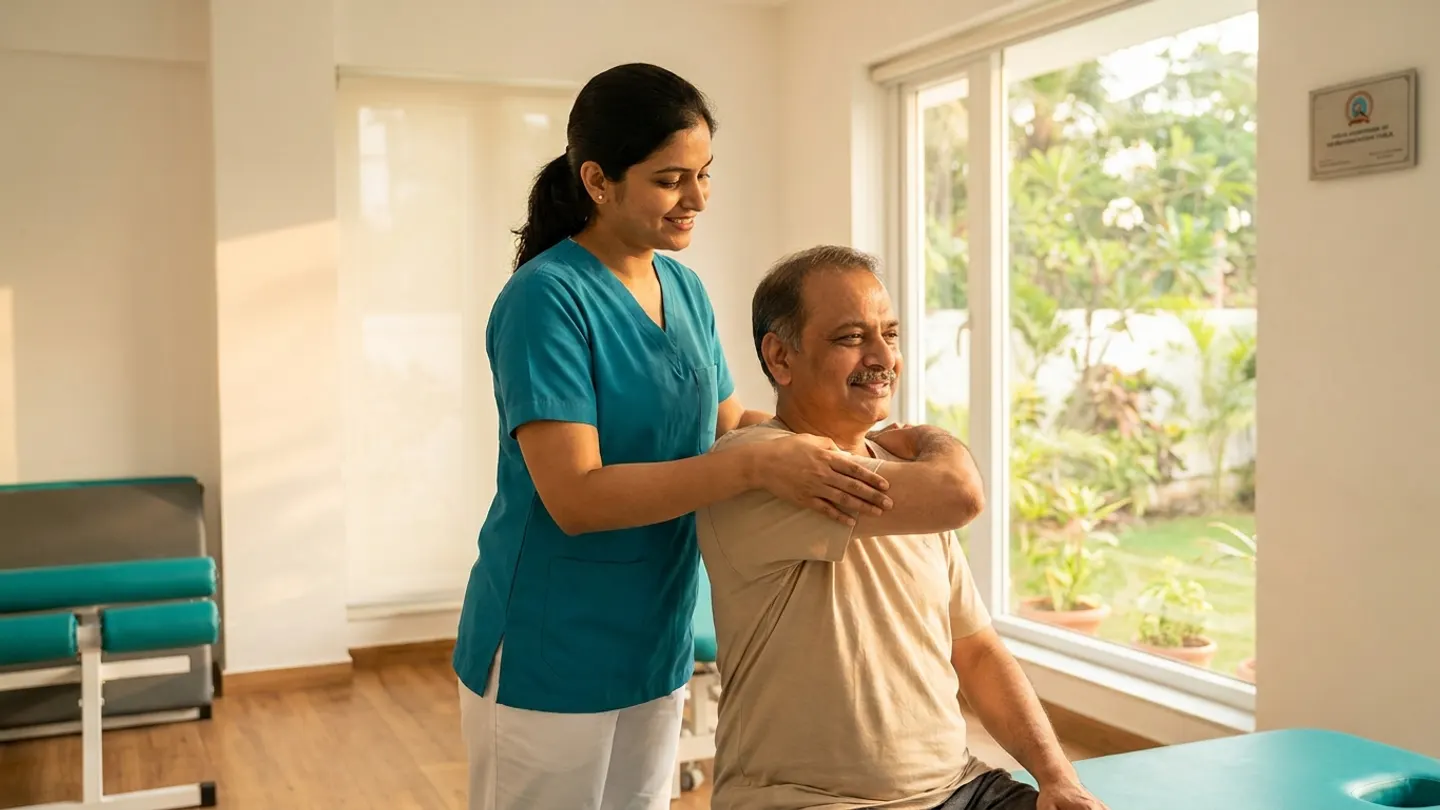
Living with a shoulder that grinds, aches, or simply refuses to lift above waist height is demoralising. When you finally hear the words “you need a shoulder replacement,” the next shock is usually the cost estimate or the waiting list — and sometimes both at once. You should know that there is a well-established, clinically sound alternative that thousands of international patients now choose every year.
What Does Shoulder Replacement Cost in India in 2026?
Shoulder replacement cost in India typically ranges from $5,000 to $9,000 all-inclusive — a fraction of equivalent procedures in the United States, United Kingdom, or Australia. That single figure covers the implant, surgeon’s fee, anaesthesia, theatre charges, hospital accommodation, and the supervised physiotherapy you need before flying home. Most patients achieve the same clinical result for roughly 80 to 85 percent less than they would pay at home.
The range exists because several real variables affect the final price: the type of replacement (total, reverse, or partial), the hospital tier and city, the specific implant brand, and whether you require additional investigations on arrival. The comparison table below will help you benchmark your options.
Country-by-Country Cost Comparison (2026)
| Country | Approximate All-in Cost (USD) | Notes |
|---|---|---|
| India | $5,000 – $9,000 | Includes implant, hospital stay, physio |
| United States | $35,000 – $55,000 | Varies sharply by insurer and state |
| United Kingdom | $28,000 – $40,000 | Private; NHS wait often exceeds 12 months |
| Australia | $22,000 – $38,000 | Private cover frequently falls short |
| UAE / Dubai | $18,000 – $28,000 | Popular but considerably pricier than India |
| Thailand | $9,000 – $15,000 | Fewer specialist shoulder arthroplasty centres |
All figures are indicative 2026 ranges. Actual costs depend on implant type, hospital tier, and individual case complexity.
The price gap is structural, not a signal of lower quality. Lower hospital overheads, government-regulated implant pricing, and a very different cost-of-living base mean that Indian hospitals can charge a fraction of Western rates while maintaining internationally audited standards of care.
Types of Shoulder Replacement Available in India
India’s accredited orthopaedic centres perform every variant of shoulder arthroplasty that you would find at a major Western hospital.
Total (Anatomic) Shoulder Replacement
The standard choice for osteoarthritis where the rotator cuff is still intact. Both the ball (humeral head) and the socket (glenoid) are replaced with prosthetic components. In India, this typically costs $5,500 to $8,000.
Reverse Shoulder Replacement
Recommended when the rotator cuff is severely torn or has previously failed repair. The positions of the ball and socket are switched so the deltoid muscle compensates. This is marginally more complex and typically costs $6,000 to $9,000 in India.
Partial (Hemi) Shoulder Arthroplasty
Only the humeral head is replaced — usually indicated for certain fractures or early, localised arthritis. This is often at the lower end of the cost range, from approximately $5,000.
All three procedures use FDA-cleared, CE-marked implants from established global manufacturers. If your home surgeon has recommended a particular implant brand, your IndoMedTour coordinator can confirm availability before you commit to a hospital.
What Is Included in a Typical Package?
When you receive a written quote through IndoMedTour, the price almost always covers:
- Pre-operative investigations (blood panel, X-rays, MRI review on arrival)
- Surgeon’s fee and assistant surgeon’s fee
- Anaesthetist’s fee
- Theatre and equipment charges, including the implant itself
- 2 to 4 nights in a private hospital room with meals
- Nursing care and daily physiotherapy during your admission
- Airport pick-up and transfers to and from the hospital
- A dedicated patient coordinator available around the clock
What is generally not included: international flights, travel insurance, hotel or serviced-apartment costs outside the hospital, and extended outpatient physiotherapy after discharge. IndoMedTour is transparent about this boundary in every written quote.
“I had been told for two years that I needed a shoulder replacement. The NHS waiting list was over a year and the private quote in the UK was more than £32,000. In India I paid roughly £5,800 all-in, stayed two weeks, and came home moving my arm freely again. I wish I had looked into this sooner.”
Representative patient experience, shared with permission. This is illustrative; it does not represent a specific identifiable individual.
Why Is the Cost So Much Lower?
This is the question every patient rightly asks. The answer is structural:
Hospital overheads: Land, utilities, and staffing costs in India are a fraction of those in the US or UK. A hospital can price aggressively and still operate profitably.
Government-regulated implant pricing: India capped trade margins on orthopaedic implants in 2017. Hospitals cannot inflate implant costs the way American facilities routinely do.
No outsized malpractice insurance burden: Premiums in the US can exceed $100,000 per surgeon per year. Indian orthopaedic surgeons pay a small fraction of that, and the saving flows through to the patient.
Volume and specialisation: Top Indian joint-replacement centres perform hundreds of procedures each month. High volume drives surgical efficiency, precision, and consistent outcomes — not corner-cutting.
Choosing the Right Hospital: Quality Markers That Matter
Quality is not uniform across every hospital in India. The single most reliable filter is JCI (Joint Commission International) or NABH (National Accreditation Board for Hospitals) accreditation. These certifications are awarded only after rigorous audits of infection-control protocols, staffing ratios, equipment records, and patient-safety checklists — the same standards that international regulators recognise as equivalent to Western norms.
Beyond accreditation, ask your coordinator for:
- The surgeon’s fellowship training specifically in shoulder arthroplasty
- The hospital’s annual volume of shoulder replacements
- Availability of a dedicated in-hospital physiotherapy team
- ICU backup capability for higher-risk patients
- A clear documented protocol for managing complications after you return home
IndoMedTour works exclusively with accredited hospitals that have an established track record with international patients.
Recovery: What to Expect Before and After You Fly Home
Shoulder replacement recovery unfolds over months, not days. Here is a realistic picture of what your India stay will cover and what continues at home.
During your India stay (approximately Days 1 to 14):
- Surgery day: the procedure takes 90 to 120 minutes under general anaesthesia
- Days 1 to 3: hospital stay, arm in a sling, pain managed with medication, passive exercises begin under physiotherapy supervision
- Days 4 to 14: daily outpatient physiotherapy sessions, gentle range-of-motion progression, and wound review before medical clearance to fly
After you return home:
- Weeks 3 to 6: continuing physiotherapy locally, sling typically worn for 4 to 6 weeks
- Months 2 to 4: progressive strengthening programme begins
- Around Month 6: most patients with uncomplicated cases reach 80 percent of normal shoulder function
- Month 12: full functional recovery is the expected outcome for straightforward cases
Your IndoMedTour coordinator prepares a detailed physiotherapy handover report that your local physiotherapist can follow without gaps in your care.
Your Pre-Booking Checklist
Before you commit to a hospital or a quote, get written answers to each of these:
- Is the hospital JCI or NABH accredited?
- What implant brand and model will be used, and is it FDA or CE cleared?
- Is the surgeon fellowship-trained in shoulder arthroplasty specifically?
- How many shoulder replacements does this surgeon perform annually?
- What is the protocol if I develop a complication after returning home?
- Is a physiotherapy handover report included in the package?
- Does the quoted price include all investigations, or will there be add-ons?
- Is there a 24-hour emergency contact for international patients?
Any hospital confident in its quality will answer all of these questions without hesitation. If answers are vague or slow to come, treat that as information.
For a full breakdown of what to expect throughout the process, explore how it works or see the complete treatments and costs overview. You can also go deeper into orthopedics and joint replacement to compare procedures side by side.
If it helps to hear from patients who have already made this journey, our success stories page carries accounts from people in similar situations.
How IndoMedTour Helps
We understand that researching major surgery abroad while managing daily pain is an enormous ask. Start with a free counselling call with a patient coordinator who knows the landscape and will listen without pressure. We match you with the right accredited hospital for your specific case, arrange written all-in quotes within 48 hours, and handle visa documentation and travel logistics from start to finish. From the morning you land to the day you fly home, a dedicated coordinator stays with you through every appointment, every report, and every step of your recovery. You bring the worry. We bring the plan.