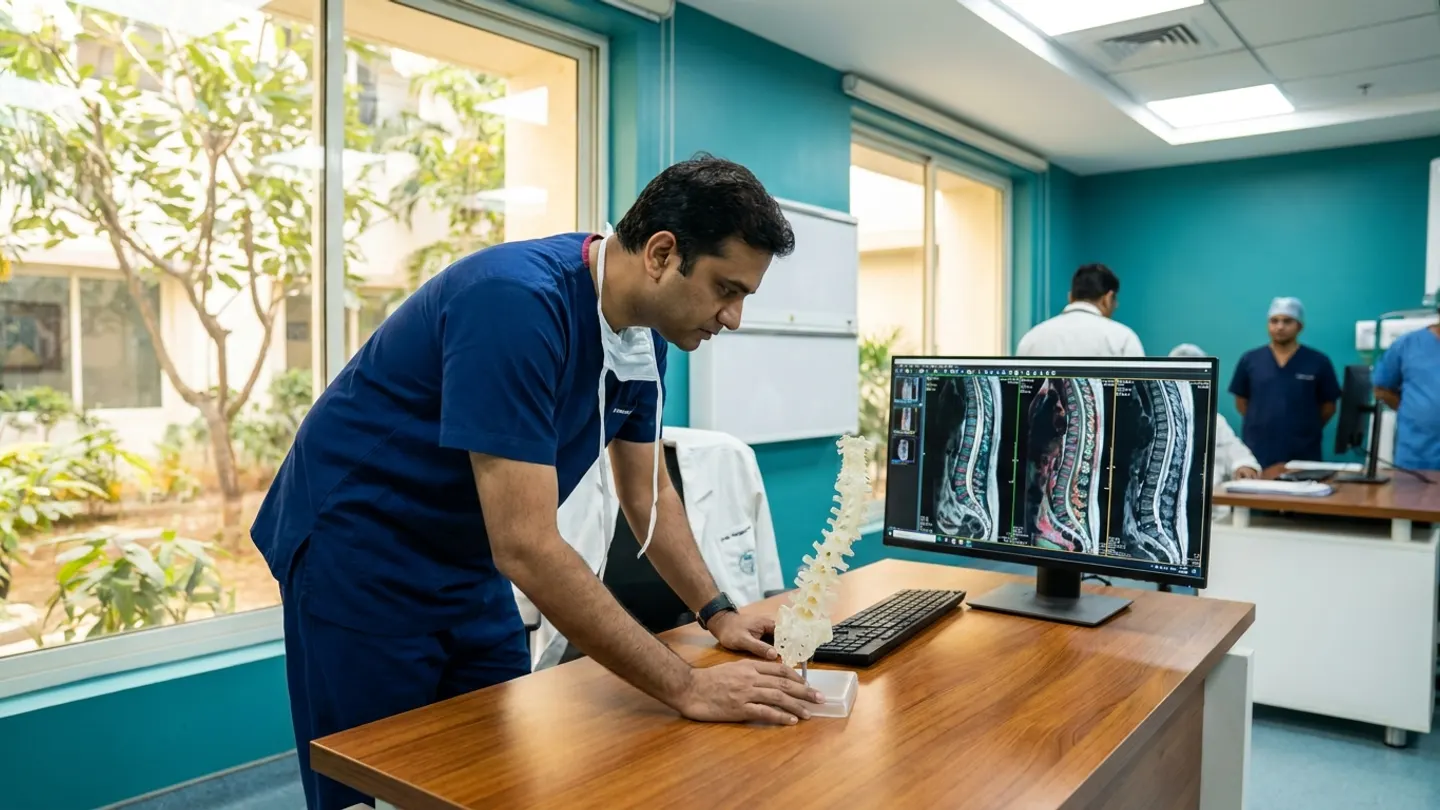
Facing a spine surgery bill that looks like a mortgage payment — or a waiting list that stretches past a year — is genuinely frightening. You are not being dramatic. The pain is real, the urgency is real, and the financial pressure is real. The good news is that tens of thousands of international patients every year discover that world-class spinal fusion surgery is available in India at a fraction of what they would pay at home, without compromising on safety or surgical skill.
Spinal Fusion Surgery Cost in India: The Honest Numbers
Spinal fusion surgery in India costs approximately $3,500 to $9,000 USD for a standard single- or two-level lumbar fusion, all-inclusive of surgery, anaesthesia, implants, hospital stay, and post-operative physiotherapy. Compare that with the United States, where the same procedure routinely reaches $50,000 to $150,000, and the case for medical travel begins to make itself.
The exact price depends on several factors: how many vertebral levels are being fused, which surgical approach your surgeon recommends (posterior, anterior, or TLIF/PLIF), the grade of implants used, and whether you choose a metro super-specialty hospital or a slightly more affordable tier-two city. Either way, patients almost always save enough to cover all travel and accommodation costs many times over.
Cost Comparison: Spinal Fusion Surgery by Country (2026 Estimates)
| Country | Estimated Cost (USD) | Typical Wait Time |
|---|---|---|
| India | $3,500 – $9,000 | 1 – 3 weeks |
| United States | $50,000 – $150,000 | 4 – 12 weeks (insured) |
| United Kingdom | $25,000 – $55,000 | 6 – 18 months (NHS) |
| Australia | $20,000 – $45,000 | 6 – 12 months (public) |
| UAE | $18,000 – $35,000 | 2 – 6 weeks |
| Germany | $20,000 – $40,000 | 4 – 10 weeks |
All figures are indicative 2026 ranges. Costs vary by hospital, surgeon experience, implant brand, and individual patient complexity. Always obtain a written quote based on your medical reports.
Explore the full breakdown on our treatments & costs page, or look through our all treatments directory if your spine condition may point to a different procedure.
What Does Spinal Fusion Surgery Actually Involve?
Spinal fusion joins two or more vertebrae into a single, stable unit, eliminating painful motion at a damaged or unstable segment. It is most commonly recommended for:
- Degenerative disc disease causing chronic lower back or neck pain
- Spondylolisthesis (one vertebra slipping forward over another)
- Spinal stenosis with instability
- Herniated discs that have not responded to conservative treatment
- Fractures, deformities, or post-tumour reconstruction
Modern techniques — including minimally invasive spine surgery (MISS) — allow surgeons to perform the fusion through small incisions, reducing blood loss, hospital stay, and recovery time significantly. Many Indian spine centres have adopted robotic-assisted navigation systems that improve implant placement accuracy and surgical outcomes.
Why India for Spinal Fusion? Quality, Not Just Cost
The savings alone would be reason enough for many people. But patients consistently report that the clinical experience itself was a positive surprise.
“I had been told I might wait 14 months on the NHS list. My pain was getting worse every week. I arrived in India a little nervous, honestly, but the surgeon explained every step patiently, the hospital felt modern and clean, and I was walking the corridor the day after surgery. I came home standing straighter than I had in years.” — representative patient experience; not a specific identifiable patient.
Accreditation and Surgeon Credentials
The hospitals IndoMedTour works with hold JCI (Joint Commission International) or NABH accreditation — the internationally recognised benchmarks for patient safety, infection control, and clinical quality. Many attending spine surgeons hold memberships in the American Association of Neurological Surgeons (AANS), the North American Spine Society (NASS), or equivalent European bodies, and a significant number completed advanced fellowship training abroad.
Implants and Technology
India’s top spine centres use the same implant systems — titanium cages, pedicle screw systems, bone graft options — that your home-country surgeon would use. Imaging suites with intraoperative CT and fluoroscopy, neuromonitoring during surgery, and dedicated spine physiotherapy teams are standard at accredited hospitals.
Breaking Down the Cost: What Is Included?
When you receive a written quote through IndoMedTour, it will typically cover:
- Pre-operative diagnostic tests (MRI, X-rays, blood panel)
- Surgeon and anaesthesia fees
- Operating theatre and equipment
- Titanium implants and bone graft material
- Hospital room (private, with an attendant bed for a companion)
- Nursing care and meals during admission
- In-hospital physiotherapy sessions
- Discharge medications
What is usually quoted separately: international flights, accommodation outside the hospital, and any extended physiotherapy programme after discharge. Our team will provide a transparent breakdown so there are no surprises.
Single-Level vs Multi-Level Fusion: Indicative Price Bands
| Procedure | Estimated India Cost (USD) |
|---|---|
| Single-level lumbar TLIF / PLIF | $3,500 – $5,500 |
| Two-level lumbar fusion | $5,000 – $7,500 |
| Three-level fusion or complex revision | $7,000 – $10,000 |
| Cervical fusion (ACDF, 1-2 levels) | $4,000 – $7,000 |
| Minimally invasive spine fusion (MISS) | $4,500 – $8,500 |
The Recovery Timeline: What to Expect in India
Understanding the recovery arc helps you plan your stay realistically.
- Days 1-2 (in hospital): Rest, pain management, monitoring. Most patients sit up and take a few assisted steps on Day 1.
- Days 3-5: Walking with support, beginning gentle physiotherapy, wound checks. Many patients are discharged by Day 4 or 5.
- Days 6-14 (at accommodation): Daily outpatient physiotherapy, rest, short walks. The care team checks in regularly.
- Day 14-21: Surgeon review, clearance for the flight home. Long-haul travel is typically approved between Day 14 and Day 21, depending on fusion levels and individual recovery.
- At home (weeks 4-12): Continued physiotherapy. Most patients return to desk work within 6-8 weeks; physical labour takes longer. Full fusion of the bone can take 3-12 months.
Pre-Travel Checklist
Before you travel for spinal fusion surgery in India, make sure you have:
- Recent MRI and CT scan reports (digital copies, ideally from the last 6 months)
- Full list of current medications
- Any previous spine surgical notes or imaging
- A written clinical opinion from your home doctor
- Travel insurance that covers a pre-existing spinal condition and surgical procedures abroad
- A companion or family member to travel with you (strongly recommended)
Our team will review your documents and connect you with the right specialist before you book anything. Start with a free counselling call.
Choosing the Right Hospital in India
India has dozens of hospitals capable of performing spinal fusion surgery, but not all are equal for international patients. When evaluating options, look for:
- JCI or NABH accreditation
- A dedicated international patient services department with multilingual staff
- Surgeon who has performed more than 200 spinal fusion procedures per year
- In-house physiotherapy and rehabilitation unit
- Transparent, written pricing before you commit
Cities with strong spine surgery infrastructure include Delhi-NCR, Mumbai, Chennai, Bangalore, and Hyderabad. Each has its own combination of hospital density, cost level, and connectivity for international flights.
For related spine and neurological conditions, see our full /treatments/orthopedics-joint-replacement section, and if you have questions about the process from first contact to flying home, our how it works page walks through every stage.
Practical Tips: Saving More and Travelling Smarter
- Book the shoulder season. Flights to India are cheapest in January-February and September-October.
- Bring a companion. Beyond emotional support, a companion can assist during the recovery days and advocate for you if you are in pain.
- Ask about package pricing. Some hospitals offer bundled international patient packages that include a hospital room upgrade and a set number of physiotherapy sessions.
- Compare at least two written quotes. Different hospitals price differently; the most expensive is not always the best for your specific condition.
- Factor in post-discharge accommodation. Serviced apartments near major hospitals typically cost $30-$70 per night — a small line in the overall budget.
How IndoMedTour Helps
We start with a free counselling call where a medical coordinator reviews your case, answers your questions honestly, and helps you understand whether India is the right choice for your situation — with no pressure either way. If you decide to proceed, we gather your reports, present them to two or three accredited hospitals, and return written cost estimates within a few days. We handle visa invitation letters, airport transfers, hospital appointments, and translator support if needed. Throughout your surgery and recovery in India, a dedicated coordinator is reachable around the clock, staying beside you from the moment you land until you board your flight home.
You bring the worry. We bring the plan.
Book your free counselling call or explore all treatments to learn more about what is possible.