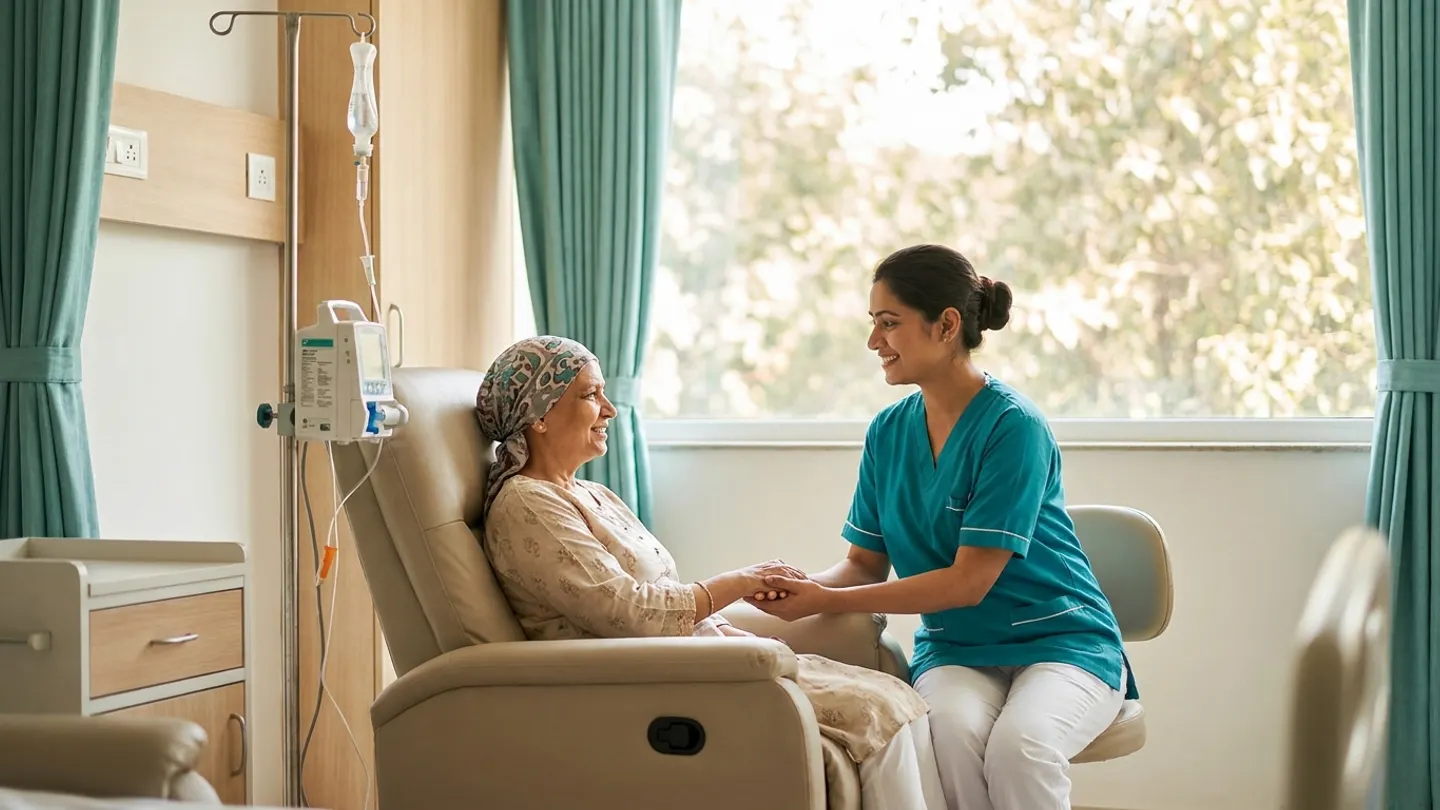
When you receive a cancer diagnosis, everything else stops. For families across Africa, that frightening moment often comes with a second, equally crushing question: how on earth will we pay for this?
For Grace Wanjiku, a 43-year-old schoolteacher from Nairobi, the diagnosis in October was stage II invasive ductal carcinoma. Her oncologist was thorough and honest. The recommended treatment — surgery, chemotherapy, and a course of targeted therapy — carried a private price tag in Nairobi that her family could not cover. Friends mentioned South Africa. Her sister mentioned India.
This is a representative story based on the experiences of international patients IndoMedTour has supported. It does not describe a specific, identifiable individual.
Cancer Treatment from Africa to India: A Path That Works
This patient story, from Africa to India, illustrates a clear pattern: cancer treatment in India is both world-class and dramatically more affordable. Patients from East Africa typically save 60 to 75 percent compared to equivalent private oncology care in South Africa or the United Kingdom. India’s leading hospitals — many holding JCI (Joint Commission International) and NABH accreditation, the global and national benchmarks for clinical quality — run multi-disciplinary cancer boards, offer the same treatment protocols used in Western Europe, and provide advanced imaging, robotic surgery, and molecular pathology under one roof.
The gap between India and other destinations is not in quality. It is in price.
Explore our cancer and oncology treatment page to understand what Indian hospitals offer across cancer types and stages.
Why Bangalore for African Cancer Patients?
For patients flying from East Africa, Bangalore is a particularly practical oncology destination. Direct and one-stop flights connect Nairobi to Bangalore in seven to nine hours — considerably less than flying to London, Houston, or even Johannesburg with a connection. The time zone difference between Kenya and India is only two to three hours, so families at home can stay in daily contact without disruptive schedules.
Bangalore’s oncology centres have long-standing experience with international patients from across Africa. English is widely spoken, and international patient departments handle everything from visa letters to dietary preferences. Services typically include:
- Surgical oncology, medical oncology, and radiation oncology coordinated within a single tumour board
- Robotic-assisted surgery for breast, colorectal, and gynaecological cancers
- PET-CT, MRI, and digital pathology for precise staging and treatment planning
- Targeted therapy and immunotherapy infusion units
- Psychological support and palliative care services available in-house
- Dedicated coordinators experienced with African patients
What Cancer Treatment in India Costs: A Realistic Comparison
The figures below are indicative 2026 estimates. Actual costs depend on cancer type, stage, hospital tier, and the individual treatment protocol. Always request a written, itemised quote before making any commitment.
| Treatment | India (approx.) | South Africa (approx.) | UK — private (approx.) | USA (approx.) |
|---|---|---|---|---|
| Breast cancer surgery (lumpectomy or mastectomy) | $3,500–$8,000 | $10,000–$20,000 | $18,000–$35,000 | $40,000–$90,000 |
| Chemotherapy — full course (6-8 cycles) | $5,000–$12,000 | $15,000–$30,000 | $25,000–$50,000 | $50,000–$150,000 |
| Targeted therapy (e.g., 12-month course) | $8,000–$20,000 | $25,000–$45,000 | $35,000–$60,000 | $70,000–$120,000 |
| Radiation therapy (20-30 sessions) | $3,000–$7,000 | $10,000–$20,000 | $20,000–$40,000 | $30,000–$80,000 |
| PET-CT scan | $400–$700 | $1,200–$2,000 | $1,500–$3,000 | $3,000–$6,000 |
All figures are indicative 2026 estimates. Costs vary significantly by cancer type, stage, hospital, and individual protocol.
See our treatments and costs overview for broader pricing across medical specialties.
Grace’s Journey: From Diagnosis in Nairobi to Surgery in Bangalore
Grace made her first enquiry to IndoMedTour in late November, about three weeks after her diagnosis. Within 48 hours she had an initial call with a care coordinator who listened to the diagnosis, the options she had already explored, and her family’s financial situation. Within a week she had received written quotes from two Bangalore hospitals, both itemising surgery, chemotherapy, targeted therapy, scans, and accommodation separately so she could see exactly what she was agreeing to.
“I was expecting it to be confusing and overwhelming,” she said later. “But someone took the time to explain everything in plain English. The quote made sense. I could see the numbers.”
Grace and her younger sister flew to Bangalore in early January. The hospital’s international patient team arranged airport pickup, accommodation close to the hospital, and a same-day registration appointment. Her full oncology consultation and pre-surgical workup were completed within four days. On day five, she underwent a successful lumpectomy and sentinel lymph node biopsy under a surgical oncology team.
The first week of recovery was hard in the way that recovery from any cancer surgery is hard. But the room was clean and quiet. Her sister slept in the companion bed beside her. A coordinator from IndoMedTour visited on day two to check in and answer questions. Grace’s children called every morning from Nairobi, their voices a two-hour time difference away but somehow very close.
Her chemotherapy protocol began during the third week in Bangalore. Two cycles were completed in India; the remaining cycles were planned for continuation in Nairobi under her local oncologist, guided by a detailed treatment summary prepared in English by the Indian oncology team. This hybrid model — starting treatment in India and completing it at home — is common and saves meaningfully on total travel and accommodation costs.
Grace’s total cost for care in Bangalore — surgery, two chemotherapy cycles, one targeted therapy infusion, all scans, all consultant fees, and accommodation for two people across five weeks — came to approximately $19,000. The comparable private packages she had been quoted in Nairobi and Johannesburg had ranged from $42,000 to $55,000.
“I came here frightened and not knowing what to expect. I am going home with a clear treatment plan, a team that knows my case, and enough left over that my daughters can stay in school. That is everything.” — Representative patient, Nairobi, 2025
The Human Side of Traveling for Cancer Care
No cost table captures what it actually feels like to fly across a continent for cancer treatment. There is the late-night doubt about whether you chose the right hospital, the anxiety of presenting your diagnosis to doctors you have never met, and the quiet guilt of being so far from your children. Grace described sitting in the hotel room on her first night in Bangalore, running through every decision she had made since her diagnosis, wondering if India had been the right choice.
What settled her was a phone call. Her IndoMedTour coordinator rang that evening — not to tick a box, but simply to check in. To ask how the flight had been, whether the accommodation was comfortable, whether she had eaten. “She knew my name,” Grace said. “She knew my diagnosis. She knew which doctor I was seeing the next morning. She was not reading from a script.” That kind of human continuity is not a luxury for patients facing cancer in an unfamiliar city. It is a necessity.
Before You Travel: What African Cancer Patients Should Prepare
Planning thoroughly before you leave makes a significant difference to how smoothly the trip goes. Here is a practical checklist:
- Full diagnostic records in digital format: Histopathology report, biopsy slides (physical or digitised), all imaging (CT, MRI, PET-CT if available), full blood results, and all oncology notes from your home doctor
- Written, itemised quotes from at least two hospitals: Compare what is and is not included. Ask specifically about companion accommodation, airport transfers, scan fees, and what contingency costs might arise mid-treatment
- Indian e-Medical visa for you and your companion: This visa category is designed for medical travel and is typically faster than a standard tourist visa; it allows multiple entries over one year
- One trusted companion: Cancer treatment is physically and emotionally demanding. If at all possible, bring someone with you
- Accreditation confirmation: Choose only hospitals with JCI or NABH accreditation, which provides independent verification of clinical and safety standards
- A plan for follow-up care at home: Before leaving India, confirm the telemedicine and communication arrangements between your Indian oncology team and your home oncologist
Learn more about the end-to-end process on our how it works page.
How IndoMedTour Helps
IndoMedTour offers a free counselling call where our care team listens to your diagnosis, your concerns, and your budget before making any recommendation at all. We then match you with accredited oncology hospitals suited to your specific cancer type and stage, obtain written itemised quotes from multiple centres, and manage Indian medical visa guidance, airport transfers, and accommodation for you and your companion. A dedicated coordinator stays beside you through pre-surgical investigations, surgery, chemotherapy, and recovery — and remains your point of contact for telemedicine follow-up after you return home. You bring the worry. We bring the plan.